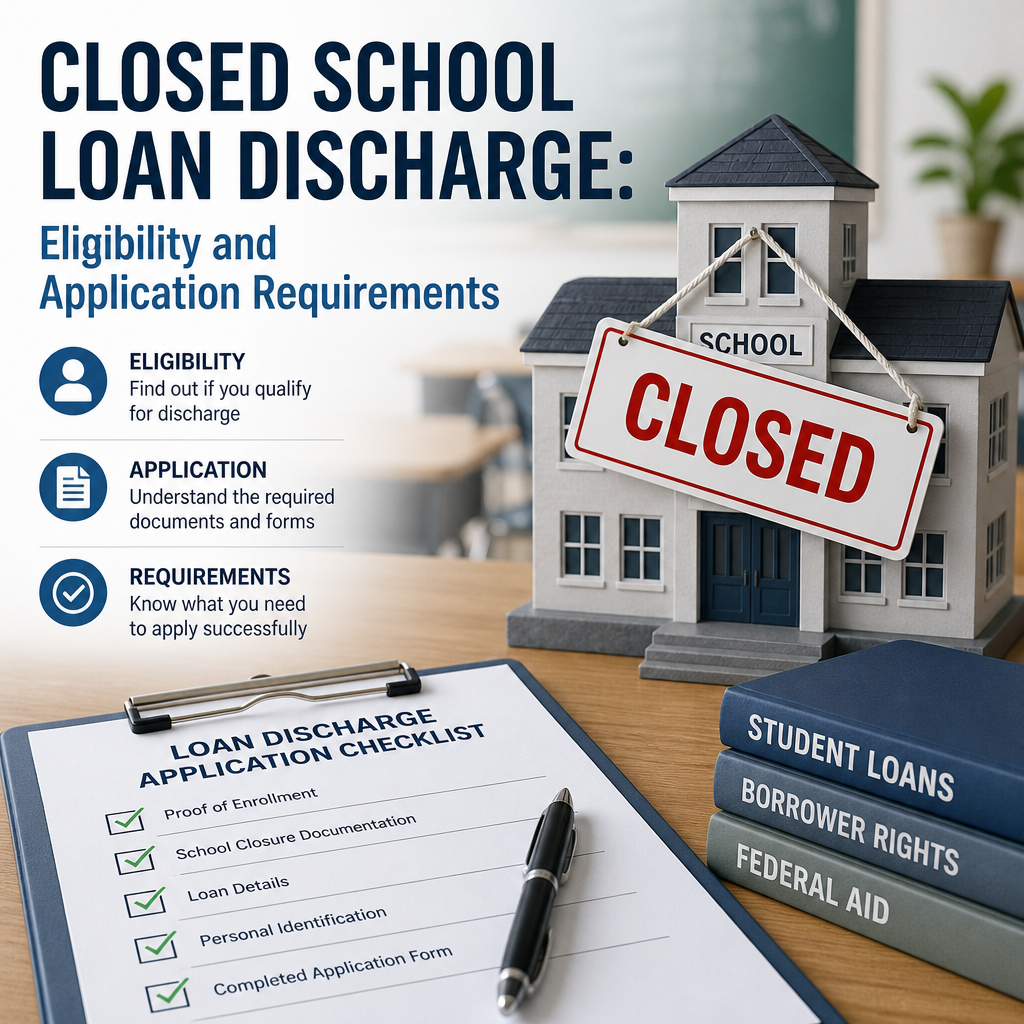
Closed School Loan Discharge: Eligibility and Application Requirements
If your school closed before you could finish your program, a closed school loan discharge may let you wipe out eligible federal student debt and start fresh. Understanding the rules, deadlines, and required documents can help you avoid mistakes and improve your chances of approval.
By: Jennifer Collins on August 1, 2026
Anúncios
If your college or career school closes before you finish your program, you may not be stuck with the debt forever. A closed school loan discharge can help eligible borrowers get federal student loans canceled when a school shuts down unexpectedly and leaves students unable to complete their education there. For many borrowers, this relief can be a financial lifeline, but the rules matter. Knowing the eligibility criteria, the application process, and common pitfalls can make the difference between approval and denial.
This guide explains how closed school loan discharge works, who qualifies, what documents you need, and how to apply with confidence. It also covers important exceptions, timelines, and practical steps you can take if your school recently closed.
Anúncios
What Is Closed School Loan Discharge?
A closed school loan discharge is a form of federal student loan cancellation available to borrowers whose school closed while they were enrolled or shortly after they withdrew. If approved, the federal loans tied to that school may be erased, and you generally won’t have to repay the discharged balance.
This discharge applies to certain federal student loans, not private student loans. It is designed to protect students who paid for an education they could not complete because the school shut down.
Anúncios
Which loans may qualify?
Typically, the discharge may apply to:
Direct Loans
Federal Family Education Loan (FFEL) Program loans
Federal Perkins Loans
Some consolidated loans, depending on how the consolidation was structured
Private loans are not covered by the federal closed school discharge process. If you have private student loans, you’ll need to contact the lender directly and review your contract or hardship options.
Closed School Loan Discharge Eligibility
To qualify for a closed school loan discharge, you must meet specific federal requirements. The most important factor is the timing of the school closure relative to your enrollment or withdrawal.
You may be eligible if:
Your school closed while you were enrolled.
Your school closed while you were on an approved leave of absence.
Your school closed within a certain window after you withdrew.
You did not complete your program at another location through a teach-out or similar arrangement.
The timing rules matter
In general, borrowers may qualify if the school closed:
While they were enrolled, or
Within 180 days after they withdrew
That 180-day rule is one of the most important parts of the process. If you withdrew too long before the school closed, you may not qualify.
You may not qualify if:
You completed your program before the school closed
You transferred credits and finished at another school under a teach-out arrangement
You withdrew more than 180 days before the closure, unless a special exception applies
You still owe loans for a program you completed elsewhere
How Closed School Loan Discharge Works
When a school closes, the U.S. Department of Education and your loan servicer review whether borrowers are eligible for discharge. In many cases, borrowers receive notice of possible eligibility, but you should not wait for a letter if you believe you qualify.
A discharge request usually involves:
Confirming the school closure date
Verifying when you enrolled or withdrew
Identifying the loans tied to the closed school
Submitting the required application or certification
If approved, the eligible federal loans are discharged. In most cases, the discharged loans are removed from future repayment obligations. You may also be eligible for reimbursement of payments made on the discharged loans, depending on the situation and loan type.
Application Requirements for Closed School Loan Discharge
Applying for a closed school loan discharge is usually straightforward, but accuracy is essential. Missing details or incomplete records can delay processing.
What you’ll need
Gather the following before you apply:
Your full legal name and contact information
Social Security number
School name, campus location, and program name
Approximate dates of attendance
Your withdrawal date, if applicable
Loan information, if available
Any letters, transcripts, or enrollment records showing you attended the school
If you no longer have all your records, don’t panic. Loan servicers and the Department of Education may already have some of the needed information. Still, your own documentation can help support your claim.
Common proof documents
Helpful documents may include:
Enrollment agreement
Tuition statements
Withdrawal notice
Transcript
School closure notice
Correspondence from the school or loan servicer
Records of a teach-out offer, if one was presented
How to Apply for Closed School Loan Discharge
The application process varies slightly depending on your loan type and servicer, but the steps are generally similar.
Step 1: Confirm the school closed
Make sure the institution is officially closed, not merely on pause or under change of ownership. If another entity took over the campus and your program continued uninterrupted, the closure rules may not apply.
Step 2: Contact your loan servicer
Your federal student loan servicer can tell you whether your loans may qualify and where to send the application. If your loans are held by the Department of Education, your servicer will usually handle the request.
Step 3: Complete the discharge application
Fill out the official closed school discharge request. Be sure to:
List the correct school
Include accurate dates
Sign the form
Attach any supporting evidence you have
Step 4: Submit the form and keep copies
Send the application to the correct office or servicer and keep copies of everything you submit. Save proof of mailing or electronic confirmation whenever possible.
Step 5: Follow up
Processing can take time. If you do not hear back, contact your servicer to check the status. Respond quickly to any request for additional documentation.
Teach-Outs, Transfers, and Other Exceptions
Not every school closure results in a discharge. One major reason is the presence of a teach-out.
What is a teach-out?
A teach-out happens when another school helps complete your program after the original school closes. If you finished your program through a teach-out or transferred credits and completed elsewhere, you may not be eligible for discharge.
Important exceptions to know
You may be ineligible if:
You completed the same or equivalent program at another institution
You accepted a teach-out and finished your education
Your school closed, but you had already graduated
You withdrew too long before the closure date without meeting an exception
It is worth reviewing your records carefully, because some borrowers assume they are ineligible when they may actually qualify under the timing rules.
What Happens After Approval?
If your closed school loan discharge is approved, the eligible federal loans are canceled. This can bring real relief, especially if you were paying for a program that ended before you could complete it.
Possible outcomes
Depending on your circumstances:
Your outstanding balance may be discharged
Collection activity may stop
You may receive a refund for eligible payments already made
Default-related consequences on the discharged loans may be addressed
Will it affect your credit?
A discharge should not create a new debt burden, but credit reporting outcomes can vary based on account status and timing. If your loans were in default before discharge, the history may still appear on your credit report for a period of time. You can review your credit reports to make sure discharged loans are updated correctly.
Closed School Loan Discharge vs. Borrower Defense
Borrowers sometimes confuse closed school loan discharge with borrower defense to repayment. These are different relief programs.
Closed school loan discharge
This applies when:
The school closed
You couldn’t finish your program there
You meet the enrollment or withdrawal timing rules
Borrower defense to repayment
This applies when:
The school made misleading claims or engaged in misconduct
You believe the school violated state law or misrepresented its services
If your school closure involved misleading practices, you may want to review both options. In some cases, one relief path is more appropriate than the other.
Tips to Strengthen Your Application
A strong application is usually a complete and well-documented one. Use these practical steps to improve your chances.
1. Act quickly
Don’t wait until years after the closure if you can avoid it. The sooner you apply, the easier it may be to locate records and correct errors.
2. Match your dates carefully
Double-check your enrollment and withdrawal dates. Even a small mismatch can slow the process.
3. Keep copies of everything
Save:
Your application
Supporting documents
Emails and letters
Proof of submission
Notes from phone calls, including dates and names
4. Ask for written confirmation
If your servicer says your request is being processed or approved, ask for confirmation in writing.
5. Watch for scams
Only use official federal channels or your loan servicer. No legitimate company can guarantee discharge for a fee.
What If Your Application Is Denied?
A denial does not always mean the end of the road. First, read the denial reason carefully.
Common reasons for denial
The school closure date does not fall within the qualifying period
You completed your program elsewhere
The loans are not eligible federal loans
The application lacked documentation
Records show you withdrew too early
What to do next
If you disagree with the decision:
Request an explanation in writing.
Gather missing records.
Check whether a teach-out was incorrectly recorded.
Contact the Federal Student Aid Ombudsman Group if needed.
Consider whether another relief program may fit your situation better.
Practical Example
Imagine you attended a for-profit career school in 2023, but the school closed in 2024 before you finished your program. You did not transfer to another institution, and you withdrew only a few weeks before the closure because the school had already stopped offering classes.
In that case, you may be a strong candidate for closed school loan discharge if the loans were federal and the dates line up with the eligibility rules. You would gather your attendance records, confirm the closure date, and submit the discharge application through your loan servicer.
By contrast, if you had already completed your program at a different school through a teach-out, you likely would not qualify under the closed school rules.
Frequently Asked Questions
1. What loans are eligible for closed school loan discharge?
Usually, federal student loans qualify, including Direct Loans, FFEL loans, and some Perkins Loans. Private student loans do not qualify under the federal discharge process. If you have mixed loan types, only the eligible federal loans may be discharged.
2. Do I need to apply if my school closed?
Yes, in many cases you do. Some borrowers are identified automatically, but it is still a good idea to submit the application if you believe you qualify. Applying helps ensure your request is reviewed and supported by your records.
3. How long do I have to apply after the school closes?
There is not always a strict short deadline in the same way there is for some other benefits, but you should apply as soon as possible. Waiting can make it harder to prove eligibility or locate your records. If you’re unsure, contact your servicer promptly.
4. Can I still qualify if I transferred credits?
Maybe, but it depends on whether you completed your program elsewhere. If you transferred and finished the same or an equivalent program through a teach-out or another school, you likely will not qualify. If you transferred credits but did not complete the program, you may still have a case.
5. Will I get back the money I already paid?
You may be eligible for a refund of certain payments made on discharged loans, but it depends on the loan type and circumstances. Not every borrower will receive a refund. If your discharge is approved, ask your servicer whether any payment reversal applies to your account.
A closed school loan discharge can provide important relief when a college or career school shuts down before you can complete your education. The key is understanding the eligibility rules, especially the school closure timing, your enrollment or withdrawal date, and whether you finished through a teach-out or transfer arrangement. Federal loan type also matters, since private student loans are not included in this program.
If you think you may qualify, gather your records, verify the school’s closure date, and submit the application through the proper federal channel or your loan servicer. The process is often manageable, but attention to detail is crucial. Missing documents, incorrect dates, or confusion about program completion can delay or derail your request.
For borrowers affected by a school closure, this discharge is more than paperwork—it can be a meaningful step toward financial recovery. Reviewing your options early, keeping thorough records, and using official resources can help you move forward with confidence and avoid paying for an education you were never given the chance to finish.
Jennifer, M.Ed., holds a degree in Higher Education Administration, with
a focus on U.S. college financial aid, admissions policy, and student
support systems. She researches and writes about scholarships, federal
aid programs, and the college planning process to help students and
families make informed, well-supported decisions.