GI Bill Enrollment Verification in 2026: What Beneficiaries Must Do
Anúncios
If you use education benefits, understanding GI Bill enrollment verification in 2026 is essential. The process may seem routine, but missing a verification step can delay payments or interrupt your benefits. Whether you’re attending college, trade school, apprenticeship training, or another approved program, knowing what to verify and when to do it helps you stay on track.
The good news is that the process is manageable once you know the rules. In 2026, education beneficiaries should expect the same core responsibility: confirm enrollment accurately and on time so the Department of Veterans Affairs (VA) can release the correct housing allowance, tuition support, or monthly payments. This guide explains what GI Bill enrollment verification means, how it works, common mistakes to avoid, and the steps beneficiaries should take to protect their benefits.
Anúncios
What GI Bill Enrollment Verification Means
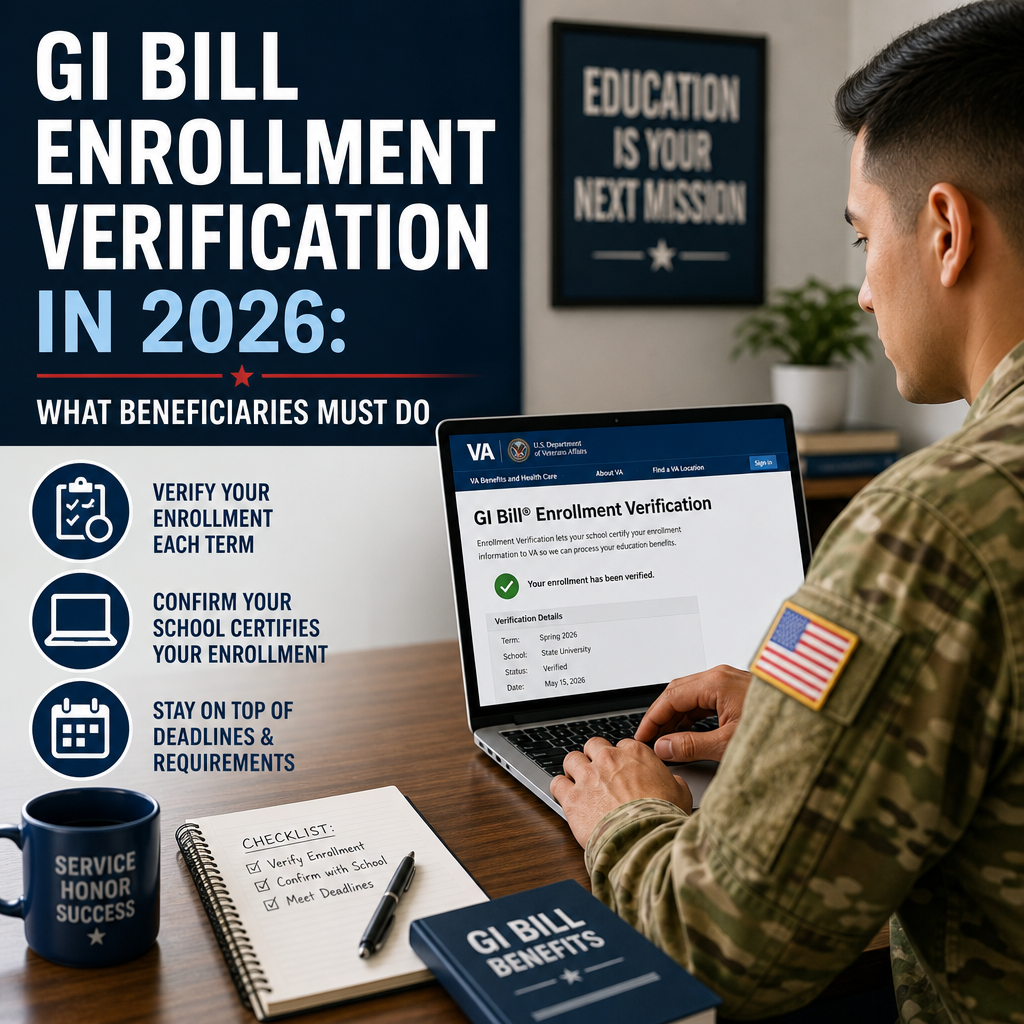
GI Bill enrollment verification is the process of confirming that you are actively enrolled in school or training and still eligible to receive education benefits. The VA uses this information to make sure payments match your actual enrollment status.
Depending on your benefit type and school situation, verification may involve:
Anúncios
- Confirming your enrollment dates
- Reporting how many credit hours or training hours you are taking
- Notifying the VA if your schedule changes
- Certifying that you are still attending classes
- Updating your school or training program information
Verification is not just paperwork. It directly affects whether your benefits continue without interruption. If your enrollment changes and you do not report it, you could receive an overpayment notice later.
Why GI Bill Enrollment Verification Matters in 2026
The VA uses enrollment information to keep education payments accurate. That matters because benefit amounts can change based on:
- Full-time, half-time, or part-time enrollment
- In-person, online, or hybrid attendance
- School term dates
- Training program hours
- Changes in course load
In 2026, the process is still designed to reduce errors and make sure beneficiaries receive only the support they are eligible for. Verification helps prevent:
- Delayed housing payments
- Incorrect stipend amounts
- Overpayments that must be repaid
- Suspended benefits
- Administrative headaches with your school’s certifying official
For many beneficiaries, the biggest issue is not fraud or major mistakes—it’s simply forgetting to update the VA after dropping a class, changing programs, or graduating early.
Who Must Complete GI Bill Enrollment Verification
Not every beneficiary follows the exact same verification steps. Your responsibilities may depend on the GI Bill program you use and how your school or training provider reports your enrollment.
You may need to verify enrollment if you receive benefits under:
- Post-9/11 GI Bill
- Montgomery GI Bill-Active Duty
- Montgomery GI Bill-Selected Reserve
- Survivors’ and Dependents’ Educational Assistance (DEA)
- Veteran Readiness and Employment education support, if applicable
- Flight, apprenticeship, on-the-job training, or other non-traditional programs
Special situations that often require extra attention
You should pay especially close attention if you are:
- Taking a mixed in-person and online schedule
- Switching from full-time to part-time status
- Attending a program with nonstandard term dates
- Using transferred benefits as a dependent
- Completing an apprenticeship or on-the-job training program
- Repeating a course after a change in academic progress
In these situations, your school or training sponsor may still certify your attendance, but you are responsible for making sure the VA has accurate information.
How GI Bill Enrollment Verification Works in 2026
The exact verification method can vary, but the basic idea is the same: you confirm that your enrollment is active and accurate.
1. School certifies your enrollment
Most beneficiaries start with the school’s certifying official, often called a VA school certifying official or SCO. This person sends enrollment information to the VA, including:
- Your program of study
- Number of credits or clock hours
- Enrollment dates
- Modality of attendance
- Changes to your schedule
2. You verify your attendance or enrollment when required
Some beneficiaries must also personally verify enrollment. This may happen through:
- VA’s online systems
- Phone-based verification
- Other VA-approved reporting methods
If the VA requires you to take this step, do it promptly. Waiting too long can delay your payment.
3. The VA processes the information
After receiving certification and verification, the VA calculates your payment based on your eligibility, attendance status, and term dates.
4. Payments are issued or updated
If everything matches, your benefits continue. If something is missing or inconsistent, the VA may hold or adjust the payment until the issue is resolved.
What Beneficiaries Should Do Before Verifying Enrollment
The best way to avoid problems is to review your information before you submit or confirm anything.
Check these details carefully
- Your school name and campus
- Your degree or training program
- Class start and end dates
- Credit hours or training hours
- Full-time or part-time status
- In-person, hybrid, or online classification
- Any drops, withdrawals, or schedule changes
Keep supporting records handy
It helps to keep copies of:
- Your class schedule
- Registration confirmations
- Add/drop notices
- Email communication with your school
- Training attendance records, if applicable
These records can help if the VA or your school needs to correct a discrepancy later.
Common Mistakes to Avoid With GI Bill Enrollment Verification
Even careful students sometimes run into avoidable issues. Here are the most common mistakes.
Missing a required verification deadline
If the VA asks you to verify enrollment and you miss the deadline, your payment may be delayed or stopped until you complete the step.
Forgetting to report schedule changes
Dropping a class, changing programs, or reducing your credit hours can affect your benefits. If you do not report the change, you may receive an overpayment.
Assuming the school handles everything
Your school certifies your enrollment, but you are still responsible for reviewing your status and responding to VA requests.
Not checking your payment statements
If a payment looks too high, too low, or missing entirely, investigate right away. Small errors can become larger issues if you ignore them.
Using outdated contact information
If the VA cannot reach you, you may miss important notifications about enrollment verification or payment changes.
How to Stay on Top of GI Bill Enrollment Verification
A simple routine can make verification much easier.
Build a monthly benefits checklist
Each month, review:
- Your current class schedule
- Any recent drops or adds
- Your enrollment status
- Payment notices from the VA
- Messages from your school certifying official
Set reminders for key dates
Use your phone calendar or planner to track:
- The start of each term
- Drop/add deadlines
- Tuition due dates
- Verification deadlines
- Graduation or program completion dates
Communicate with your school early
If you think your schedule will change, talk to your certifying official before making major adjustments. They can help you understand how the change may affect your benefits.
Save every confirmation
After you verify enrollment or report a change, save the confirmation number, screenshot, or email receipt. That documentation can be helpful if you need to prove you completed the process.
What Happens If You Miss GI Bill Enrollment Verification
Missing GI Bill enrollment verification does not always mean you lose benefits forever, but it can cause immediate problems.
Possible consequences include:
- Payment delays
- Temporary suspension of benefits
- Overpayment notices
- Extra paperwork to fix the record
- Frustration with your school or VA processing times
If you miss a step, act quickly. Verify as soon as possible and contact the VA or your school certifying official if the issue continues.
GI Bill Verification for Online, Hybrid, and Nontraditional Programs
Verification can be especially important for students outside traditional classroom settings.
Online programs
If you take all online classes, your housing payment rules may differ from those of in-person students. Make sure the VA has the right attendance classification.
Hybrid programs
Hybrid students should confirm whether their course load counts as in-person, distance learning, or a combination. That can affect payment calculations.
Apprenticeships and on-the-job training
These programs often rely on hour-based reporting. You may need to keep accurate attendance or training logs and confirm your ongoing participation.
Flight, vocational, and technical programs
Because these programs may use clock hours or specialized schedules, it is important to verify the exact program structure and attendance status with your school.
Practical Example: A Simple Verification Scenario
Imagine you are using the Post-9/11 GI Bill and taking 12 credits for a fall semester. In October, you drop one 3-credit course because it is no longer required for your degree.
If you do not report the change, the VA may continue paying you based on 12 credits even though you are now enrolled in only 9. That can create an overpayment.
If you notify your school promptly, your certifying official can update the VA, and your payment can be adjusted correctly. That is why timely GI Bill enrollment verification matters—it keeps your benefits accurate and reduces future problems.
Tips for Smooth Benefit Management in 2026
Here are a few habits that can make the process easier all year long:
- Review your VA and school emails weekly
- Keep your mailing address and phone number current
- Verify enrollment as soon as you receive a reminder
- Notify your school before withdrawing from a class
- Ask questions when your schedule or payment changes
- Save all benefit-related documents in one folder
Small habits like these can save hours of stress later.
Frequently Asked Questions
1. How often do I need to complete GI Bill enrollment verification in 2026?
The frequency depends on your benefit type and the VA’s current reporting requirements. Some beneficiaries verify enrollment only when prompted, while others may need to update status more regularly. Always follow the instructions in the VA notice or portal you use.
2. Does my school handle GI Bill enrollment verification for me?
Your school usually certifies your enrollment, but that does not always replace your own responsibility to verify attendance or enrollment. In many cases, the school submits academic information while you confirm your status separately if the VA requires it.
3. What should I do if I dropped a class after verification?
Report the change as soon as possible. Dropping a class can affect your enrollment status and payment amount. Contact your school certifying official and review whether the VA needs an updated certification.
4. Can GI Bill enrollment verification affect my housing allowance?
Yes. Your housing allowance is often tied to your enrollment status, training location, and term dates. If your status changes and the VA does not have updated information, your housing payment may be adjusted or delayed.
5. What if I miss the verification deadline?
If you miss the deadline, complete the verification as soon as possible and check whether your payment was affected. You may need to contact the VA or your school to fix the record and restart benefits.
Official Resources
- U.S. Department of Veterans Affairs – Education and Training
- VA GI Bill® Comparison Tool
- VA Ask a Question – Education Benefits
- Federal Student Aid – Veterans and Military
- VA School Certifying Officials Resources
Conclusion
GI Bill enrollment verification in 2026 is one of the most important responsibilities for education beneficiaries. It helps ensure your benefits are paid accurately, prevents avoidable delays, and protects you from overpayment issues. The process may feel like a small administrative task, but it has a direct impact on your tuition support, housing allowance, and overall access to education benefits.
The key is to stay organized. Review your schedule, keep your contact information current, communicate with your school certifying official, and respond quickly to any VA verification request. If your classes, program, or training status changes, update the record right away. That simple habit can save time, reduce stress, and keep your education benefits running smoothly.
Whether you are attending college, pursuing technical training, or finishing an apprenticeship, staying proactive with GI Bill enrollment verification will help you get the full value of the benefits you earned.