How Federal Agencies Prioritize the Most Dangerous Cybersecurity Vulnerabilities
Anúncios
Cyber threats move quickly, but many organizations still struggle to decide what to fix first. That challenge is exactly why federal agencies are prioritizing the most dangerous cybersecurity vulnerabilities with more urgency and structure than ever before. Instead of treating every patch as equally important, agencies are focusing on flaws that are actively exploited, easy to weaponize, or likely to cause major harm if left unaddressed.
For government IT teams, this shift is more than a best practice—it is a necessity. Attackers frequently target known weaknesses in public-facing systems, remote access tools, email platforms, and widely used software. By prioritizing the vulnerabilities that present the greatest risk, agencies can reduce exposure faster and use limited resources more effectively.
Anúncios
This approach is also shaping how private-sector organizations think about vulnerability management, patching, and cyber risk reduction. Understanding how federal agencies rank and respond to threats can help any security team build a smarter defense strategy.
Why Federal Agencies Are Changing Their Vulnerability Prioritization Strategy
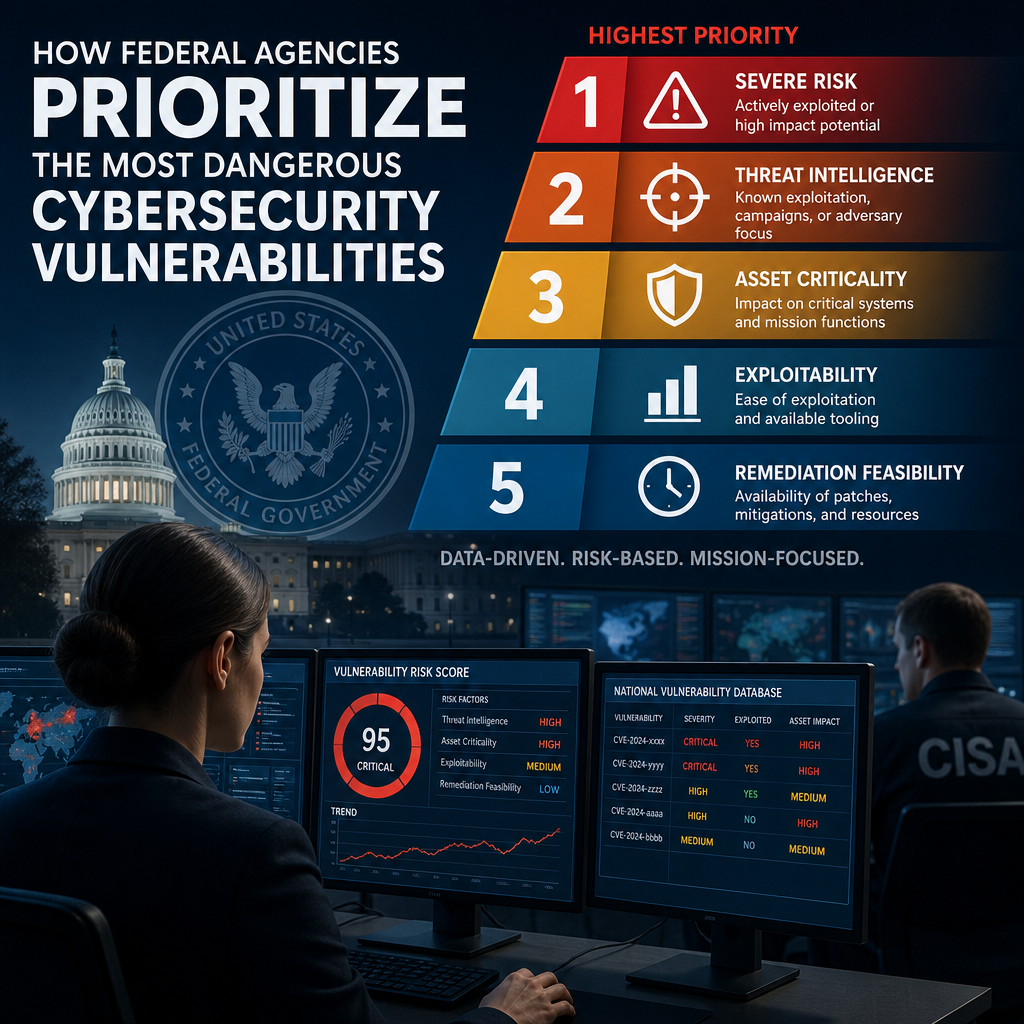
Traditional vulnerability management often relied on severity scores alone. A high CVSS score might have pushed a flaw to the top of the list, while a lower-scoring issue could wait weeks for attention. The problem is that severity does not always reflect real-world danger.
Anúncios
A vulnerability with a moderate score may be more dangerous if:
- it is already being exploited in the wild,
- it affects widely deployed software,
- it requires little skill to weaponize,
- or it appears in a critical system with sensitive data.
Federal agencies have learned that risk-based prioritization works better than score-based triage. This means weighing context, such as exploitability, asset value, exposure, and known attacker behavior.
The goal is not just to patch faster. It is to patch smarter.
How Federal Agencies Identify the Most Dangerous Cybersecurity Vulnerabilities
Using real-world threat intelligence
One of the biggest shifts in federal cybersecurity is the use of threat intelligence to guide remediation. Agencies monitor indicators such as:
- active exploitation reports,
- malware campaigns,
- attacker toolkits,
- public proof-of-concept code,
- and advisories from trusted sources.
If a vulnerability is already being used in attacks, that flaw immediately rises in priority. Agencies do not wait for theoretical risk to become a breach.
Relying on known-exploited vulnerability lists
A major tool in this effort is the Known Exploited Vulnerabilities Catalog maintained by CISA. The catalog helps agencies focus on vulnerabilities with confirmed exploitation activity, making it easier to identify threats that require urgent action.
This model has become influential because it reflects reality instead of relying only on estimated severity. If attackers are actively using a weakness, it deserves immediate attention.
Mapping vulnerabilities to mission-critical assets
Not every vulnerability affects an equally important system. Federal agencies prioritize based on where the flaw exists and what the asset does.
For example, a vulnerability in:
- a public web server,
- identity and access management infrastructure,
- endpoint management tools,
- or systems holding sensitive citizen or operational data
is likely to receive a higher priority than the same flaw on a low-risk internal workstation.
This asset-based approach helps agencies align patching with operational impact. The most dangerous cybersecurity vulnerabilities are often dangerous because of where they live, not just what they are.
The Role of CISA and Federal Policy in Vulnerability Prioritization
CISA’s guidance shapes federal action
The Cybersecurity and Infrastructure Security Agency plays a central role in helping agencies respond quickly to emerging threats. CISA issues alerts, technical advisories, and deadlines for remediation when certain vulnerabilities pose significant risk.
These recommendations often drive action across the federal enterprise because they provide a clear signal: if a flaw is known to be exploited, it should not sit in the queue.
Binding operational directives
Federal civilian agencies are subject to Binding Operational Directives, which require specific actions within defined timeframes. These directives help create consistency across agencies and reduce delays that attackers can exploit.
This policy framework matters because it removes ambiguity. Security teams know which vulnerabilities require immediate mitigation and which can be scheduled later based on risk.
The push toward faster remediation
Federal guidance increasingly emphasizes not just awareness, but speed. Agencies are expected to:
- inventory assets,
- identify exposure quickly,
- patch or mitigate high-priority flaws,
- verify remediation,
- and document the outcome.
This structured process reduces the window of opportunity for adversaries.
What Makes a Vulnerability “Most Dangerous”?
A dangerous vulnerability is not always the one with the highest score. Federal agencies often consider several factors together:
Exploitability
Can the flaw be exploited remotely? Does it require authentication? Is the exploit simple or advanced? The easier it is to abuse, the more urgent the response.
Exposure
Is the vulnerable system internet-facing? Is it accessible through a VPN, remote desktop, or third-party connection? Public exposure increases the likelihood of attack.
Asset criticality
Does the affected system support essential operations, authentication, emergency services, or sensitive records? If so, the impact of compromise may be severe.
Availability of exploit code
If proof-of-concept code is public, attackers can move quickly from research to real intrusion attempts.
Attack path potential
Some flaws may not seem severe alone, but they become dangerous when combined with credential theft, privilege escalation, or lateral movement. Federal agencies increasingly prioritize vulnerabilities that can serve as stepping stones in a broader attack chain.
How Agencies Turn Prioritization Into Action
Building patching queues by risk
Federal teams often sort vulnerabilities into tiers rather than treating them as one long list. A practical queue may look like this:
- Immediate action: actively exploited flaws, internet-facing systems, identity tools
- High priority: high-impact vulnerabilities with public exploit paths
- Standard remediation: important but less urgent issues
- Deferred with justification: low-risk flaws on noncritical systems
This structure improves decision-making and prevents teams from wasting time on issues that are serious in theory but unlikely to be exploited soon.
Using compensating controls when patching is delayed
Sometimes agencies cannot patch immediately because of operational constraints. In those cases, they may apply compensating controls such as:
- restricting access,
- disabling vulnerable features,
- segmenting networks,
- increasing logging and monitoring,
- or taking systems offline temporarily.
These measures do not replace patching, but they can reduce risk while remediation is underway.
Coordinating across IT, security, and operations
One common failure in vulnerability management is treating patching as purely a security problem. Federal agencies are improving outcomes by involving system owners, operations staff, incident responders, and leadership.
That coordination matters because the most dangerous cybersecurity vulnerabilities often touch multiple teams. A fast fix may require maintenance windows, vendor support, testing, and business approval.
Lessons Private Organizations Can Learn From Federal Prioritization
Federal practices are not limited to government networks. Private companies can adopt the same mindset to strengthen their own cybersecurity programs.
Focus on exploited vulnerabilities first
If a flaw is known to be under active attack, it should move to the top of the list. Waiting for a regular patch cycle can create unnecessary exposure.
Combine vulnerability scanning with asset context
A scanner alone cannot tell you what matters most. Pair scan results with business criticality, internet exposure, and data sensitivity to create a meaningful risk picture.
Track remediation as a business process
Strong vulnerability management requires more than alerts. It needs owners, deadlines, escalation paths, and verification steps.
Measure exposure, not just counts
A lower number of vulnerabilities does not always mean lower risk. It is better to ask:
- Which critical systems remain exposed?
- Which flaws are being exploited?
- How quickly are urgent items being closed?
Those questions lead to better decisions than raw totals alone.
Common Challenges Agencies Still Face
Even with better prioritization, federal agencies face persistent obstacles.
Legacy systems
Older systems may be difficult to patch without disrupting essential operations. In some environments, replacement takes longer than mitigation.
Limited staffing
Security teams often juggle large inventories, making it hard to assess every issue manually. Automation helps, but it cannot solve everything.
Complex dependencies
A single application may rely on multiple vendors, plugins, and connected services. Fixing one vulnerability may require testing several related systems.
Alert overload
When every tool labels an issue as critical, teams can lose focus. That is why ranked, risk-based prioritization is so valuable. It cuts through the noise.
A Practical Framework for Prioritizing Vulnerabilities
Organizations looking to follow the federal model can use a simple framework:
- Identify the vulnerability
- Gather scanner results, advisories, and threat intelligence.
- Check for active exploitation
- Determine whether attackers are already using the flaw.
- Evaluate the asset
- Ask whether the system is critical, exposed, or sensitive.
- Estimate attack feasibility
- Consider whether the flaw is remotely exploitable or easy to automate.
- Assign a remediation timeline
- Set urgent deadlines for the highest-risk items.
- Apply temporary controls if needed
- Reduce exposure while waiting for a patch window.
- Verify and document
- Confirm the fix and keep records for accountability.
This process is straightforward, but it dramatically improves response quality.
Why This Approach Matters Now
Attackers do not wait for organizations to catch up. They look for the fastest path in, and that often means exploiting vulnerabilities that defenders already know about. Federal agencies are prioritizing the most dangerous cybersecurity vulnerabilities because timing matters as much as technical severity.
The lesson is clear: focus on what attackers can use today, not only what looks alarming on paper. A disciplined prioritization strategy reduces risk, improves resilience, and helps teams spend time where it counts most.
Frequently Asked Questions
1. What does it mean to prioritize the most dangerous cybersecurity vulnerabilities?
It means ranking vulnerabilities based on real-world risk, not just severity scores. Federal agencies consider active exploitation, asset criticality, exposure, and attacker behavior to decide what needs immediate action.
2. Why aren’t CVSS scores enough on their own?
CVSS scores measure technical severity, but they do not fully reflect whether a vulnerability is being exploited in the wild, how exposed the system is, or how important the affected asset may be. A lower-scoring flaw can still be urgent if attackers are actively using it.
3. How do federal agencies know which vulnerabilities are being exploited?
They rely on threat intelligence from sources such as CISA advisories, vendor notices, incident reports, and monitoring of attacker activity. The Known Exploited Vulnerabilities Catalog is especially important because it highlights flaws with confirmed exploitation.
4. What should an organization do if it cannot patch a critical vulnerability right away?
It should apply compensating controls as quickly as possible. These may include restricting access, disabling vulnerable features, segmenting networks, enhancing monitoring, or temporarily taking the system offline until a patch can be safely deployed.
5. How can private companies adopt the federal approach to vulnerability management?
They can combine vulnerability scanning with asset inventory, threat intelligence, and business context. The key is to prioritize issues that are actively exploited or affect critical systems, then assign clear owners and deadlines for remediation.
Official Resources
- CISA Known Exploited Vulnerabilities Catalog
- CISA Alerts and Advisories
- NIST Cybersecurity Framework
- NIST National Vulnerability Database
- U.S. Government Accountability Office Cybersecurity Resources
Conclusion
Federal agencies are prioritizing the most dangerous cybersecurity vulnerabilities by focusing on what poses the greatest real-world threat: actively exploited flaws, exposed systems, and weaknesses that could disrupt critical operations. This risk-based approach is more effective than relying on severity scores alone because it reflects how attackers actually operate.
For government teams, the shift improves response speed, reduces unnecessary backlog, and helps protect essential services. For private organizations, it offers a practical model for smarter vulnerability management. The core idea is simple: not every vulnerability deserves the same urgency, but the wrong delay can have serious consequences.
If your organization wants to reduce cyber risk, start by identifying the vulnerabilities that are both exploitable and high impact. Pair scanning with asset context, use threat intelligence to guide decisions, and assign clear remediation timelines. The more carefully you prioritize, the faster you can close the gaps that matter most. In cybersecurity, focus is a defense strategy—and it may be one of the most important ones you have.