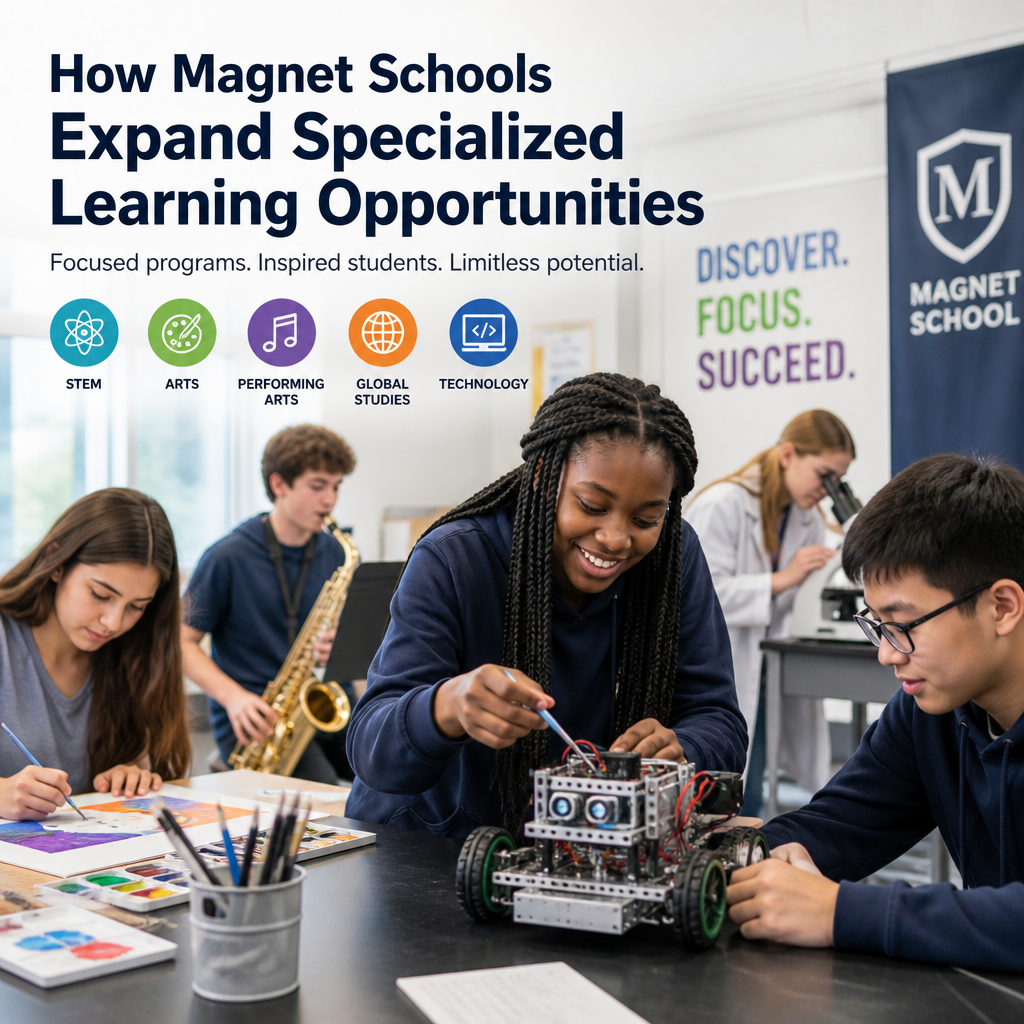
How Magnet Schools Expand Specialized Learning Opportunities
Magnet schools open the door to specialized learning by giving students access to programs built around their interests, from STEM and arts to language immersion and career pathways. For families looking for a public-school option with a more focused, engaging experience, magnet schools can make a big difference.
By: Jennifer Collins on August 1, 2026
Anúncios
Magnet schools give families a powerful option when they want more than a traditional neighborhood assignment. By focusing on a specific theme, career pathway, or instructional approach, magnet schools expand specialized learning opportunities for students who are ready to explore their interests in a deeper, more structured way. These schools can emphasize areas like STEM, performing arts, world languages, Montessori methods, health sciences, or advanced college preparation.
For many families, the appeal is simple: students get access to programs that are harder to find in a standard school setting, often without paying private school tuition. Just as important, magnet schools can support stronger engagement because students learn in an environment built around a shared focus.
Anúncios
What Are Magnet Schools?
Magnet schools are public schools designed around a particular educational theme or academic model. Students usually apply to attend, and selection may depend on space, eligibility, or a lottery system. While each school is different, the goal is generally the same: to attract a diverse student body by offering specialized instruction that stands out from the typical curriculum.
Unlike a traditional neighborhood school, a magnet school may organize classes and projects around a central theme. For example:
Anúncios
A science and technology magnet may include coding, robotics, and engineering projects
An arts magnet may focus on visual arts, dance, theater, or music
A language immersion magnet may teach core subjects in another language
A career magnet may offer pathways in healthcare, education, or business
Because these schools are still public, they often provide tuition-free access to a specialized educational environment.
How Magnet Schools Expand Specialized Learning Opportunities
The biggest advantage of magnet schools is that they create room for deeper learning in a focused area. Instead of treating subjects as isolated blocks, magnet programs often connect lessons to real-world applications, student interests, and long-term goals.
Deeper study in areas of interest
A student who loves computers may thrive in a STEM magnet where they can learn more than basic computer skills. They may study:
Coding and software design
Robotics and automation
Digital media production
Engineering design challenges
Cybersecurity basics
That kind of concentration can build confidence and motivation. When students feel that school connects to something they care about, they often participate more actively and take greater ownership of their learning.
Access to specialized teachers and resources
Magnet schools frequently hire teachers with experience in the school’s focus area. That can make a real difference. An arts magnet might employ instructors with professional performance or design backgrounds. A science magnet may have educators trained in lab-based instruction or project-based learning.
These schools may also invest in specialized resources such as:
Science labs and maker spaces
Art studios and recording rooms
Language labs
Performance stages
Industry-standard equipment or software
This added infrastructure can make learning more hands-on and more relevant.
Stronger preparation for future pathways
Magnet schools often help students start thinking early about college and careers. A health sciences magnet, for example, may introduce medical terminology, anatomy, or patient-care simulations. A business magnet might teach entrepreneurship, marketing, and financial literacy.
These experiences can help students:
Explore possible careers before high school ends
Build a stronger academic portfolio
Develop technical and communication skills
Gain exposure to internships, certifications, or competitions
That preparation can make the transition to college, trade school, or the workforce feel less overwhelming.
Common Types of Magnet School Programs
Magnet schools come in many forms, and the program structure often reflects the needs of the district or community. Some of the most common models include the following.
STEM and STEAM magnets
STEM magnets focus on science, technology, engineering, and math. STEAM schools add the arts to encourage creativity and design thinking. These programs often use hands-on learning, collaborative problem-solving, and inquiry-based lessons.
Students may work on:
Coding projects
Robotics competitions
Environmental science studies
Engineering prototypes
Math modeling and data analysis
Arts magnets
Arts magnets serve students who want a stronger focus on creative expression. These schools may offer advanced instruction in:
Visual arts
Dance
Theater
Vocal and instrumental music
Film and digital media
In many arts magnets, students still study core academic subjects, but the arts play a central role in their daily schedule.
Language immersion magnets
Language immersion magnets give students the chance to learn academic content in another language, such as Spanish, French, Mandarin, or American Sign Language. These schools can support bilingual development while also strengthening cognitive flexibility and cultural awareness.
Montessori and child-centered magnets
Some magnet schools use Montessori or similar educational models. These programs often emphasize independence, self-paced learning, and mixed-age classrooms. They can be especially appealing to families seeking a different approach to early education or elementary school.
Career and technical education magnets
Career-focused magnets expose students to professional fields through project-based learning and technical training. Common pathways include:
Culinary arts
Health sciences
Computer science
Engineering
Business and finance
Media production
These schools can help students see how academic content connects to practical work.
Why Families Choose Magnet Schools
Families often look into magnet schools for reasons that go beyond test scores or rankings. While academics matter, the right learning environment can shape a child’s attitude toward school for years.
A better fit for student strengths
Some children learn best when lessons match their interests. A student who enjoys drawing may struggle in a school that offers little creative expression, but may flourish in an arts magnet. Likewise, a student who loves building, experimenting, or solving puzzles may do well in a STEM-focused environment.
More engagement and motivation
Specialized learning can make school feel more meaningful. When students see a connection between coursework and something they care about, they tend to stay more engaged. That can lead to better attendance, stronger participation, and more persistence when work becomes challenging.
A diverse peer environment
Many magnet schools are designed to draw students from across a district or region. That can create a more diverse student body in terms of background, interests, and academic goals. Learning alongside peers with different perspectives can improve collaboration and social growth.
Public school access to enriched programs
For families who want specialized programming but do not want private school tuition, magnet schools offer a valuable public option. They can provide enrichment, structure, and opportunities that might otherwise be available only through expensive extracurricular programs.
What to Look For in a Magnet School
Not every magnet school is the right match for every student. A strong program on paper may still be a poor fit if it does not align with a child’s learning style, goals, or schedule.
Academic quality
Look beyond the theme and examine the overall academic strength of the school. Ask:
Are core subjects taught well?
Do students receive support in reading, math, and writing?
Are teachers experienced and well-trained?
What is the school’s approach to assessment and student growth?
Depth of the specialty program
A true magnet program should offer more than a surface-level theme. For example, a school labeled as a “science magnet” should provide meaningful science instruction, lab experiences, and related enrichment—not just a few extra activities.
Student support services
Specialized learning should not come at the expense of support. Families should ask whether the school offers:
Special education services
English language learner support
Counseling
Academic intervention
Transportation options
Admission process and logistics
Magnet schools may have applications, deadlines, lotteries, or eligibility requirements. Some may also require auditions, interviews, portfolios, or prior academic records.
Practical questions include:
How do students apply?
Is transportation provided?
What happens if there is a waiting list?
Can students stay through multiple grade levels?
School culture
Visit if possible. Look for signs of a healthy school culture, such as engaged students, respectful classrooms, and clear communication. A strong specialty program works best in a school where students feel safe, supported, and challenged.
How Magnet Schools Support Long-Term Growth
The benefits of magnet schools often extend beyond the classroom. By giving students focused opportunities, these schools can shape habits and skills that carry into adulthood.
Building confidence through mastery
When students spend time developing a skill area they care about, they often experience a sense of progress and accomplishment. That confidence can spill over into other academic subjects.
Developing problem-solving skills
Many magnet programs rely on project-based learning, collaboration, and applied thinking. Students learn how to test ideas, revise their work, and work through setbacks. Those habits matter in college, careers, and everyday life.
Encouraging exploration and identity
Specialized learning helps students discover what they enjoy and where they excel. That kind of exploration can be especially valuable in middle school and high school, when young people are figuring out who they are and what they want to pursue.
Creating early exposure to careers
Career magnets and themed academies can introduce students to professions they may not have encountered otherwise. That exposure may shape future course choices, internships, or college majors.
Tips for Parents Considering a Magnet School
If you are exploring magnet schools, a thoughtful approach can help you find the best fit.
Start with your child’s interests
Ask what excites your child most. Do they like science experiments, music, technology, languages, or hands-on projects? The best magnet school is often one that matches those interests with strong instruction.
Visit the school community
Attend an open house, tour the campus, or talk with current families if possible. Ask students what they enjoy and what challenges they face.
Compare the program structure
Some magnet schools dedicate a large part of the day to the specialty focus. Others integrate the theme into only certain classes. Make sure the structure matches your expectations.
Think about long-term fit
A school that seems exciting in kindergarten may not be the best choice for middle or high school. Consider whether the program can grow with your child.
Review transportation and schedule
Even the strongest school can become inconvenient if commuting is difficult. Check bus routes, start times, and after-school options before applying.
Magnet Schools and Equity in Education
Magnet schools were originally developed in part to support school desegregation efforts and broaden access to high-quality programs. Today, many districts still use them to increase educational opportunity and attract a more diverse student body.
When designed well, magnet schools can help reduce barriers to specialized learning by making focused programs available through the public school system. However, access still depends on fair admissions, clear communication, and adequate transportation. Families benefit most when districts ensure that information and opportunities reach students across the community.
Frequently Asked Questions
What is the main purpose of magnet schools?
The main purpose of magnet schools is to offer specialized learning opportunities within the public school system. They often focus on themes like STEM, arts, language immersion, or career preparation to engage students with specific interests and strengths.
Are magnet schools public schools?
Yes. Magnet schools are public schools, which means they are typically tuition-free. However, they may have an application process, limited enrollment, or special eligibility criteria depending on the district.
How do students get into a magnet school?
Admission processes vary. Some magnet schools use lotteries, while others consider applications, auditions, academic records, or program-specific requirements. Families should check deadlines and rules early because competition can be high in popular programs.
Do magnet schools have better academics than regular schools?
Not always. A magnet school’s quality depends on the school itself, the teachers, the curriculum, and the support services. Some magnet schools offer excellent academic opportunities, but families should evaluate each school individually rather than assuming all magnet schools are better.
Can magnet schools help students choose a career path?
Yes, they can. Career and technical magnet schools often expose students to fields such as healthcare, engineering, business, and media. Even theme-based programs like STEM or arts magnets can help students discover interests that influence future college or career choices.
Magnet schools expand specialized learning opportunities by combining the structure of public education with the depth of a focused academic theme. For students who thrive when lessons connect to real interests, these schools can offer a more engaging and meaningful path through elementary, middle, or high school.
Whether a family is looking for stronger arts instruction, advanced STEM learning, language immersion, or career preparation, magnet schools can provide access to programs that may not exist in a standard neighborhood school. They also give students the chance to learn from specialized teachers, use unique resources, and build skills that support future success.
The best choice depends on the child, the school’s quality, and how well the program fits long-term goals. By researching admissions, visiting campuses, and comparing support services, families can make a more informed decision. In the right setting, a magnet school can do more than educate—it can help a student discover confidence, curiosity, and direction.
Jennifer, M.Ed., holds a degree in Higher Education Administration, with
a focus on U.S. college financial aid, admissions policy, and student
support systems. She researches and writes about scholarships, federal
aid programs, and the college planning process to help students and
families make informed, well-supported decisions.