Why Critical Mineral Supply Chains Matter for Technology and Security
Anúncios
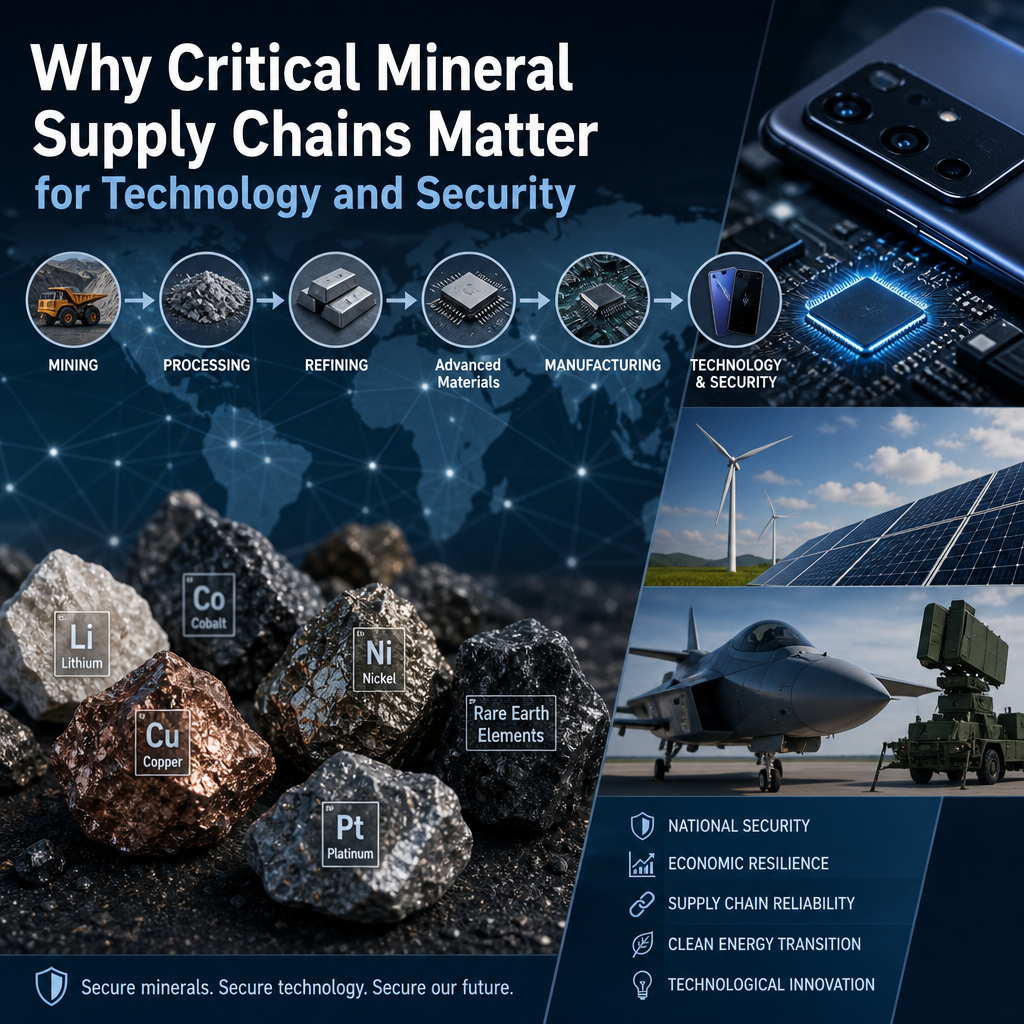
Modern life depends on materials most people never see. The smartphone in your pocket, the electric vehicle in your driveway, the wind turbines on the horizon, and the guidance systems behind advanced defense platforms all rely on a steady flow of critical mineral supply chains. These minerals may be small in volume, but they are enormous in importance.
Anúncios
As demand grows for clean energy, digital infrastructure, and advanced manufacturing, countries are paying closer attention to where these materials come from, who controls them, and what happens if access is disrupted. That’s why critical mineral supply chains have become a major issue for both technology leadership and national security.
What Are Critical Minerals?
Critical minerals are raw materials essential to modern technologies and economic activity, yet vulnerable to supply disruptions. Common examples include:
- Lithium
- Cobalt
- Nickel
- Graphite
- Rare earth elements
- Copper
- Gallium
- Germanium
These minerals are used in batteries, semiconductors, defense systems, electric motors, medical devices, telecommunications equipment, and more. The phrase “critical” does not mean the minerals are rare in every case. Instead, it means they are strategically important and difficult to replace quickly.
Anúncios
Why they matter more than ever
The global economy is shifting toward electrification, automation, and advanced computing. That transition increases demand for minerals used in:
- EV batteries and charging systems
- Solar panels and wind turbines
- Data centers and servers
- Precision-guided defense systems
- Aircraft and satellite components
When supplies are tight, prices rise, production slows, and governments and businesses face hard tradeoffs.
Why Critical Mineral Supply Chains Matter for Technology
Technology innovation depends on reliable inputs. If manufacturers cannot secure enough minerals, even the best designs cannot reach production at scale.
1. They power the clean energy transition
The push toward cleaner energy depends heavily on minerals. Lithium, nickel, cobalt, and graphite are central to battery storage. Copper supports power grids and electric motors. Rare earth elements help build high-performance magnets used in wind turbines and electric vehicles.
Without stable critical mineral supply chains, clean energy projects can stall, become more expensive, or rely on lower-performing alternatives.
2. They support semiconductor and electronics production
Semiconductors are the backbone of modern electronics, and many of the materials needed to manufacture them come from concentrated global sources. Gallium and germanium, for example, are used in specialized chips and advanced communications applications.
A weak supply chain can create bottlenecks that affect:
- Consumer electronics
- Medical devices
- Industrial automation
- Cloud computing infrastructure
- Telecommunications networks
3. They affect product cost and availability
When mineral supply becomes uncertain, manufacturers often face higher input costs. Those costs can show up as:
- More expensive phones and laptops
- Higher EV prices
- Delays in infrastructure projects
- Slower rollout of new technologies
In other words, critical mineral supply chains are not just a mining issue. They influence what technology gets built, how quickly, and at what price.
Why Critical Mineral Supply Chains Matter for National Security
Technology is only one side of the equation. The other is security. Governments view mineral access as a strategic necessity because defense systems and critical infrastructure depend on these materials.
Defense systems rely on specialized materials
Modern military equipment uses critical minerals in:
- Jet engines
- Missiles and radar systems
- Communication equipment
- Navigation tools
- Armored vehicles
- Satellite and space systems
Some materials are needed for high-temperature performance, lightweight design, or magnetic and electronic properties that are difficult to replicate. If a nation lacks secure access, it risks delays in procurement, higher costs, and reduced readiness.
Supply chain concentration creates vulnerability
Many critical minerals are mined, refined, or processed in a small number of countries. That concentration can create risk if geopolitical tensions rise, exports are restricted, or transport routes are disrupted.
Vulnerabilities may include:
- Dependence on foreign refining capacity
- Limited domestic mining and processing
- Exposure to trade restrictions
- Shipping disruptions
- Political instability in producing regions
For national security planners, a supply chain with too many single points of failure is a strategic weakness.
Economic security and defense are connected
National security is not just about weapons. It also depends on industrial capacity, energy resilience, and technological leadership. If a country cannot build batteries, chips, or defense components at home or with trusted partners, it becomes more exposed to coercion and disruption.
That’s why policymakers increasingly treat critical mineral supply chains as part of broader economic security.
Where the Risks Come From
Understanding the risks helps explain why governments and businesses are racing to diversify supply.
Geopolitical concentration
A few countries dominate the extraction or processing of certain minerals. That concentration can lead to leverage, especially when there are few substitute suppliers.
Refining and processing bottlenecks
Mining is only one step. In many cases, the real choke point is refining. Ore may be mined in one country, processed in another, and manufactured into components elsewhere. If any stage slows down, the entire chain can suffer.
Long project timelines
New mines and processing facilities take years to permit, finance, build, and bring online. This makes it hard to respond quickly when demand spikes.
Environmental and social pressures
Mining projects often face scrutiny related to land use, water, labor practices, and community impact. These are legitimate concerns, and they can slow development if not managed well. Responsible sourcing matters because weak practices create reputational, legal, and operational risk.
How Governments Are Responding
Around the world, governments are taking steps to strengthen critical mineral supply chains and reduce dependence on fragile sources.
Diversification of suppliers
One common strategy is to source from more countries and more companies. Diversification reduces the risk that one disruption can derail production.
Domestic mining and processing
Some countries are investing in local extraction, refining, and recycling capacity. Building more of the supply chain at home can improve resilience, though it takes time and careful environmental management.
Strategic partnerships
Alliances and trade agreements can help trusted partners coordinate investment, standards, and emergency planning. These partnerships are especially important for countries that do not have all the minerals they need within their own borders.
Recycling and circular economy efforts
Recycling batteries, electronics, and industrial materials can recover valuable minerals and reduce dependence on primary mining. While recycling cannot solve every supply issue, it can become an important part of long-term strategy.
Stockpiling and forecasting
Some governments maintain strategic reserves of essential minerals or monitor market trends to anticipate shortages. Better forecasting can help industries prepare before supply becomes critical.
What Businesses Should Be Doing
Companies that depend on minerals should not wait for a crisis to assess their exposure. A resilient strategy starts with visibility.
Map your supply chain
Businesses should know where key materials originate, where they are refined, and which suppliers sit at each stage. Hidden dependencies often cause the biggest surprises.
Identify single points of failure
Look for materials or suppliers that have no easy backup. If one plant, one country, or one shipping route fails, what happens?
Build supplier diversity
Where possible, source from multiple vendors and regions. Dual sourcing can reduce exposure, even if it takes more coordination.
Invest in traceability
Traceability tools help companies verify sourcing, meet compliance requirements, and respond to customer and investor expectations. This is especially important for industries with ESG commitments or human rights due diligence obligations.
Plan for substitution and redesign
Engineers can sometimes redesign products to use less of a constrained mineral or switch to an alternative material. That flexibility can make a company far more resilient.
The Role of Recycling and Innovation
One of the most promising responses to mineral risk is innovation. Better technology can reduce dependence on scarce materials while improving efficiency.
Battery chemistry improvements
Battery manufacturers are working on chemistries that use less cobalt or other constrained inputs. That does not eliminate mineral needs, but it can reduce pressure on vulnerable parts of the supply chain.
Material efficiency
Smarter design can reduce waste and lower the amount of material required per unit. In large-scale manufacturing, even small efficiency gains matter.
Urban mining
Recovering minerals from old electronics, vehicles, and industrial equipment is sometimes called urban mining. This approach can recover valuable materials already in circulation and reduce pressure on new extraction.
Why This Matters to Everyday People
It’s easy to think of mineral supply chains as a niche policy issue, but the effects are practical and widespread.
If supply chains weaken, people may see:
- Higher prices for electronics and vehicles
- Slower rollout of clean energy infrastructure
- Delays in defense procurement
- Reduced access to next-generation technologies
- More dependence on foreign producers
In short, critical mineral supply chains influence the cost, availability, and security of the systems people use every day.
What a Resilient Supply Chain Looks Like
A strong critical mineral strategy does not rely on one fix. It combines several approaches:
- Diversified sourcing from trusted partners
- Domestic capacity where feasible and responsible
- Recycling and recovery to reduce waste
- Transparent procurement and traceability
- Research and development for material substitution
- Strategic coordination between government and industry
The goal is not total self-sufficiency. That is rarely realistic. The goal is resilience: enough flexibility to absorb shocks without shutting down innovation or weakening security.
Frequently Asked Questions
1. What are critical mineral supply chains?
Critical mineral supply chains are the networks that move essential minerals from mining and refining through manufacturing and end use. They include extraction, processing, transport, component production, and recycling. These chains matter because many modern technologies depend on materials that are difficult to replace quickly.
2. Why are critical minerals important for national security?
Critical minerals support defense equipment, communication systems, satellites, energy infrastructure, and advanced electronics. If access is disrupted, military readiness and industrial capacity can suffer. That makes secure mineral access a strategic issue, not just a business concern.
3. Which industries depend most on critical minerals?
The biggest users include clean energy, electric vehicles, semiconductors, telecommunications, aerospace, defense, and advanced manufacturing. Consumer electronics and medical technology also depend heavily on these materials.
4. Why is supply chain concentration a problem?
When mining or processing is concentrated in just a few countries, disruptions can spread quickly. Trade disputes, export restrictions, shipping delays, or political instability can affect global availability. Concentration also gives suppliers more leverage over pricing and access.
5. Can recycling solve critical mineral shortages?
Recycling helps, but it cannot solve every shortage on its own. It can reduce waste, recover valuable materials, and improve resilience over time. However, new mining and processing capacity are still needed to meet growing demand, especially during the transition to cleaner energy and advanced technologies.
Official Resources
- U.S. Geological Survey: Mineral Commodity Summaries
- U.S. Department of Energy: Critical Materials Assessment
- International Energy Agency: Critical Minerals
- National Institute of Standards and Technology: Supply Chain Resources
- European Commission: Critical Raw Materials
Conclusion
Critical mineral supply chains are the hidden foundation of modern life. They shape whether new technologies reach the market, whether clean energy systems scale successfully, and whether nations can maintain secure defense and industrial capacity. Because these materials often travel through complex, global networks, even small disruptions can ripple across electronics, transportation, energy, and security sectors.
The good news is that resilience is possible. Governments can diversify supply, strengthen domestic and allied capacity, support recycling, and invest in smarter forecasting. Businesses can map dependencies, reduce single points of failure, and design products with flexibility in mind. Consumers may not see these supply chains directly, but they benefit every day when they are stable and secure.
If you want to understand the future of technology and national resilience, this is one topic worth watching closely. The countries and companies that manage critical minerals well will be better positioned to innovate, compete, and stay secure in an uncertain world.