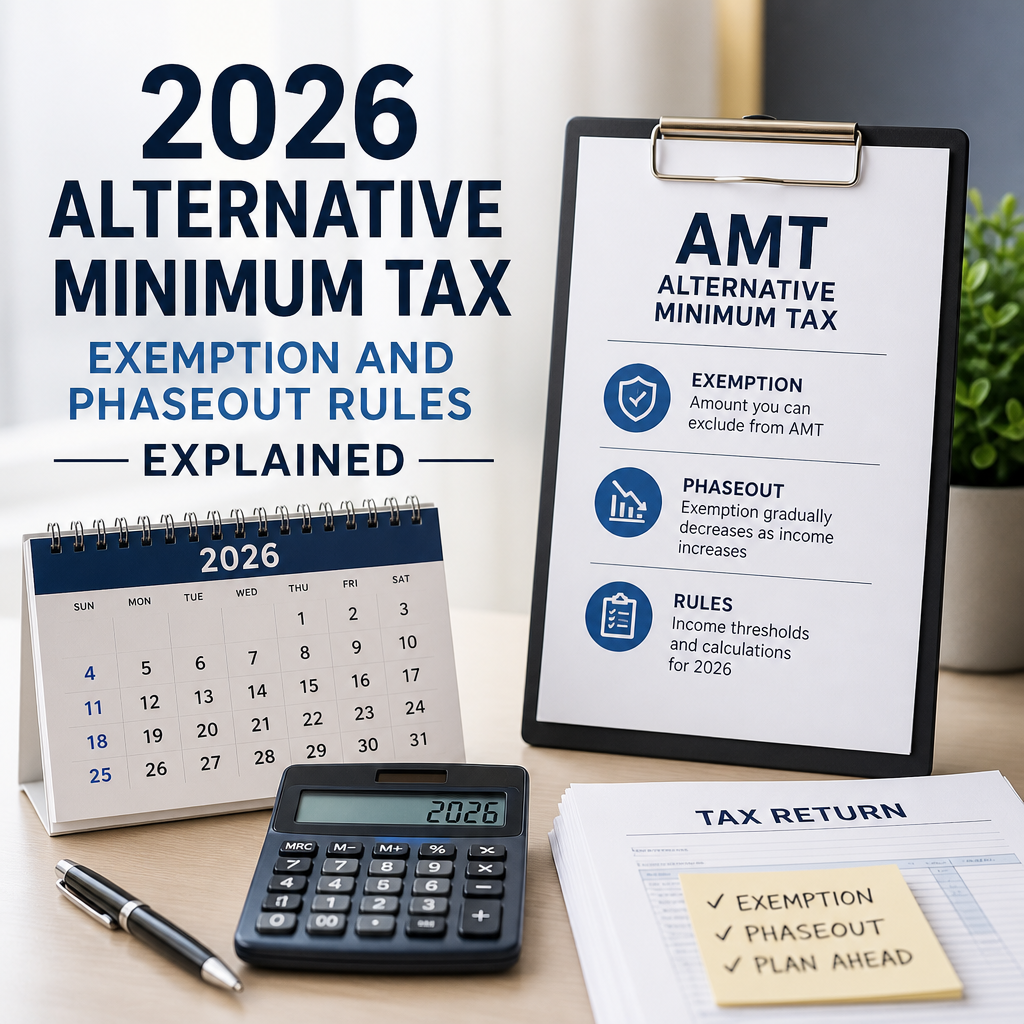
2026 Alternative Minimum Tax Exemption and Phaseout Rules Explained
The 2026 AMT exemption rules can make a big difference in how much tax you owe, especially if your income is rising or you have deductions that AMT treats differently. Here’s a simple breakdown of how the exemption and phaseout work, so you can spot potential surprises before you file.
By: Mary Mitchell on August 2, 2026
Anúncios
The 2026 Alternative Minimum Tax exemption and phaseout rules matter to more taxpayers than many people expect, especially as income rises and deductions change over time. The Alternative Minimum Tax, or AMT, is a separate tax system designed to ensure higher-income taxpayers pay at least a minimum amount of tax, even if they claim certain deductions or credits under the regular tax rules.
If you have stock options, large capital gains, significant itemized deductions, or a higher household income, understanding the 2026 Alternative Minimum Tax exemption and phaseout rules can help you avoid surprises when you file. In this guide, we’ll break down how AMT works, what the exemption amount means, when the phaseout begins, and what practical steps can help you prepare.
Anúncios
What Is the Alternative Minimum Tax?
The Alternative Minimum Tax is a parallel tax calculation. You first compute your tax under the regular income tax rules, then compute it again under AMT rules. If the AMT result is higher, you pay that amount instead.
AMT adds back or limits certain tax benefits that are allowed under the regular system. Common AMT adjustments include:
Anúncios
State and local tax deductions
Certain miscellaneous deductions
Incentive stock option exercises
Private activity bond interest in some cases
Depreciation differences for some business assets
The goal is not to tax everyone the same way. Instead, it is to make sure taxpayers with substantial income and tax preferences still pay a minimum level of tax.
2026 Alternative Minimum Tax Exemption and Phaseout Rules: The Basics
The 2026 Alternative Minimum Tax exemption and phaseout rules determine how much income is shielded from AMT and when that protection starts shrinking.
What Is the AMT exemption?
The AMT exemption is the amount of income that is excluded from AMT calculations. In simple terms, it acts like a cushion. The larger the exemption, the less likely a taxpayer is to owe AMT.
For 2026, the exemption amount is set under inflation-adjusted rules and current law, but the exact figure can depend on filing status and future law changes. Because tax law can change before filing season, taxpayers should confirm the final IRS numbers for 2026 before making tax decisions.
What Is the phaseout?
The phaseout reduces the AMT exemption once alternative minimum taxable income reaches a certain threshold. Once your income passes that threshold, the exemption shrinks gradually until it disappears.
This matters because the phaseout can make AMT increase quickly for taxpayers with higher income. In practice, the 2026 Alternative Minimum Tax exemption and phaseout rules mean that two people with similar deductions can face very different tax results if one crosses the phaseout line.
How the AMT Calculation Works
The AMT calculation follows a few broad steps:
Start with regular taxable income.
Add back certain deductions and make required adjustments.
Apply the AMT exemption, if eligible.
Calculate tax using AMT rates.
Compare AMT to regular tax and pay the higher amount.
AMT rates
AMT uses its own tax brackets and rates, which are different from the regular income tax brackets. While the details may change with legislation, the structure is generally progressive: income within certain ranges is taxed at one rate, and higher income is taxed at another.
Why the exemption matters so much
Without the exemption, many more taxpayers would owe AMT. The exemption keeps the tax targeted mainly toward households that benefit from specific tax preferences or have higher incomes.
For that reason, the 2026 Alternative Minimum Tax exemption and phaseout rules are especially important for:
Upper-middle-income families
Taxpayers with large incentive stock option income
Households in high-tax states
People with large capital gains in a single year
Taxpayers who itemize heavily
Who Is Most Likely to Be Affected in 2026?
Most taxpayers do not owe AMT. Still, certain situations increase the chance of exposure.
Common AMT triggers
1. Exercising incentive stock options
If you exercise incentive stock options and hold the shares, the “spread” between the strike price and fair market value can increase AMT income.
2. High state and local taxes
Because the state and local tax deduction is limited for regular tax purposes and treated differently under AMT, taxpayers in high-tax states may be more likely to encounter AMT.
3. Large itemized deductions
Some deductions allowed under the regular system are limited or disallowed for AMT.
4. Large one-time income events
A big bonus, business sale, investment gain, or Roth conversion can push income high enough to interact with the phaseout.
5. Multiple tax benefits in one year
Several smaller tax preferences can combine and create a surprise AMT result.
Filing Status and the Exemption Threshold
Your filing status affects how the exemption and phaseout work. The IRS applies different exemption amounts and thresholds for:
Single filers
Married filing jointly
Married filing separately
Head of household
In general, married couples filing jointly receive a larger exemption than single filers, while married filing separately receives different treatment that may be less favorable in some cases.
Because the 2026 Alternative Minimum Tax exemption and phaseout rules depend on filing status, a tax strategy that works for one household may not work for another.
Practical Example of How Phaseout Can Affect Taxpayers
Imagine two taxpayers with similar salaries. Both claim itemized deductions and both have some investment income.
Taxpayer A has income below the AMT phaseout threshold.
Taxpayer B has income above the threshold due to a large bonus and stock option exercise.
Taxpayer A may still receive most or all of the AMT exemption. Taxpayer B, however, may lose part of the exemption, which increases alternative minimum taxable income and can raise the final tax bill.
That is the key reason the 2026 Alternative Minimum Tax exemption and phaseout rules can feel sudden: the tax impact often accelerates after income passes a specific point.
How to Estimate AMT Before You File
You do not need to wait until tax season to think about AMT. A simple year-end estimate can help identify whether you are at risk.
Start with these questions
Will I exercise stock options this year?
Did I sell a business, investment, or property at a gain?
Did I have unusually high state or local taxes?
Did I make a large Roth conversion?
Did my income jump because of a bonus or severance package?
Use tax software or a professional
Tax software can often estimate AMT exposure, but a tax professional may be better if your return includes stock compensation, business income, or multiple deductions. The AMT rules are technical, and one missed adjustment can change the outcome.
Review withholding and estimated payments
If you suspect AMT exposure, check your withholding and quarterly estimated payments. Underpayment penalties can add to the cost if you wait until April to address the issue.
Smart Planning Moves Before Year-End
A little planning can reduce the odds of an AMT surprise.
Consider timing income and deductions
Depending on your situation, you may be able to:
Defer income into the next tax year
Accelerate deductible expenses into the current year
Spread capital gains over more than one year
Time stock option exercises more carefully
Review incentive stock options carefully
Stock options are one of the biggest AMT triggers. If you are planning to exercise options, it helps to calculate the tax consequences first rather than after the fact.
Watch large charitable gifts and state tax payments
Some taxpayers bunch charitable contributions or state tax payments into a single year. That strategy may help under regular tax rules, but it can have different effects under AMT. Always compare the full tax picture before making a decision.
Talk to a tax professional after major life events
AMT planning matters even more if you recently:
Changed jobs
Sold equity in a company
Moved to a high-tax state
Retired early
Realized a large investment gain
These events can shift you into or out of the 2026 Alternative Minimum Tax exemption and phaseout rules in ways that are hard to predict without a detailed estimate.
Common Misunderstandings About AMT
People often assume AMT is outdated or only affects the very rich. That is not always true.
“AMT no longer affects middle-class taxpayers.”
Not necessarily. While AMT affects fewer taxpayers than it once did, it can still apply to people with large deductions or unusual income events.
“If I paid AMT last year, I’ll pay it again.”
Not always. AMT can appear in one year and disappear the next because it often depends on timing, stock transactions, and deduction patterns.
“The exemption means I’m safe.”
The exemption helps, but the phaseout can reduce or eliminate it if income gets high enough.
“My regular tax software will catch everything.”
Software is useful, but it only works well when your data is complete and accurate. Complex returns may still need professional review.
Why 2026 Planning Matters Now
Tax planning works best before the year ends, not after the return is filed. Even if the final IRS figures change slightly, the structure of the 2026 Alternative Minimum Tax exemption and phaseout rules gives you useful planning signals now.
If you expect income changes, stock compensation events, or large deductions, you can take steps during the year to reduce risk. That may mean adjusting the timing of income, reviewing withholding, or simply checking whether your deductions are likely to push you into AMT territory.
Frequently Asked Questions
1. What is the Alternative Minimum Tax in simple terms?
The Alternative Minimum Tax is a separate tax calculation designed to make sure taxpayers with certain tax benefits still pay at least a minimum amount of federal income tax. You calculate both regular tax and AMT, then pay whichever is higher.
2. Who is most likely to owe AMT in 2026?
Taxpayers most likely to owe AMT in 2026 include those with incentive stock options, high income, large itemized deductions, major capital gains, or significant state and local tax deductions. It can also affect people who have a large one-time income event in a single year.
3. What does the AMT exemption do?
The exemption reduces the amount of income subject to AMT. It lowers the chance of owing AMT, but it can be reduced or eliminated once income reaches the phaseout range.
4. How does the phaseout affect my tax bill?
The phaseout gradually reduces the AMT exemption as income rises. Once the exemption shrinks, more income becomes subject to AMT, which can raise your total tax liability. The higher your income above the threshold, the more likely the phaseout will matter.
5. How can I tell if I might owe AMT before filing?
You can estimate your risk by reviewing stock option activity, major capital gains, itemized deductions, and any large income changes. Tax software can help with a basic estimate, but complex situations often require a CPA or enrolled agent to calculate AMT accurately.
The 2026 Alternative Minimum Tax exemption and phaseout rules are important because they can change the tax outcome for taxpayers with high income, stock compensation, significant deductions, or large one-time financial events. While most people will never owe AMT, those who are exposed often find out only after the year is over, when planning options are limited.
The best approach is to treat AMT as a planning issue, not just a filing issue. Review your income during the year, keep track of deductions that may be treated differently under AMT, and pay special attention if you exercise incentive stock options or realize major gains. Even a quick estimate can help you make better decisions about withholding, estimated payments, and timing.
If your finances are straightforward, the rules may never affect you. But if your tax picture is more complex, understanding AMT now can help you avoid surprises later and keep more control over your overall tax strategy.
Mary S, CFP®, is a Certified Financial Planner with over 12 years of experience in personal finance, retirement planning, and wealth management. She writes educational content that helps readers understand financial concepts and make informed decisions based on reliable information.