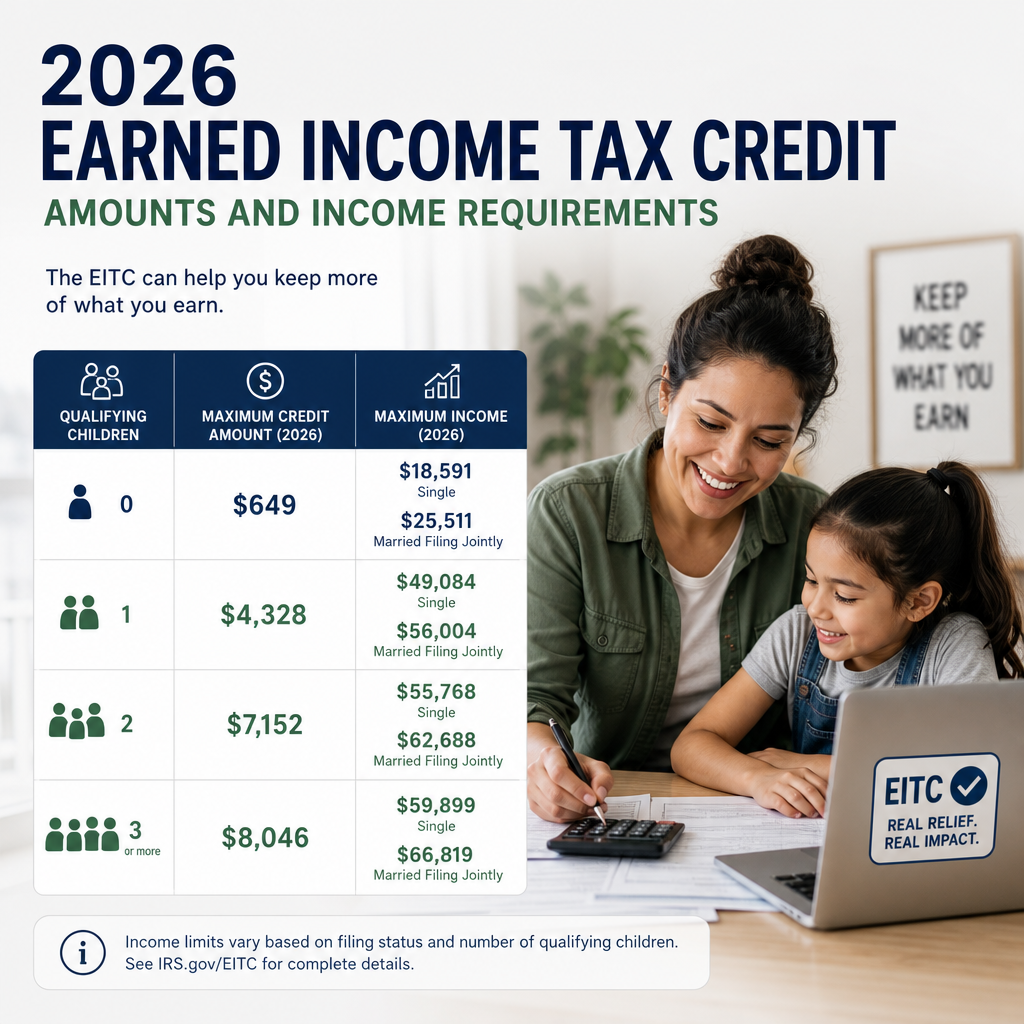
2026 Earned Income Tax Credit Amounts and Income Requirements
The earned income tax credit can be a valuable way for working individuals and families to lower their tax bill and, in some cases, receive a refund. Here’s what to know about the 2026 amounts and income requirements so you can check whether you may qualify.
By: Mary Mitchell on August 2, 2026
Anúncios
The 2026 Earned Income Tax Credit amounts and income requirements matter to millions of working individuals and families who want to lower their tax bill and, in many cases, receive a refund. The Earned Income Tax Credit, often called the EITC, is one of the most valuable tax credits available because it targets low- to moderate-income workers and can reduce taxes owed dollar for dollar. In some cases, it can even create a refund.
If you’re planning ahead for the 2026 tax year, understanding how the EITC works can help you estimate eligibility, avoid filing mistakes, and make better financial decisions. While the IRS usually updates exact thresholds for inflation closer to filing season, the core rules remain consistent: your earned income, filing status, and number of qualifying children all affect whether you qualify and how much you may receive.
Anúncios
What Is the Earned Income Tax Credit?
The Earned Income Tax Credit is a federal tax benefit designed to support working people with modest incomes. Unlike many credits, the EITC is refundable, which means it can reduce your tax liability below zero and result in a refund.
To qualify, you generally must have:
Anúncios
Earned income from work
A valid Social Security number
A filing status allowed for the credit
Investment income below the IRS limit
Income and age requirements that match your household situation
The EITC is especially helpful for:
Workers with children
Single parents
Married couples with lower incomes
Childless workers who meet the age and income rules
Because the credit changes based on family size and income, it pays to understand the 2026 Earned Income Tax Credit amounts and income requirements before tax season begins.
2026 Earned Income Tax Credit Amounts: What to Expect
The IRS adjusts EITC amounts each year for inflation. That means the final numbers for 2026 will be released by the IRS before the 2026 filing season for tax returns filed in 2027.
How the credit is structured
The EITC has three main parts:
Phase-in range — The credit increases as earned income rises.
Plateau range — The credit reaches its maximum amount.
Phaseout range — The credit gradually decreases as income exceeds a certain threshold.
The exact 2026 Earned Income Tax Credit amounts and income requirements will depend on:
Filing status
Number of qualifying children
Earned income
Adjusted gross income (AGI)
Why the exact amounts matter
Even a small change in income can affect your credit. For example:
A worker with no qualifying children may qualify for a much smaller credit than a parent with two or more children.
A married couple filing jointly may face a different income threshold than a single filer.
A small increase in wages could reduce the credit if it pushes income into the phaseout range.
If you’re budgeting for the year, it’s smart to treat the EITC as a possible tax benefit—not guaranteed income—until you confirm the final IRS numbers.
2026 Income Requirements for the Earned Income Tax Credit
The IRS looks at both earned income and adjusted gross income when determining eligibility. You must stay below the applicable limit for your filing status and household size.
Earned income includes
Wages, salaries, tips, and other taxable employee pay
Net earnings from self-employment
Certain disability benefits received before retirement age in some cases
Earned income does not include
Social Security benefits
Unemployment compensation
Alimony for divorce agreements executed after 2018
Child support
Interest, dividends, and most investment income
Investment income limit
To qualify for the EITC, your investment income must remain below the IRS cap. This includes items such as:
Taxable interest
Dividends
Capital gains
Rental income, in some situations
Royalties
If your investment income is too high, you may lose eligibility even if your wages are within range.
Who Qualifies for the EITC in 2026?
The main eligibility rules for the EITC are straightforward, but they can still catch people off guard. To qualify for the 2026 Earned Income Tax Credit amounts and income requirements, you typically need to meet all of the following conditions.
Basic eligibility rules
You must have earned income from work.
Your investment income must be under the IRS limit.
You must have a valid Social Security number by the due date of your return.
You must be a U.S. citizen or resident alien for the full year.
You cannot file as “married filing separately.”
You must meet the income threshold for your filing status and family size.
Special rules for children
If you claim a qualifying child, that child must meet IRS tests for:
Relationship
Age
Residency
Joint return status
A qualifying child must generally live with you in the United States for more than half the year. The child must also be your:
Son or daughter
Stepchild
Foster child
Brother or sister
Half sibling
Grandchild
Or another eligible descendant in some cases
Childless workers
Workers without children can still qualify for the EITC, but the age and income rules are stricter. For example, the IRS generally limits the childless EITC to certain age groups, and the credit amount is much smaller than for families with qualifying children.
Filing Status and How It Affects the EITC
Your filing status plays a major role in your eligibility and possible credit amount.
Allowed filing statuses
You may qualify if you file as:
Single
Head of household
Married filing jointly
Qualifying surviving spouse
Not allowed
You generally cannot claim the EITC if you file as:
Married filing separately
That rule matters because some couples mistakenly think separate returns might help them manage income thresholds. For EITC purposes, that filing status usually disqualifies you.
Example
A single parent with two children may qualify at a different income level than a married couple with two children. Even if both households have the same wages, the filing status affects the income phaseout and the amount of credit available.
How the 2026 EITC Works in Real Life
To make the 2026 Earned Income Tax Credit amounts and income requirements easier to understand, it helps to look at practical scenarios.
Example 1: A single worker with no children
A worker earns modest wages and has no qualifying children. If their income falls within the childless worker range and they meet the age rules, they may qualify for a small EITC. But the credit phases out quickly, so income changes can make a big difference.
Example 2: A parent with one qualifying child
A single parent with one qualifying child may receive a larger credit because the EITC is designed to support working families. If their income rises within the phase-in range, the credit increases. Once income enters the phaseout range, the credit starts shrinking.
Example 3: Two parents with three children
A married couple filing jointly with three qualifying children may qualify for a higher maximum credit than a smaller household. However, if one spouse has additional income from a side business, that income may push the family closer to the phaseout limit.
These examples show why it’s important to evaluate both wages and household details when estimating the EITC.
Common Mistakes That Can Delay or Reduce the Credit
The EITC is valuable, but it’s also one of the most commonly examined tax credits because eligibility depends on multiple rules. Avoiding mistakes can help prevent refund delays.
Mistakes to avoid
Claiming a child who does not meet the residency test
Forgetting to include all earned income
Misreporting filing status
Exceeding the investment income limit
Using an incorrect Social Security number
Filing separately when married
Not reporting self-employment income accurately
Self-employment caution
If you work for yourself, report all net earnings and keep records of business income and expenses. The IRS may review self-employment claims closely because this income can affect both eligibility and credit size.
Documentation helps
Keep records such as:
W-2s
1099 forms
Pay stubs
Child care records
School or medical records showing residency if needed
Proof of income and expenses for self-employment
Good records can make filing easier and help support your return if the IRS asks questions later.
How to Estimate Your 2026 EITC
Since the IRS final figures for 2026 will be released later, the best approach is to estimate using your expected income and household information.
Steps to estimate the credit
Add up your expected earned income for the year.
Check whether your investment income will stay below the limit.
Confirm how many qualifying children you can claim.
Review your filing status.
Compare your information with the IRS EITC rules when the 2026 tables are published.
Tools that can help
You can use:
The IRS EITC Assistant
Tax preparation software
A qualified tax professional
A free tax help program if you qualify
If your income changes during the year, revisit your estimate. A raise, new job, side gig, or change in family status can all affect eligibility.
Additional Tax Credits You May Want to Review
While the EITC is powerful on its own, it may work alongside other tax benefits.
Credits often considered with the EITC
Child Tax Credit
Child and Dependent Care Credit
Saver’s Credit
Premium Tax Credit for marketplace health coverage
Each credit has its own rules, so qualifying for one does not automatically mean you qualify for another. Still, reviewing all possible credits can help you avoid leaving money on the table.
When to Check the Final 2026 Numbers
The IRS typically publishes updated thresholds and instructions before the filing season opens. That’s the best time to confirm the official 2026 Earned Income Tax Credit amounts and income requirements.
Best times to check
Late in the year before tax filing season
When your income changes significantly
When your family structure changes
After IRS updates to tax tables and publications
If you want the most accurate estimate, use the official IRS guidance once it becomes available.
Frequently Asked Questions
What are the 2026 Earned Income Tax Credit amounts and income requirements?
The IRS has not always released final EITC figures far in advance, because the amounts are adjusted for inflation. The 2026 rules will depend on IRS updates for that tax year. In general, the credit will still be based on earned income, filing status, number of qualifying children, and investment income limits.
Can I qualify for the EITC if I don’t have children?
Yes. Childless workers may qualify for the EITC if they meet the age, income, filing status, and other IRS rules. However, the credit amount is smaller than for taxpayers with qualifying children, and the income limit is lower.
Does self-employment income count for the EITC?
Yes. Net self-employment earnings count as earned income for the EITC. You must report the income accurately and keep records of business income and deductible expenses. If you underreport income, you could reduce or lose the credit and face IRS issues later.
Can married couples claim the EITC if they file separately?
Usually no. Taxpayers who file as married filing separately are not eligible for the EITC. Most married couples who want to claim the credit must file a joint return and meet the other requirements.
Why might my EITC refund be delayed?
The IRS may delay refunds if you claim the EITC or Additional Child Tax Credit, since those returns often receive extra review. Delays can also happen if your return has errors, missing information, identity verification issues, or mismatched Social Security numbers.
The 2026 Earned Income Tax Credit amounts and income requirements will remain an important tax topic for working individuals and families who want to reduce their tax burden and possibly increase their refund. Although the IRS final numbers for 2026 will be released closer to filing season, the basic framework of the credit is unlikely to change: your earned income, investment income, filing status, and number of qualifying children will still determine eligibility and the size of the credit.
The best way to prepare is to understand the rules now, keep accurate records throughout the year, and check the official IRS guidance once the 2026 tables are published. That way, you can estimate your refund more confidently and avoid surprises at tax time. If you qualify, the EITC can make a meaningful difference in your household budget. Taking a few minutes to review the requirements today can help you claim every dollar you’ve earned when you file.
Mary S, CFP®, is a Certified Financial Planner with over 12 years of experience in personal finance, retirement planning, and wealth management. She writes educational content that helps readers understand financial concepts and make informed decisions based on reliable information.