Mutual Funds Explained: Management, Diversification, and Investor Costs
Mutual funds make it easy to invest in a diversified portfolio without having to pick every stock or bond yourself. In this guide, you’ll learn how mutual funds are managed, what drives their costs, and how to tell if one fits your goals.
By: Mary Mitchell on August 2, 2026
Anúncios
Mutual funds remain one of the most popular ways to invest for retirement, long-term growth, and everyday wealth building. If you’ve ever wondered how mutual funds work, why so many investors use them, and what you actually pay to own them, this guide breaks down the essentials in plain English. Understanding mutual funds can help you choose investments that fit your goals, risk tolerance, and budget.
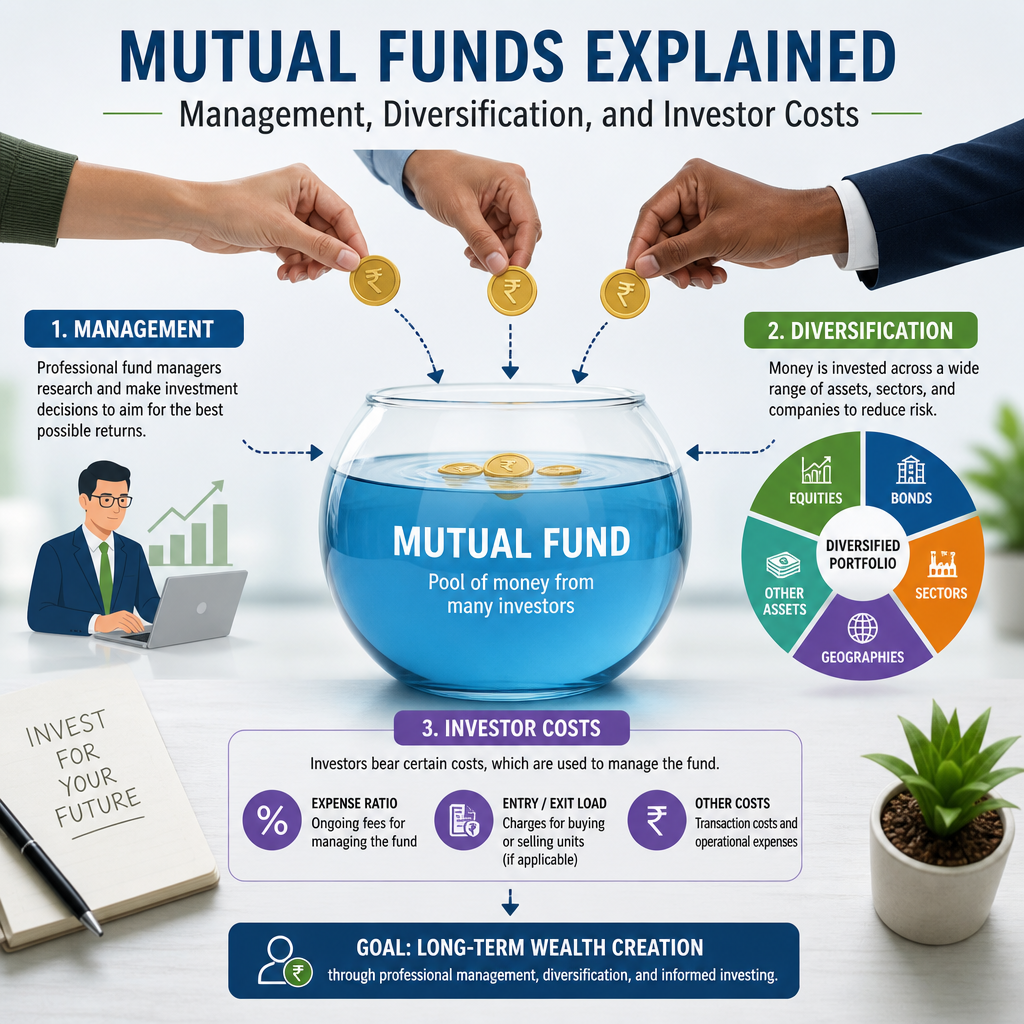
At their core, mutual funds pool money from many investors and use that capital to buy a diversified mix of stocks, bonds, or other securities. That structure gives everyday investors access to professional management and diversification that would be hard to build on their own.
Anúncios
What Are Mutual Funds?
A mutual fund is an investment vehicle that collects money from multiple investors and uses that pool to purchase a portfolio of assets. Each investor owns shares of the fund, and those shares represent a portion of the fund’s holdings.
Mutual funds can invest in:
Anúncios
Large U.S. companies
Small-cap stocks
Bonds and other fixed-income securities
International markets
Mixed asset portfolios
Sector-specific strategies
Because the fund holds many investments, your money is not tied to just one company or one bond. That broad exposure is one reason mutual funds are often seen as a beginner-friendly way to invest.
How Mutual Funds Are Priced
Mutual funds are typically priced once per trading day after the market closes. Their share price is called the net asset value, or NAV. The NAV reflects the total value of the fund’s holdings, minus liabilities, divided by the number of shares outstanding.
This means mutual funds do not trade like individual stocks throughout the day. Investors buy and sell based on the end-of-day price.
How Mutual Funds Are Managed
Management is one of the defining features of mutual funds. Some are actively managed by professionals who research securities and make decisions about what to buy or sell. Others are passively managed and simply aim to track a market index.
Active Management
In an actively managed mutual fund, a portfolio manager or team makes decisions designed to outperform a benchmark index. The manager may adjust the portfolio based on market conditions, company performance, interest rates, or broader economic trends.
Active management may appeal to investors who want:
Professional judgment
A strategy that responds to changing conditions
Exposure to less efficient or niche parts of the market
However, active management does not guarantee better returns. In fact, many active funds underperform their benchmarks over time, especially after fees are considered.
Passive Management
A passive mutual fund, often called an index fund, is designed to mirror the performance of a market index such as the S&P 500 or a bond market benchmark. Instead of trying to beat the market, it aims to match it.
Passive funds usually have:
Lower fees
Less trading activity
More predictable investment style
Broad market exposure
For many investors, passive mutual funds offer a simple and low-cost way to build long-term wealth.
Who Manages the Fund?
A mutual fund is typically run by:
Portfolio managers, who make investment decisions
Analysts, who research companies, bonds, and markets
Compliance teams, who help ensure the fund follows regulations
Administrators and custodians, who handle recordkeeping and asset safekeeping
This structure gives investors access to a coordinated team, rather than requiring them to manage every investment decision themselves.
Why Diversification Matters
Diversification is one of the biggest advantages of mutual funds. Instead of placing your money into a single stock or bond, the fund spreads investments across many holdings. That can reduce the impact of any one company or sector performing poorly.
The Role of Diversification in Risk Management
Diversification does not eliminate risk, but it can help smooth out the ups and downs of investing. For example, if one stock in a fund falls sharply, gains from other holdings may help offset the damage.
A diversified fund may reduce exposure to:
Company-specific risk
Industry downturns
Geographic concentration
Interest rate sensitivity, depending on the fund type
This is especially useful for new investors who may not yet have the time, research skills, or capital to build a diversified portfolio on their own.
Different Types of Diversification
Mutual funds can diversify in several ways:
By Asset Class
Some funds hold a mix of stocks, bonds, and cash equivalents. These balanced funds are often used by investors who want a single-fund solution.
By Market Cap
Stock funds may spread investments across large-cap, mid-cap, and small-cap companies.
By Geography
International and global mutual funds invest across regions and countries, helping reduce dependence on one economy.
By Sector
Some funds focus on technology, healthcare, energy, or other sectors. These can offer targeted exposure, but they may also be more volatile.
Diversification Has Limits
It’s important to remember that diversification works best when the underlying assets do not all move in the same direction at the same time. During broad market declines, even diversified funds can fall in value.
Still, compared with holding just a handful of securities, mutual funds generally provide a more balanced starting point for most investors.
Understanding Investor Costs
Costs matter more than many investors realize. Even seemingly small fees can take a meaningful bite out of long-term returns. When comparing mutual funds, you should know exactly what you are paying and why.
Common Mutual Fund Fees and Expenses
Mutual fund costs may include:
Expense ratio: The annual cost of operating the fund, expressed as a percentage of assets
Sales loads: Commissions paid when buying or selling certain funds
12b-1 fees: Marketing or distribution fees included in some share classes
Trading costs: Costs related to buying and selling securities inside the fund
Account fees: Charges from brokers or retirement platforms, depending on where you invest
What Is the Expense Ratio?
The expense ratio is one of the most important numbers to review. It covers the fund’s operating expenses, including management, administration, and recordkeeping. A fund with an expense ratio of 0.50% charges $5 annually for every $1,000 invested, though the actual dollar amount will vary with market performance.
Low-cost funds can be especially attractive for long-term investors because expenses compound over time just like returns do.
Front-End and Back-End Loads
Some mutual funds charge sales loads:
Front-end load: Paid when you buy shares
Back-end load: Paid when you sell shares, sometimes called a deferred sales charge
Not all mutual funds charge loads. Many no-load funds are widely available and may be a better fit for cost-conscious investors.
Why Fees Deserve Attention
Two mutual funds may invest in similar securities but deliver very different results after expenses. A fund with high fees has a harder time keeping up with the market and may need stronger performance just to match a lower-cost alternative.
When choosing a mutual fund, it often makes sense to compare:
Long-term performance
Risk level
Investment style
Expense ratio
Any additional sales charges
Types of Mutual Funds
Mutual funds come in many forms, and each serves a different purpose.
Stock Funds
These funds invest primarily in stocks and are generally used for growth. They may focus on:
U.S. large-cap stocks
Growth stocks
Value stocks
Dividend-paying stocks
Small- or mid-cap companies
Stock funds can offer higher long-term return potential but usually come with greater short-term volatility.
Bond Funds
Bond mutual funds invest in government, municipal, or corporate debt securities. They may appeal to investors seeking income and relative stability.
Bond funds vary by:
Credit quality
Duration
Issuer type
Interest rate sensitivity
Balanced Funds
Balanced funds combine stocks and bonds in one portfolio. They are designed to provide a middle ground between growth and income.
Target-Date Funds
Target-date mutual funds automatically shift toward more conservative investments as a target retirement year approaches. These are common in employer-sponsored retirement plans because they offer a hands-off approach.
Money Market Funds
Money market funds invest in short-term, high-quality instruments and aim to preserve capital while offering liquidity. They are not the same as bank savings accounts, but they are often used for short-term cash management.
How Mutual Funds Fit Into a Portfolio
Mutual funds can serve many roles depending on your investment goals.
For Long-Term Investors
If you’re saving for retirement or another long-term goal, mutual funds can help you build a diversified portfolio with less effort than buying individual securities.
A simple long-term approach might include:
A broad U.S. stock fund
An international stock fund
A bond fund for stability
A target-date fund for convenience
For Hands-Off Investors
Many investors prefer mutual funds because they can simplify decision-making. Instead of monitoring dozens of positions, you can use a few broad funds to cover the market.
For Income or Stability
Bond funds and certain dividend-oriented stock funds may help generate income, though they also carry risk. Income is never guaranteed, and fund value can still fluctuate.
Practical Example: Comparing Two Mutual Funds
Imagine two investors each put $10,000 into a U.S. stock mutual fund.
Fund A has an expense ratio of 0.05%
Fund B has an expense ratio of 1.00%
Both hold similar stocks, but Fund B costs much more to own. Over time, Fund A may leave more of the investment return in the investor’s account because lower fees create less drag on performance.
This example shows why cost isn’t just a technical detail. It can directly influence long-term results.
What to Look for Before Investing
Before buying a mutual fund, review the fund’s prospectus and key information documents. Pay close attention to:
Investment objective
Asset allocation
Risk level
Performance history
Expense ratio
Manager experience
Turnover rate
Minimum investment requirements
Ask These Questions
A practical checklist can help you choose more confidently:
Does this fund match my goal?
How much risk am I comfortable taking?
Is the fund actively or passively managed?
What fees will I pay?
How does the fund compare with similar options?
These questions can help you avoid buying a fund just because it sounds familiar or has had recent strong performance.
Mutual Funds and Tax Considerations
Taxes can affect mutual fund returns, especially in taxable accounts.
Capital Gains Distributions
When a fund sells securities at a profit, it may pass taxable capital gains to shareholders. Even if you did not sell your shares, you could still owe taxes on those distributions in a taxable account.
Dividends and Interest
Mutual funds that earn dividends or interest may distribute that income to shareholders. The tax treatment depends on the type of income and the type of account you use.
Tax-Advantaged Accounts
Holding mutual funds in retirement accounts such as 401(k)s or IRAs may help reduce current tax consequences, depending on the account type and tax rules.
Common Mistakes to Avoid
Even experienced investors can make avoidable errors with mutual funds.
Chasing Past Performance
A fund that performed well recently is not guaranteed to keep winning. It may simply have benefited from a favorable market cycle.
Ignoring Fees
High fees can quietly reduce your returns year after year.
Overlooking Overlap
If you own several mutual funds, they may hold many of the same securities. That can reduce the diversification benefit you expected.
Choosing Complexity Over Clarity
Some mutual funds are easy to understand and hold. Others are so specialized that they make portfolio management harder. Simpler is often better, especially for long-term investors.
Frequently Asked Questions
1. What is the main advantage of mutual funds?
The main advantage is built-in diversification combined with professional management. Mutual funds pool money from many investors to buy a range of securities, which can reduce the impact of any single investment performing poorly. They also make it easier to access a diversified portfolio without having to buy each security individually.
2. Are mutual funds better than individual stocks?
It depends on your goals, experience, and tolerance for risk. Individual stocks can offer higher upside, but they also create more company-specific risk. Mutual funds spread your money across many holdings, which can reduce volatility and simplify investing. For many people, especially beginners, mutual funds are a more practical starting point.
3. What is the difference between active and passive mutual funds?
Active mutual funds use portfolio managers who try to beat a benchmark by selecting investments and adjusting the portfolio over time. Passive mutual funds aim to match an index and usually have lower fees. Active funds may offer more flexibility, while passive funds often appeal to investors who want lower costs and simpler market exposure.
4. Why do mutual fund fees matter so much?
Fees matter because they reduce your investment returns every year. Even a small difference in expense ratios can add up significantly over time due to compounding. Lower-cost funds give more of the market’s return back to the investor, which can make a meaningful difference in long-term performance.
5. Can I lose money in a mutual fund?
Yes. Mutual funds can decline in value if the securities they hold lose value. Stock funds may fall during market downturns, and bond funds can also lose value because of interest rate changes, credit risk, or other factors. Mutual funds are not guaranteed investments, so it’s important to match the fund to your risk tolerance and timeline.
Mutual funds can be a powerful tool for building a diversified, professionally managed portfolio without having to pick every investment yourself. By understanding how mutual funds are managed, how diversification works, and what investor costs can affect your returns, you put yourself in a much stronger position to make smart investment choices.
The best mutual fund is not necessarily the one with the flashiest recent performance. It is the one that fits your goals, your timeline, and your comfort with risk while keeping costs reasonable. For many investors, that means favoring broad, low-cost funds that offer clear strategies and transparent fees. Whether you are investing for retirement, education, or long-term financial security, taking the time to understand mutual funds can help you avoid common mistakes and stay focused on what matters most: disciplined, informed investing.
Mary S, CFP®, is a Certified Financial Planner with over 12 years of experience in personal finance, retirement planning, and wealth management. She writes educational content that helps readers understand financial concepts and make informed decisions based on reliable information.