Municipal Bonds Explained: Tax Benefits, Returns, and Risks
Anúncios
Municipal bonds are a popular way for investors to seek steady income while supporting public projects like schools, roads, utilities, and hospitals. If you’ve ever wondered how municipal bonds work, why their yields often look lower than corporate bonds, or whether the tax advantages are worth it, this guide breaks it down in plain English.
Understanding municipal bonds matters because the appeal is not just the interest payment. The real story includes tax considerations, returns, and risks—and the details can change the investment’s value quite a bit. For some investors, municipal bonds can be a smart fit. For others, the tax benefits may not outweigh the tradeoffs.
Anúncios
What Are Municipal Bonds?
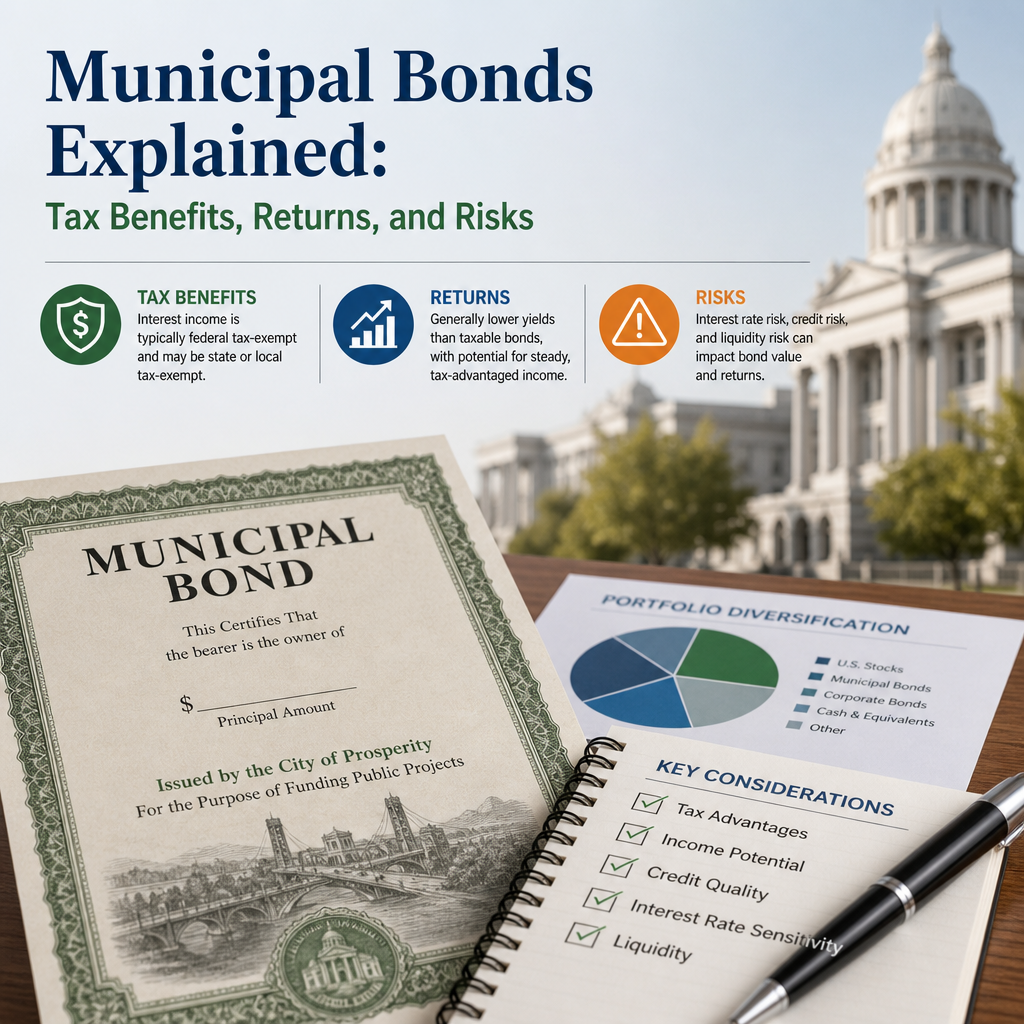
Municipal bonds, often called munis, are debt securities issued by state and local governments or by agencies and authorities tied to public services. When you buy a municipal bond, you’re lending money to the issuer in exchange for interest payments and the return of principal at maturity.
These bonds are commonly used to fund:
Anúncios
- Roads and bridges
- Schools and universities
- Water and sewer systems
- Hospitals and health facilities
- Public transit and other infrastructure
Municipal bonds come in two main types:
General Obligation Bonds
These bonds are backed by the issuer’s taxing power and overall financial strength. They are often used for projects that benefit the public broadly, such as schools or city improvements.
Revenue Bonds
These are repaid from income generated by a specific project or source, such as toll roads, utilities, or airport fees. Because repayment depends on project revenues, revenue bonds may carry different risk levels than general obligation bonds.
Why Investors Buy Municipal Bonds
Many investors are drawn to municipal bonds for one simple reason: tax-advantaged income. In many cases, the interest paid by municipal bonds is exempt from federal income tax. Depending on where you live and where the bond was issued, it may also be exempt from state and local taxes.
That tax treatment can make munis especially attractive to:
- High-income investors
- Retirees seeking income
- People in higher tax brackets
- Investors looking to diversify fixed-income holdings
Still, tax exemption is only part of the picture. A bond’s after-tax return, credit quality, maturity, and interest-rate sensitivity all matter.
Municipal Bonds and Tax Considerations
Tax treatment is one of the most important reasons people consider municipal bonds. But it’s also the area where investors make the most mistakes by assuming “tax-free” means universally tax-free.
Federal Tax Treatment
Most municipal bond interest is exempt from federal income tax. That can improve the bond’s effective return compared with taxable bonds that offer higher stated yields.
However, not all muni income is fully exempt in every situation. Some municipal bonds may be subject to federal taxes if they involve certain private activity structures or if you are affected by alternative minimum tax rules.
State and Local Tax Treatment
If you buy a bond issued by your home state or local government, the interest may also be exempt from state and local income taxes. This can create a meaningful advantage for residents in high-tax states.
For example:
- A California resident may favor California municipal bonds for potential federal and state tax benefits.
- A New York resident may prefer in-state munis to avoid state income tax on the interest.
Cross-state purchases can still make sense, but the tax benefit may be smaller if the bond does not qualify for your state’s exemption rules.
Taxable Equivalent Yield
One of the most useful concepts in municipal bond investing is taxable equivalent yield. This tells you what a taxable bond would need to yield to match the after-tax return of a municipal bond.
A simple way to think about it:
- If a taxable bond yields 5%
- And a municipal bond yields 3.5% tax-free
- The muni may actually be more attractive for someone in a high tax bracket
The higher your tax rate, the more valuable the tax exemption tends to be.
Bonds Subject to AMT or Other Taxes
Some municipal bonds, especially certain private activity bonds, can be subject to the Alternative Minimum Tax (AMT) for some investors. That means the interest may not be fully tax-free in all cases.
Before buying, check:
- Whether the bond is exempt from federal tax
- Whether it is subject to AMT
- Whether your state taxes out-of-state municipal interest
- Whether the bond generates any capital gains or losses when sold
Returns: What Municipal Bonds Really Offer
Municipal bonds usually do not aim to deliver high growth. Instead, they tend to offer predictable income and capital preservation potential, depending on the issuer and market conditions.
Yield Versus Total Return
When people talk about returns, they often focus on yield. But with municipal bonds, total return matters too. Total return includes:
- Interest income
- Price changes if you sell before maturity
- Any reinvestment gains or losses
If interest rates rise after you buy a bond, the bond’s market price may fall. If you hold to maturity and the issuer does not default, you generally expect to receive principal back at par value, but you could still face opportunity costs if newer bonds offer better yields.
How Maturity Affects Returns
Municipal bonds can have short, intermediate, or long maturities. In general:
- Short-term bonds usually carry lower yield but less interest-rate risk
- Long-term bonds often offer higher yield but greater price volatility
- Intermediate bonds may strike a balance between income and risk
A longer maturity can be appealing if you want to lock in a rate. But it also increases sensitivity to changing interest rates.
Callable Bonds and Return Potential
Many municipal bonds are callable, which means the issuer can redeem them early, usually when rates fall. That can limit your upside because the bond may be paid off before you expected, forcing you to reinvest at lower rates.
This is especially important when comparing municipal bonds with similar yields. A bond with a higher coupon may still produce lower long-term returns if it is called away early.
Risks to Watch in Municipal Bonds
Like any investment, municipal bonds carry risk. They are often considered relatively conservative, but they are not risk-free.
Credit Risk
Credit risk is the possibility that the issuer fails to make interest or principal payments. While defaults on municipal bonds are less common than in some other bond sectors, they can happen.
Credit quality depends on:
- The issuer’s financial strength
- Local economic conditions
- Debt levels
- Revenue stability
- The type of project being financed
Rating agencies assess many municipal bonds, but ratings are not guarantees. Investors should still review the bond’s financial disclosures and underlying source of repayment.
Interest-Rate Risk
When market interest rates rise, existing bond prices often fall. This matters most if you might need to sell before maturity.
Longer-maturity muni bonds usually carry more interest-rate risk than shorter ones. If you plan to hold the bond until maturity, the impact may be less important, but it still affects market value along the way.
Call Risk
As noted earlier, many munis are callable. If the issuer redeems the bond early, you may lose a relatively high income stream and have to reinvest at lower prevailing rates.
Inflation Risk
Municipal bond income is typically fixed, so inflation can gradually reduce the purchasing power of your payments. If inflation rises faster than expected, the real return on a muni bond may look less attractive.
Liquidity Risk
Not every municipal bond trades heavily. Some bonds can be harder to buy or sell quickly without affecting price. Thin trading can make it tougher to get a fair price, especially for smaller or more specialized issues.
Legislative and Tax Policy Risk
Municipal bonds rely partly on tax rules. If tax laws change, the value of municipal bond income could shift. While policy changes are unpredictable, this is one reason investors should avoid assuming muni tax treatment will always stay the same.
How to Evaluate a Municipal Bond
Before buying a municipal bond, it helps to look beyond the yield and ask a few practical questions.
1. Who Is the Issuer?
Start with the issuer’s identity and repayment source.
- Is it a city, state, school district, or authority?
- Is the bond backed by general taxes or project revenue?
- What does the issuer’s financial condition look like?
2. What Is the Credit Rating?
Credit ratings can provide a useful starting point, though they should not be the only factor. Higher-rated bonds generally indicate lower default risk, but often offer lower yields.
3. What Is the Yield After Taxes?
Compare the bond’s tax-free yield with taxable alternatives. The taxable equivalent yield can help you decide whether the muni is actually competitive.
4. What Is the Maturity Date?
Match the maturity to your goals. If you need money in a few years, a shorter maturity may be more appropriate than a long-term bond.
5. Is the Bond Callable?
If so, check the call date and call price. A bond with a favorable coupon but aggressive call features may not deliver the return you expect.
6. What Are the Fees and Trading Costs?
If you’re buying through a brokerage, ask about markups, commissions, or spreads. These costs can affect your overall return, especially on smaller purchases.
Practical Examples of Municipal Bond Use
Municipal bonds can play different roles depending on the investor’s situation.
Example 1: A High-Income Investor
An investor in a high federal tax bracket may find a lower-yielding municipal bond more attractive than a higher-yielding taxable corporate bond because the muni’s interest is not taxed federally.
Example 2: A Retiree Looking for Income
A retiree who wants predictable cash flow may use municipal bonds for income stability and potential tax efficiency, especially if taxable investment income could push them into a higher bracket.
Example 3: A Conservative Diversifier
An investor with a stock-heavy portfolio may use municipal bonds to add fixed income and reduce overall volatility, while still keeping some tax advantages.
Municipal Bonds Versus Other Fixed-Income Investments
It helps to compare municipal bonds with other bond choices.
Municipal Bonds vs. Corporate Bonds
- Municipal bonds often provide tax advantages
- Corporate bonds usually offer higher stated yields
- Corporate bonds may carry different default and credit profiles
Municipal Bonds vs. Treasury Bonds
- Treasuries are backed by the U.S. government
- Munis offer tax advantages that Treasuries do not usually provide at the state or local level
- Treasuries may be easier to trade and compare, depending on the market
Municipal Bonds vs. Bond Funds
Bond funds can offer diversification and professional management, but they do not have a fixed maturity like an individual bond. Their value can fluctuate daily, and distributions may include taxable income depending on the fund structure.
Tips for Investing Wisely
If you’re considering municipal bonds, a disciplined approach can help you avoid common mistakes.
- Compare after-tax yields, not just headline yields
- Review the issuer’s credit quality and financial strength
- Understand whether the bond is callable
- Diversify across issuers, sectors, and maturities
- Consider whether an individual bond or a fund better fits your needs
- Read the official offering documents before buying
For many investors, the best muni strategy is not chasing the highest yield. It’s choosing bonds that fit their tax situation, time horizon, and risk tolerance.
Frequently Asked Questions
Are municipal bonds always tax-free?
No. Most municipal bond interest is exempt from federal income tax, but some bonds may be subject to state taxes, local taxes, or the Alternative Minimum Tax. The tax treatment depends on the bond and where you live.
Are municipal bonds safe?
They are generally considered lower-risk than many other investments, but they are not risk-free. Municipal bonds can be affected by credit risk, interest-rate risk, call risk, and liquidity risk.
How do I know if a municipal bond is a good deal?
Compare the bond’s after-tax return with taxable alternatives. Review the issuer’s credit profile, maturity, call features, and tax status. A bond with a lower stated yield may still be a better choice after taxes.
What is the difference between a general obligation bond and a revenue bond?
A general obligation bond is backed by the issuer’s taxing power and overall credit. A revenue bond is repaid from income generated by a specific project or source, such as tolls or utility payments.
Can I lose money with municipal bonds?
Yes. You can lose money if you sell before maturity at a lower price, if the issuer defaults, or if you buy a bond that gets called and reinvest at lower yields. Even tax-free income does not eliminate market risk.
Official Resources
- U.S. Securities and Exchange Commission: Municipal Securities
- FINRA: Municipal Bonds
- Municipal Securities Rulemaking Board (MSRB)
- U.S. Internal Revenue Service: Tax Exempt Bonds
- Investor.gov: Bonds
Conclusion
Municipal bonds can be a valuable part of an income-focused investment strategy, especially for investors who care about tax efficiency. But the best decision is rarely based on yield alone. To understand municipal bonds properly, you need to weigh the tax treatment, the issuer’s credit quality, the bond’s maturity, and the possibility of call features or interest-rate changes.
For some investors, munis offer a compelling blend of steady income and tax advantages. For others, a taxable bond or diversified bond fund may be a better fit. The key is to compare the after-tax return, not just the headline coupon, and to make sure the bond aligns with your goals and risk tolerance.
If you’re thinking about adding municipal bonds to your portfolio, take the time to read the official documents, compare alternatives, and consider how the bond fits into your broader financial plan. A little extra research can make a meaningful difference in both your income and your confidence as an investor.