SIPC Protection: What Happens If a Brokerage Firm Fails?
SIPC protection helps recover cash and securities if a brokerage firm fails, but it does not shield you from market losses or poor investment choices. Knowing what it covers—and what it doesn’t—can make a brokerage failure far less confusing.
By: Mary Mitchell on August 2, 2026
Anúncios
When investors hear about a brokerage firm failing, the first question is usually a simple one: what happens to the money and investments already in the account? That is where SIPC protection comes in. The Securities Investor Protection Corporation exists to help return customer assets when a brokerage firm goes out of business and customer property is missing or tied up in liquidation.
Still, SIPC protection is often misunderstood. It is not the same as insurance on your investments, and it does not protect you from market losses. It is designed to help recover securities and cash that a brokerage was supposed to hold for you. Understanding the limits and process can make a stressful situation much easier to navigate.
Anúncios
What Is SIPC Protection?
SIPC protection is a federal safety net for customers of failed brokerage firms. SIPC stands for the Securities Investor Protection Corporation, a nonprofit membership organization created under federal law.
Its job is to help restore customer assets when a brokerage firm becomes insolvent or cannot meet its obligations. If a member brokerage fails, SIPC works through a court-appointed trustee to recover missing customer property and return it to investors as quickly as possible.
Anúncios
What SIPC does
SIPC helps when:
A brokerage firm fails financially
Customer securities or cash are missing from accounts
Assets need to be transferred to another brokerage or distributed during liquidation
What SIPC does not do
SIPC does not protect against:
Declines in stock, bond, or mutual fund prices
Bad investment decisions
Fraud committed by investment professionals outside the scope of customer property recovery
Losses from non-brokerage products such as certain commodities or private placements
In other words, SIPC protection focuses on custody risk, not investment performance risk.
How SIPC Protection Works When a Brokerage Firm Fails
When a brokerage firm fails, the process usually begins with a legal filing and the appointment of a trustee. The trustee identifies customer accounts, secures assets, and compares what customers should have received with what the firm actually holds.
Step 1: The brokerage is placed into liquidation
If the brokerage cannot continue operating, a court may order liquidation. A trustee is then appointed to oversee the process. The trustee’s role is to safeguard customer assets and determine how much each customer is owed.
Step 2: Customer accounts are reviewed
The trustee reviews account records to reconstruct holdings. This may include:
Stocks
Bonds
Mutual funds
Cash balances
Margin balances
Retirement accounts held through the brokerage
The goal is to determine the net equity of each customer account.
Step 3: Assets are returned or transferred
If the firm’s records and assets are in order, customer holdings may be transferred to another brokerage. In other cases, the trustee may distribute recovered property directly to customers.
Step 4: Claims are filed if needed
If records are incomplete or customer assets are missing, investors may need to file a claim. The trustee uses account records, statements, and other documentation to resolve the claim.
What SIPC Protection Covers
A major benefit of SIPC protection is that it covers the return of customer property up to certain limits when a brokerage fails.
Covered assets typically include
Cash held for the purchase of securities
Stocks
Bonds
Treasury securities
Mutual funds
Certain other registered securities held in a brokerage account
Coverage limits
SIPC protection generally covers up to:
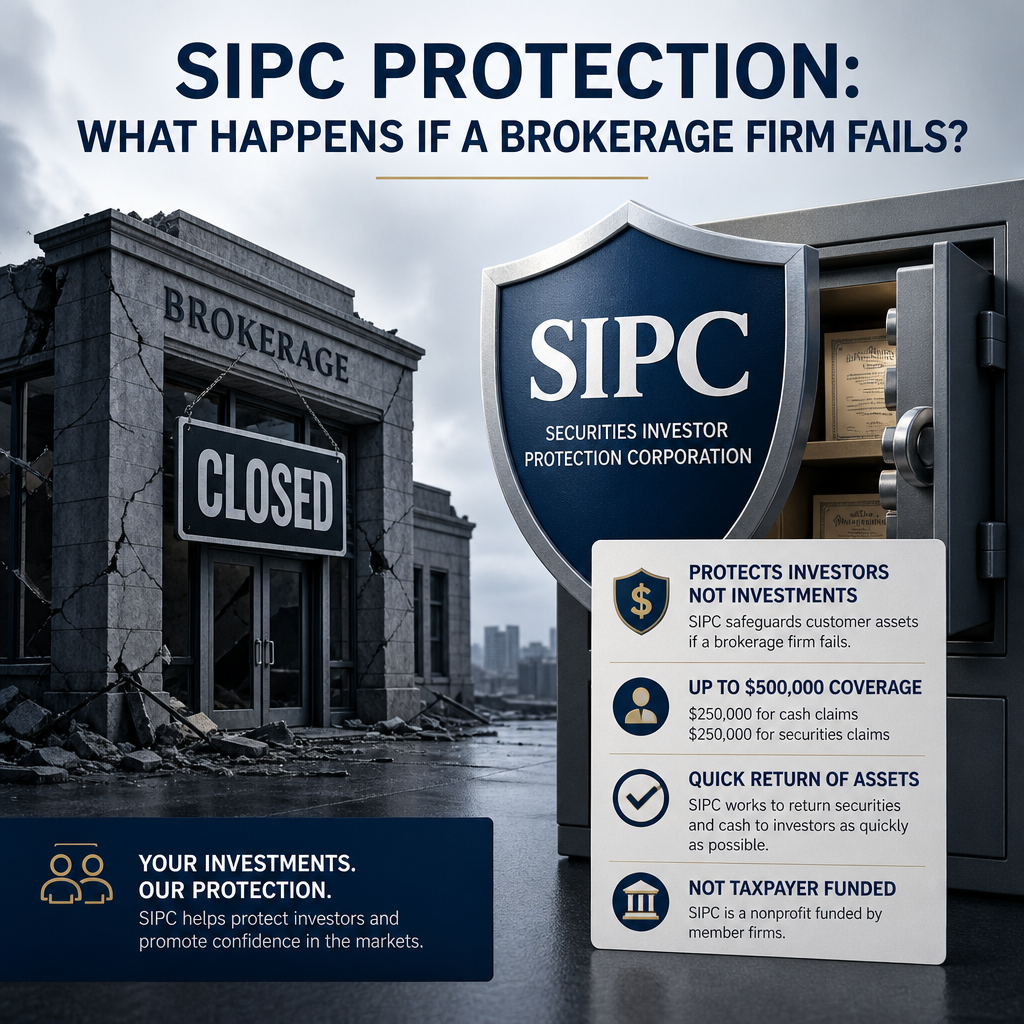
$500,000 per customer
Including up to $250,000 for cash claims
These are important limits, but they are not blanket guarantees on every type of loss. The coverage applies to the return of customer property in a liquidation, not to market value declines.
A simple example
Suppose you have:
$300,000 in stocks
$150,000 in cash
$100,000 in bonds
If your brokerage fails and those assets are missing, SIPC protection may help recover them, subject to the coverage rules and the available customer property in the case.
If your investments fall in value before the brokerage fails, SIPC does not reimburse that market loss.
What SIPC Protection Does Not Cover
This is where many investors get confused. SIPC protection has clear limits, and knowing them can prevent unrealistic expectations.
Not covered by SIPC
SIPC generally does not cover:
Market losses from stock price drops
Inflation risk
Interest rate risk
Currency risk
Poor investment advice
Unsuitable recommendations
Losses from commodities, futures, or forex products in many cases
Unregistered investments, such as some private placements
Theft or fraud by a financial professional if the assets never were in the brokerage system as customer property
Why this matters
If you buy a risky stock and its price falls, that is an investment loss, not a custody failure. SIPC protection is meant to restore what the brokerage should have safeguarded, not to make investors whole for every possible financial loss.
SIPC vs. FDIC: They Are Not the Same
Many people assume SIPC works like FDIC deposit insurance. It does not.
FDIC protects bank deposits
The Federal Deposit Insurance Corporation (FDIC) protects qualifying deposits at banks, such as:
Checking accounts
Savings accounts
Certificates of deposit
SIPC protects brokerage customer assets
SIPC protects brokerage accounts holding securities and cash earmarked for investing.
Key difference
FDIC helps if a bank fails
SIPC helps if a brokerage firm fails
If your money is sitting in a bank sweep account at an insured bank, FDIC coverage may apply there. If it is in your brokerage account as customer property, SIPC may apply if the brokerage collapses. The details depend on how the account is structured and where the cash is held.
What Happens to Your Investments if the Brokerage Fails?
The answer depends on the condition of the brokerage’s records and whether customer assets are available.
If your account records are accurate
If the firm kept clean records and your securities are accounted for, your holdings may simply be transferred to another firm. In many cases, customers regain access relatively quickly.
If assets are missing
If securities or cash are missing, the trustee uses available customer property to satisfy claims. SIPC helps fund the process and may advance limited amounts if needed, subject to the statutory limits.
If you held fully paid securities
If you owned securities outright and the brokerage properly segregated them, those assets may still be recoverable even if the firm failed. The liquidation process is designed to return customer property rather than use it to pay general creditors.
How SIPC Protection Differs From Broker-Backed “Extra” Coverage
Some brokerages advertise additional private insurance or “excess SIPC” coverage. This can create the impression of stronger protection than standard SIPC.
Excess SIPC coverage
Some firms purchase extra insurance through private insurers to cover amounts above SIPC limits. This is not the same as SIPC itself and varies by brokerage.
Important caution
Before relying on excess coverage, read the terms carefully. Private policies often have exclusions, claims procedures, and limits that differ from SIPC rules.
What to check
Is the coverage truly excess SIPC?
What types of assets are covered?
Are there sub-limits for cash?
Are alternative investments excluded?
Who is the insurer?
What Investors Should Do if Their Brokerage Firm Fails
If you learn that your brokerage is failing, take prompt, organized action. A calm response can help you protect your claim.
1. Gather your records
Save:
Account statements
Trade confirmations
Tax documents
Emails from the brokerage
Screenshots of holdings and balances
These documents can help verify what you owned and what you were owed.
2. Watch for official notices
The trustee or liquidation court will usually issue instructions. Pay attention to deadlines, claim forms, and transfer notices.
3. Do not assume the first balance is final
Sometimes a brokerage’s records are incomplete. Review the trustee’s statements carefully and compare them with your own documents.
4. File a claim if instructed
If the records do not match your statements, or if the trustee asks you to submit a claim, do so promptly and accurately.
5. Keep your contact information updated
If assets are transferred, the new brokerage or trustee may need to contact you about your account.
How SIPC Claims Are Evaluated
Claim evaluation usually centers on two questions:
What property did the customer own or entrust to the brokerage?
What property is actually available in the liquidation?
The trustee compares customer records with firm records to determine the amount due. If there is a shortfall, SIPC helps make customer recovery possible within the legal framework.
Documents that can support a claim
Monthly brokerage statements
Confirmations of purchase and sale
Dividend and interest notices
Wire transfer records
IRA or retirement account paperwork
Good recordkeeping matters. The more complete your documentation, the easier it is to resolve discrepancies.
Practical Example: A Brokerage Collapse in Real Life Terms
Imagine you have a brokerage account with:
$200,000 in diversified stocks
$40,000 in a money market fund
$60,000 in cash awaiting reinvestment
Now imagine the brokerage fails.
If the securities and cash are all properly accounted for, the trustee may transfer the account to another firm. If some of the assets are missing, SIPC protection comes into play to help recover customer property, up to the applicable limits.
If the stock market drops before the brokerage failure, SIPC does not cover that decline. But if the brokerage never properly safeguarded your holdings, SIPC is designed to help restore what should have been there.
How to Reduce Risk Before a Brokerage Failure Happens
You cannot control whether a brokerage firm fails, but you can reduce headaches by being prepared.
Smart habits for investors
Keep copies of all statements and confirmations
Review account holdings regularly
Make sure your name and account information are accurate
Understand whether cash is held at the brokerage or swept into a bank deposit program
Know whether your brokerage offers any excess coverage
Diversify assets across institutions if appropriate for your situation
Why preparation helps
If a brokerage failure occurs, records become everything. Investors who keep documents organized usually have an easier time proving their claims and understanding what should be returned.
When to Seek Help
If your brokerage firm fails and your account is complex, it may be worth consulting a qualified financial professional or attorney. This is especially true if you have:
Large cash balances
Retirement accounts
Margin debt
Disputed trades
Missing or inaccurate statements
Alternative investments or unusual account structures
Professional guidance can help you interpret notices, understand your rights, and avoid mistakes during the claims process.
Frequently Asked Questions
1. Does SIPC protect my investments if the stock market crashes?
No. SIPC protection does not cover losses from market declines. If a stock, bond, or mutual fund loses value because the market changes, that is an investment risk, not a brokerage failure.
2. How much coverage does SIPC provide?
SIPC generally covers up to $500,000 per customer, including up to $250,000 for cash claims. These limits apply to customer property in a brokerage liquidation and do not guarantee protection from every type of loss.
3. Is my cash always protected by SIPC?
Not always in the way people assume. Cash in a brokerage account may be covered if it is customer property in a brokerage liquidation, but bank deposits are generally protected by FDIC insurance, not SIPC. The exact protection depends on where the cash is held and how the account is structured.
4. What if my brokerage account has more than $500,000?
SIPC protection has limits, so balances above the coverage cap may not be fully protected in a brokerage failure. Some firms offer excess SIPC coverage through private insurers, but the terms vary and should be reviewed carefully.
5. Do I need to file a claim if my brokerage fails?
Sometimes yes, sometimes no. If the trustee can match your records and transfer your assets directly, you may not need to file a claim. If your balances are disputed or missing, the trustee will usually provide instructions on how to submit a claim.
SIPC protection plays an important role when a brokerage firm fails, but it is not a universal shield for every kind of investment loss. Its purpose is specific: to help return customer property when a brokerage cannot meet its obligations and customer assets are missing or trapped in liquidation. That distinction matters because it shapes what investors can reasonably expect and how they should respond if a firm collapses.
The best way to protect yourself is to understand the basics before a problem happens. Keep thorough records, know where your cash is held, and pay attention to the difference between SIPC protection, FDIC insurance, and private excess coverage. If a failure does occur, act quickly, follow trustee instructions, and compare official notices with your own statements.
For most investors, SIPC is a valuable backstop—not because it eliminates all risk, but because it helps preserve confidence in the brokerage system. Learning how it works now can save time, stress, and confusion later.
Mary S, CFP®, is a Certified Financial Planner with over 12 years of experience in personal finance, retirement planning, and wealth management. She writes educational content that helps readers understand financial concepts and make informed decisions based on reliable information.