2026 Social Security Disability Trial Work Period and Earnings Rules
Anúncios
If you receive disability benefits, the rules around returning to work can feel intimidating. The good news is that Social Security does not expect you to guess. The 2026 Social Security Disability Trial Work Period and Earnings Rules give people receiving Social Security Disability Insurance (SSDI) a structured way to test their ability to work without immediately losing benefits.
Understanding these rules matters whether you are considering a part-time job, a remote role, freelance work, or a gradual return to the workforce. The key is knowing how the trial work period works, what counts as work, how earnings are measured, and what happens after the trial period ends.
Anúncios
What the Trial Work Period Means in 2026
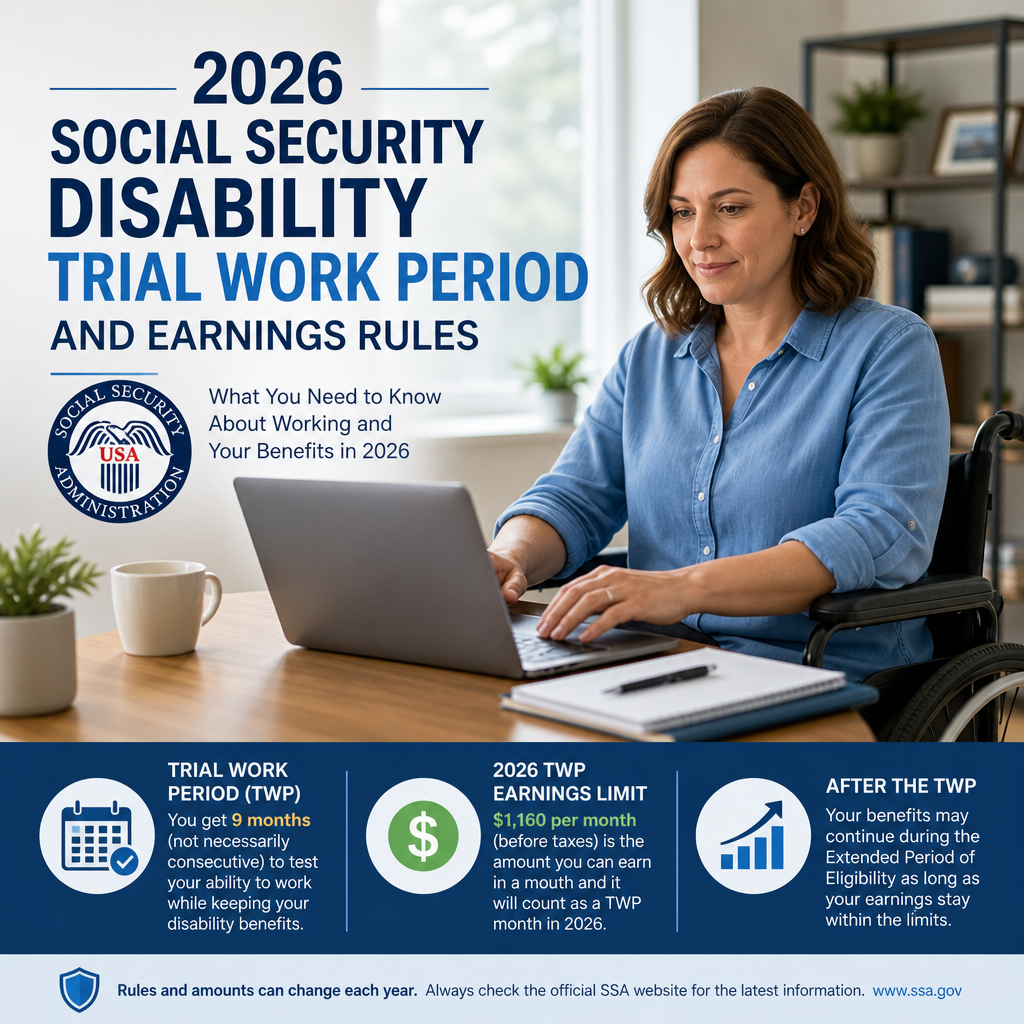
The trial work period is a Social Security program designed to help SSDI beneficiaries try working while still protecting their disability benefits. It is not the same as a permanent return to work. Instead, it gives you a chance to see whether you can sustain employment.
During the trial work period, you can work and earn money without losing your SSDI checks, as long as you follow Social Security rules. This period is especially important because many people with disabilities want to re-enter the workforce but need time to see whether they can manage their health, schedule, and job duties.
Anúncios
Who qualifies for the trial work period?
The trial work period generally applies to people who receive:
- SSDI benefits
- Disabled widow(er)’s benefits
- Certain disabled adult child benefits
It does not usually apply to SSI in the same way. Supplemental Security Income has different income and resource rules, so it is important to know which program you receive before assuming the rules are identical.
The 2026 Earnings Threshold for Trial Work Months
A core part of the 2026 Social Security Disability Trial Work Period and Earnings Rules is the monthly earnings threshold. In 2026, a month counts as a trial work month if your earnings are above the Social Security limit for that year.
Because Social Security adjusts this amount annually, the exact threshold can change. For 2026, you should confirm the current monthly amount directly with Social Security before working or reporting income. The threshold is what determines whether a month counts toward your nine trial work months.
What counts as a trial work month?
A month counts as a trial work month when you earn above the annual threshold, even if:
- You work only part of the month
- Your health condition causes you to miss shifts
- You work fewer hours but receive higher pay
- You are self-employed and your earnings exceed the threshold
Once you use nine trial work months within a rolling 60-month period, you move out of the trial work period phase and into the next stage of return-to-work rules.
How the Trial Work Period Works
The trial work period is not a lifetime benefit. It is a defined testing window that gives you flexibility without immediate risk to your SSDI checks.
The nine-month structure
You receive nine trial work months. These months do not have to be consecutive. They are counted within a 60-month rolling period.
For example:
- You work in January, February, and March.
- You stop working for several months because of your medical condition.
- You return to work later in the year.
- Each month you earn above the trial work threshold counts as one trial work month.
This structure helps people who have fluctuating conditions, such as autoimmune disorders, chronic pain, mental health conditions, or recovery after surgery.
What happens during the trial work period?
During the trial work period:
- You continue receiving SSDI benefits
- Social Security may review your work activity
- You must report earnings accurately
- You can test your ability to keep working
Even though your checks usually continue, that does not mean your reporting obligations disappear. Failing to report work can create overpayments and cause problems later.
Earnings Rules You Need to Watch in 2026
The 2026 Social Security Disability Trial Work Period and Earnings Rules involve more than just the monthly threshold. You also need to understand how Social Security looks at work activity and earnings in practical terms.
Wages from a job
If you are an employee, Social Security generally looks at your gross wages before taxes and deductions. That means the amount you earn on your paycheck may be different from the amount used for trial work month counting.
Examples of income that may count include:
- Hourly wages
- Salary
- Bonuses
- Commissions
- Paid vacation or sick leave
Self-employment income
If you are self-employed, Social Security does not rely only on gross receipts. It may consider your net earnings and the level of work you perform.
Factors can include:
- Hours worked
- Business expenses
- Net profit
- Whether you are doing significant services for the business
Self-employment can be more complicated than wage work, so careful recordkeeping is essential.
Special rules for subsidies and special conditions
Sometimes an employer provides help that makes your work possible, such as:
- Extra supervision
- Modified duties
- Flexible scheduling
- Reduced productivity expectations
In these cases, Social Security may treat part of your pay differently when determining countable earnings. This is one reason to keep written documentation from your employer.
Trial Work Period vs. Extended Period of Eligibility
A common source of confusion is the difference between the trial work period and the extended period of eligibility.
Trial work period
This is the initial nine-month window that allows you to test work without losing SSDI benefits.
Extended period of eligibility
After the trial work period ends, Social Security gives you a continued safety net. During this phase, your benefits may stop in months when your earnings rise above the substantial gainful activity level, and may restart in months when your earnings fall below it.
This means the return-to-work process is not an all-or-nothing event. Instead, Social Security uses a step-by-step system.
What Happens After the Trial Work Period Ends?
Once you complete all nine trial work months, Social Security moves into a new stage. This is where earnings become more important.
If your earnings remain above the substantial gainful activity threshold after the trial work period, your SSDI cash benefits may stop after the extended period of eligibility rules are applied.
Why substantial gainful activity matters
Substantial gainful activity, or SGA, is Social Security’s way of measuring whether work shows the ability to engage in meaningful employment. The threshold is adjusted each year and is different for blind and non-blind beneficiaries.
If your earnings exceed the applicable SGA level after the trial work period, Social Security may decide you are no longer disabled under its rules for monthly cash benefits.
Possible benefit continuation protections
Even if benefits stop, you may still have some protections, such as:
- Medicare continuation for a period of time
- Expedited reinstatement rights if your condition worsens
- Ability to request review if your situation changes
These protections make it important to understand the broader return-to-work framework, not just the trial work period itself.

Practical Examples of How the Rules Work
Real-life situations often make these rules easier to understand.
Example 1: Part-time retail job
A person receiving SSDI begins working 12 hours a week at a retail store. Each month their gross wages exceed the 2026 trial work threshold.
In this case:
- Each qualifying month counts toward the nine-month trial work period
- SSDI benefits continue during those months
- The person must report earnings to Social Security
Example 2: Freelance graphic designer
A self-employed beneficiary takes on several design projects throughout the year. Some months are slow, while others bring in more income.
In this case:
- Social Security may review net earnings and work activity
- Recordkeeping matters more than ever
- Not every month automatically counts the same way as a wage job
Example 3: Employer with accommodations
A worker returns to a clerical job with reduced responsibilities and extra time to complete tasks. Their employer pays full wages, but the accommodations make the job possible.
In this case:
- Subsidy or special condition rules may affect countable earnings
- Documentation from the employer can help Social Security evaluate the work correctly
Reporting Requirements and Recordkeeping
One of the most important parts of the 2026 Social Security Disability Trial Work Period and Earnings Rules is accurate reporting.
What you should report
You should report:
- When you start or stop working
- Your monthly earnings
- Changes in self-employment
- Changes in job duties or accommodations
- Work-related expenses that may be relevant
Good records to keep
Keep copies of:
- Pay stubs
- Tax returns
- Timesheets
- Employer letters
- Business records
- Receipts for impairment-related work expenses
If Social Security ever asks for proof, these documents can help you show exactly what happened.
Work Incentives That May Help
Social Security offers work incentives that may make returning to work less stressful.
Impairment-related work expenses
Certain disability-related expenses needed to work may be considered when Social Security reviews earnings. Examples may include:
- Specialized transportation
- Assistive technology
- Medical devices needed for employment
Ticket to Work
The Ticket to Work program helps eligible beneficiaries connect with employment services, training, and support.
Expedited reinstatement
If your benefits end because of work but your condition later worsens, you may be able to ask for expedited reinstatement instead of filing a brand-new application.
These programs can be helpful for anyone trying to build a realistic path back to work.
Common Mistakes to Avoid
Many people run into trouble not because they intended to break the rules, but because they misunderstood them.
Mistake 1: Assuming net pay is always the number that matters
For employees, Social Security usually looks at gross wages, not take-home pay.
Mistake 2: Forgetting that self-employment is treated differently
Self-employment earnings are evaluated through different rules, so do not assume they work like a regular paycheck.
Mistake 3: Not reporting income changes
Even if you think your earnings are low, you still need to report work activity accurately.
Mistake 4: Forgetting that months do not have to be consecutive
A trial work month can be counted even if it happens after a long break from work.
Mistake 5: Not keeping documentation
Without records, it can be difficult to prove what you earned or what accommodations you received.
How to Prepare Before You Start Working
Before accepting a job or increasing your hours, take a few practical steps:
- Confirm whether you receive SSDI, SSI, or both.
- Check the current 2026 trial work month threshold with Social Security.
- Estimate your likely monthly earnings.
- Ask your employer for a written description of accommodations if applicable.
- Set up a system to track pay stubs and work dates.
- Report work promptly to avoid overpayment issues.
A little planning can prevent a lot of stress later.
Frequently Asked Questions
1. Do trial work months have to be consecutive?
No. Trial work months do not need to happen one after another. Social Security counts them within a 60-month rolling period. If you work above the threshold in January, stop working for several months, and then return to work later, the new qualifying months still count as long as you have not used all nine trial work months.
2. Will I lose SSDI as soon as I earn above the trial work threshold?
No. Earning above the trial work threshold does not automatically stop your SSDI benefits during the trial work period. It simply means that month counts as one of your nine trial work months. Benefits usually continue during this phase, but you must report earnings correctly.
3. Does the trial work period apply to SSI?
Not in the same way. SSI has its own income and resource rules, and work affects SSI benefits differently. Some people receive both SSDI and SSI, which makes their situation more complex. If you receive SSI, it is important to review the rules for that program separately.
4. What if I am self-employed?
Self-employment can still count as work for Social Security purposes. The agency may look at net earnings and the amount of work you perform rather than just gross income. Keep detailed business records, including invoices, expenses, mileage, and hours worked, so you can accurately report your activity.
5. What happens after I finish nine trial work months?
After you use all nine trial work months, Social Security moves you into the next stage of return-to-work review. At that point, your earnings may affect whether your monthly SSDI benefits continue, depending on whether you are above or below the substantial gainful activity level. Other protections may still apply, including possible benefit reinstatement options.
Official Resources
- Social Security Administration: Working While Disabled
- Social Security Administration: Red Book
- Social Security Administration: Trial Work Period
- Social Security Administration: Ticket to Work Program
- National Council on Disability: Social Security Disability Employment Resources
Conclusion
The 2026 Social Security Disability Trial Work Period and Earnings Rules are designed to give SSDI beneficiaries a real chance to test working without losing benefits immediately. That flexibility can make a major difference if you want to return to the workforce but need time to understand how your health condition affects your ability to keep a job.
The most important takeaway is that the trial work period is only one part of the larger system. You also need to understand how Social Security counts monthly earnings, how self-employment is treated, when reporting is required, and what happens after the nine trial work months are used. Careful recordkeeping and timely reporting can protect you from overpayments and confusion.
If you are thinking about working in 2026, take a few minutes to review your benefits status, check the current earnings threshold, and document your income from the start. With the right information, you can make confident decisions and move forward with more peace of mind.