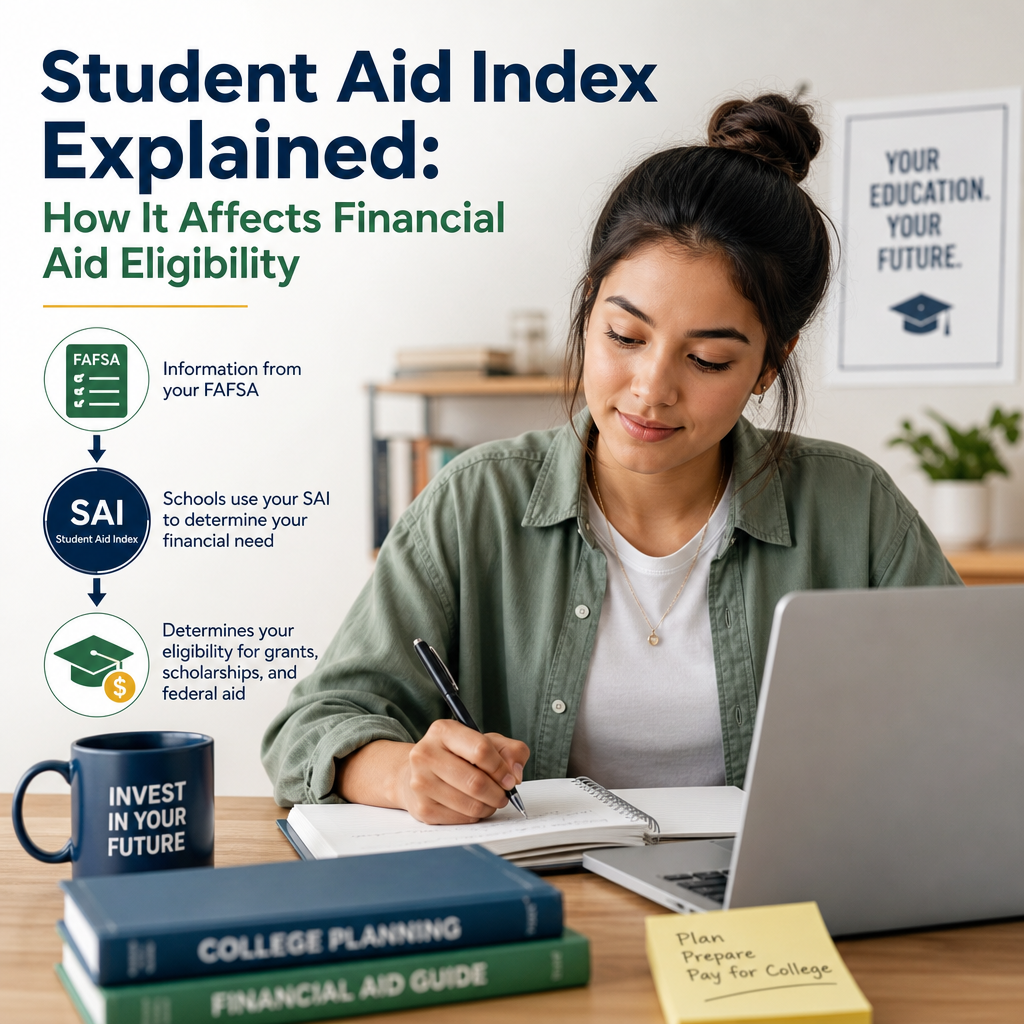
Student Aid Index Explained: How It Affects Financial Aid Eligibility
The Student Aid Index is a key number on the FAFSA that helps colleges determine how much need-based aid you may qualify for. Understanding how it works can make it easier to compare financial aid offers and plan for college costs with confidence.
By: Jennifer Collins on August 1, 2026
Anúncios
If you’re applying for college aid, understanding the Student Aid Index can make the financial aid process much less confusing. This number plays a major role in determining how much need-based aid you may qualify for, including federal grants, work-study, and some state or institutional aid. Replacing the old Expected Family Contribution system, the Student Aid Index is now a key part of the FAFSA process and the broader conversation around financial aid eligibility.
For students and families trying to plan for college costs, knowing how this number works can help you interpret award letters, compare schools, and prepare more effectively for the FAFSA. In this guide, we’ll break down what the Student Aid Index is, how it is calculated, and how it affects the aid you may receive.
Anúncios
What Is the Student Aid Index?
The Student Aid Index (SAI) is the number used by colleges and the federal government to estimate a student’s financial need. It appears on the FAFSA and helps determine eligibility for need-based financial aid.
In simple terms, the SAI helps answer this question:
Anúncios
How much can the student and family reasonably contribute toward college costs?
A lower SAI generally signals greater financial need. A higher SAI usually means a student may qualify for less need-based aid. However, the SAI is not the amount you must pay for college, and it is not a bill. It is an aid-calculation figure used to assess eligibility.
Why the SAI replaced the EFC
The Student Aid Index replaced the Expected Family Contribution (EFC) beginning with the redesigned FAFSA process. The old term often caused confusion because families assumed it represented exactly what they would owe. The new name is intended to be clearer: the SAI is an index used to measure aid eligibility, not a direct payment amount.
How the Student Aid Index Affects Financial Aid Eligibility
The Student Aid Index is one of the main factors colleges use to determine how much need-based aid you may receive. Once your FAFSA is processed, schools compare your SAI to their cost of attendance.
The basic formula colleges use
A simplified version looks like this:
Cost of Attendance – Student Aid Index = Financial Need
The higher the difference, the more need-based aid you may be eligible for.
Example
If a college’s annual cost of attendance is $30,000 and your Student Aid Index is 8,000, your financial need is roughly $22,000.
That does not mean the school will automatically cover the full amount. It only indicates the level of need the school may use when building a financial aid package.
Aid programs affected by the SAI
Your Student Aid Index can influence eligibility for:
Federal Pell Grants
Federal Supplemental Educational Opportunity Grants (FSEOG)
Federal Work-Study
Some state grants
Some institutional grants and scholarships
Certain need-based loans
Not every aid program uses the SAI the same way. Merit scholarships, athletic scholarships, and many private scholarships are based on different criteria. But for need-based aid, the SAI is a central piece of the puzzle.
How the Student Aid Index Is Calculated
The Student Aid Index is based on information submitted through the FAFSA. Several financial and household factors may be considered, depending on the student’s dependency status.
Information that may be used
The calculation can include:
Income from tax returns
Assets such as cash, savings, and investments
Household size
Number of family members in college
Untaxed income in some cases
Student and parent demographic and household information
What the SAI does not measure
The SAI is not designed to reflect every expense a family may face. It does not always account for:
High medical bills
Credit card debt
Mortgage payments
Private school tuition for siblings
Cost of living differences
Emergency expenses
Because of this, some families feel their Student Aid Index does not fully reflect their real financial situation. That’s one reason colleges offer a professional judgment process in certain situations.
SAI for Dependent vs. Independent Students
Your Student Aid Index is not calculated the same way for every applicant. Dependency status on the FAFSA matters a lot.
Dependent students
Most students under age 24 are considered dependent unless they meet specific criteria. For dependent students, the FAFSA looks at both student and parent financial information.
This means:
Parent income may affect the SAI significantly
Parent assets may also count
Household size and number in college can reduce the SAI impact in some cases
Independent students
Independent students usually report their own financial information and, in most cases, do not include parent data.
This means the SAI may be based primarily on:
Student income
Student assets
Household size
Spouse information, if applicable
Independent status can change the outcome dramatically, but it is only granted under specific FAFSA rules.
What a Low or High Student Aid Index Means
Understanding the number itself is only part of the story. You also need to know what it means in practice.
A lower SAI
A lower Student Aid Index usually indicates greater need. That may increase the chance of receiving:
Pell Grants
Need-based institutional grants
Work-study
Need-based state assistance
A higher SAI
A higher SAI often means less demonstrated need. That may reduce eligibility for need-based aid, but it does not eliminate other opportunities such as:
Merit scholarships
Academic awards
Private scholarships
Unsubsidized federal student loans
Parent PLUS Loans, if applicable
A high SAI does not automatically mean no aid. It simply means need-based aid may be more limited.
How Families Can Prepare for the FAFSA
Being prepared can make the FAFSA process smoother and may help you avoid delays that could affect aid awards.
Gather documents early
Before filing, collect:
Federal tax returns
W-2s and other income records
Bank statements
Records of untaxed income, if applicable
Net worth information for investments and business assets
Student and parent Social Security numbers and FSA IDs
Know which year’s tax information to use
The FAFSA uses prior-prior year tax data, which means the form typically relies on tax information from two years before the school year you’re applying for. This helps make the process more manageable because families usually have completed tax returns by then.
File as soon as possible
Some aid is awarded on a first-come, first-served basis. Even if your financial situation seems straightforward, early submission can improve your chances of getting the best possible aid package.
Check every school’s deadlines
Colleges, states, and scholarship programs may have different FAFSA deadlines. Missing one can reduce your eligibility, even if your Student Aid Index is favorable.
Common Mistakes That Can Affect Financial Aid Eligibility
Small errors on the FAFSA can lead to an incorrect Student Aid Index or delay your aid package.
Avoid these issues
Entering income figures incorrectly
Forgetting to report assets that should be included
Mixing up dependent and independent student rules
Missing FAFSA deadlines
Not updating school lists if you’re applying to multiple colleges
Ignoring requests for verification from financial aid offices
Why verification matters
Some students are selected for FAFSA verification. This is a routine process where schools ask for extra documentation to confirm the information on the FAFSA. If you do not respond promptly, your aid could be delayed or reduced.
Can You Appeal Your Student Aid Index?
Yes, in some situations you can ask for a review if your financial circumstances are not accurately reflected on the FAFSA.
When an appeal may make sense
You may want to contact a financial aid office if your family has experienced:
Job loss or reduced income
Divorce or separation
Death of a parent or spouse
Major medical expenses
Natural disaster losses
Other significant changes not reflected in tax data
What colleges can do
A financial aid office may use professional judgment to adjust information based on documented circumstances. This can sometimes lead to a revised aid package.
Important note: Appeals are not guaranteed, and each school has its own policies. Still, if your financial situation changed, it is worth asking.
Student Aid Index and Award Letters
Once colleges process your FAFSA, they use your Student Aid Index to help build your financial aid offer. Understanding how to read that offer is just as important as knowing your SAI.
What to look for in an award letter
Check whether the offer includes:
Grants
Scholarships
Federal work-study
Federal loans
Parent loans
Total cost of attendance
Remaining balance after aid
Compare net price, not just total aid
A school may advertise a generous aid package, but the real question is how much your family will actually need to pay. Look at the net price after grants and scholarships, not just the total aid amount.
Two schools with the same Student Aid Index can offer very different results depending on their tuition, policies, and available funding.
Practical Tips for Students and Families
A better understanding of the Student Aid Index can help you make smarter college decisions.
Helpful steps to take
Use each school’s net price calculator before applying
Submit the FAFSA early
Review all figures carefully before filing
Keep copies of tax and income records
Contact the financial aid office if your situation changes
Apply for outside scholarships to reduce borrowing
Example scenario
A student with a moderate SAI applies to three colleges:
School A has a high sticker price but strong institutional grants
School B has lower tuition but fewer grants
School C offers a large merit scholarship unrelated to need
Even with the same Student Aid Index, the final cost may differ a lot. That’s why comparing aid packages matters as much as understanding the SAI itself.
Frequently Asked Questions
1. Is the Student Aid Index the same as what my family has to pay?
No. The Student Aid Index is not a bill or a required payment amount. It is an index used to determine financial aid eligibility, especially for need-based aid. A lower SAI usually means more financial need, but it does not guarantee a specific out-of-pocket cost.
2. Does a higher Student Aid Index mean I will not get any aid?
Not necessarily. A higher SAI may reduce eligibility for need-based grants, but you may still qualify for merit scholarships, unsubsidized federal loans, private scholarships, or other forms of aid. Your final offer depends on the school and the programs you qualify for.
3. Can my Student Aid Index change from year to year?
Yes. Your SAI can change each year you submit the FAFSA. If your family’s income, assets, household size, or number of students in college changes, your SAI may also change. That is why many families file the FAFSA every year.
4. What if my FAFSA information does not reflect my current situation?
If you have had a major financial change, contact the financial aid office at your school. They may be able to review your case and, in some circumstances, adjust your aid eligibility using professional judgment. Be prepared to provide documentation.
5. Does the Student Aid Index affect merit scholarships?
Usually no. Merit scholarships are typically based on academic performance, talent, leadership, or other achievements rather than financial need. However, some schools may use FAFSA data for specific scholarship programs, so it is still important to review each scholarship’s requirements.
The Student Aid Index is one of the most important numbers in the financial aid process, but it does not have to be intimidating. At its core, the SAI helps schools estimate your financial need and decide how much need-based aid you may qualify for. Once you understand how it works, you can approach the FAFSA with more confidence, compare college offers more effectively, and spot opportunities to reduce the cost of attendance.
Remember that your SAI is only one part of the bigger picture. College affordability also depends on the school’s cost, available grants and scholarships, deadlines, and whether you qualify for special circumstances review. Filing the FAFSA accurately and on time remains one of the best ways to protect your financial aid options.
If you are planning for college, take the time to review your numbers, gather your documents, and understand each aid offer carefully. A little preparation can make a meaningful difference in how much you pay for school and how much support you receive.
Jennifer, M.Ed., holds a degree in Higher Education Administration, with
a focus on U.S. college financial aid, admissions policy, and student
support systems. She researches and writes about scholarships, federal
aid programs, and the college planning process to help students and
families make informed, well-supported decisions.