NASA Prepares Roman Space Telescope to Study the Universe
NASA is getting the Roman Space Telescope ready to explore the universe with a powerful mix of wide-field views and pinpoint detail. This next-generation observatory could help scientists unlock big questions about dark energy, exoplanets, galaxies, and how the cosmos has changed over time.
By: Peter on August 1, 2026
Anúncios
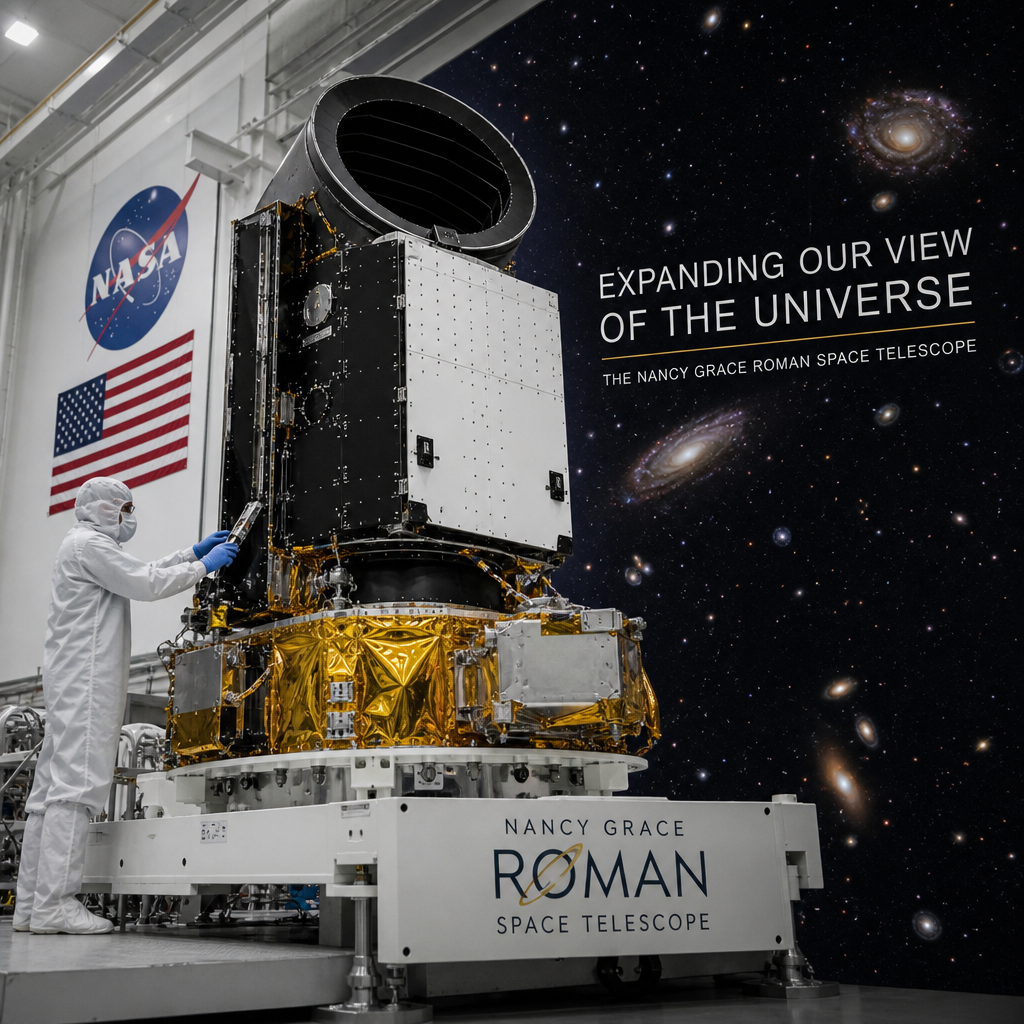
NASA is preparing the Roman Space Telescope to open a new window on the cosmos, and the mission is generating excitement for good reason. Designed to observe the universe on a massive scale while still capturing sharp detail, Roman will help scientists study dark energy, exoplanets, galaxies, and cosmic structure in ways that were difficult or impossible before. As the mission moves closer to launch, it represents one of NASA’s most ambitious efforts to answer some of astronomy’s biggest questions.
Anúncios
What makes the Roman Space Telescope especially compelling is its blend of wide-field imaging and precision measurements. Instead of focusing on a tiny patch of sky, Roman will survey large regions quickly, giving researchers a broader view of how the universe has evolved. That scale matters because many of the most important cosmic patterns only become visible when you can see the big picture.
What Is the Roman Space Telescope?
The Roman Space Telescope, formally known as the Nancy Grace Roman Space Telescope, is a next-generation space observatory named after NASA’s first Chief Astronomer. It is being built to study the universe in infrared light, which allows it to peer through dust and observe objects that are faint, distant, or otherwise difficult to detect.
Roman’s main scientific goals include:
Anúncios
Investigating dark energy and the expansion of the universe
Searching for and studying exoplanets
Mapping large cosmic structures
Observing distant galaxies and black holes
Supporting a wide range of general astrophysics research
In practical terms, Roman will give astronomers a powerful new tool for answering foundational questions about how the universe works.
Why the Roman Space Telescope Matters
Astronomy has always advanced when scientists gained access to better instruments. The Hubble Space Telescope transformed our understanding of deep space. The James Webb Space Telescope opened a new era of infrared observation. The Roman Space Telescope is expected to add a different kind of capability: breadth.
A wider cosmic view
Roman’s wide field of view will allow it to survey enormous areas of sky much faster than many other observatories. That means researchers can gather more data on galaxies, stars, and gravitational lensing events across a much larger portion of the universe.
Precision at scale
A telescope can be powerful, but it becomes especially valuable when it can collect precise data over a broad area. Roman’s design supports both. That combination will help scientists study subtle cosmic effects, including how matter is distributed across space and how dark energy may influence the universe’s expansion.
A mission built for discovery
Many telescopes are designed for a narrow set of targets. Roman is different. NASA built flexibility into the mission so it can support planned surveys while also uncovering unexpected phenomena. That kind of discovery potential is one reason the astronomy community is watching closely.
How NASA Is Preparing the Roman Space Telescope
Preparing a major space observatory involves years of engineering, testing, integration, and calibration. NASA and its partners are steadily moving Roman toward readiness by assembling and validating the telescope’s major systems.
Completing the observatory’s key components
The mission includes several critical pieces:
The telescope assembly
Science instruments
Thermal control systems
Flight software and electronics
The large solar array and support structures
Each component must function reliably in space, where repairs are far more difficult than they are on Earth. That is why testing is so extensive.
Testing for space conditions
Before launch, the Roman Space Telescope must survive conditions that include:
Extreme temperature changes
Vibrations during launch
Vacuum conditions in space
Long-duration operation with minimal maintenance
Engineers use environmental testing to make sure the telescope can perform as expected once deployed. This process helps reduce risk and increases confidence in the mission’s long-term success.
Calibrating the instruments
Scientific instruments must be carefully calibrated so the data they collect is accurate. For Roman, this includes tuning the detectors and verifying the telescope’s imaging performance. Calibration is essential because small measurement errors can affect large-scale studies of the universe.
The Science Goals of the Roman Space Telescope
The Roman Space Telescope is not a one-purpose observatory. It is designed to support multiple scientific investigations, each with its own value to astronomy.
Dark energy and the expansion of the universe
One of Roman’s most important goals is to study dark energy, the mysterious force driving the accelerated expansion of the universe. Scientists still do not fully understand what dark energy is, but Roman’s surveys should provide new clues.
It will do this by observing:
Distant supernovae
The clustering of galaxies
Weak gravitational lensing
Large-scale cosmic patterns
These measurements can help astronomers compare how the universe has expanded over time and test competing ideas about its behavior.
Exoplanet research through microlensing
Roman is also expected to help discover thousands of exoplanets using a technique called gravitational microlensing. This method looks for the slight brightening of a background star when a planet passes in front of it and bends the light through gravity.
This approach is especially useful for finding planets that may be:
Far from their host stars
Similar to Earth in mass
Located in regions of the Milky Way that are hard to study with other methods
By expanding exoplanet surveys, Roman may reveal how common different types of planets are across the galaxy.
Mapping galaxies and cosmic structure
Galaxies do not exist in isolation. They form clusters, filaments, and vast interconnected structures shaped by gravity over billions of years. Roman’s wide-field surveys will help scientists examine these structures in greater detail.
That research matters because it can show how matter has evolved and how the universe built its large-scale framework.
What Makes the Roman Space Telescope Different from Other Missions?
The astronomy world already has several powerful observatories, so it is fair to ask what makes Roman stand out.
A combination of wide-field imaging and infrared vision
Roman’s field of view is much larger than many space telescopes, yet it still delivers highly detailed infrared images. That balance gives it a unique role in the scientific ecosystem.
Designed for surveys, not just snapshots
Some telescopes excel at studying individual objects in great detail. Roman is built to conduct large surveys efficiently. That makes it ideal for identifying patterns, trends, and rare objects that only appear when enough sky is observed.
Complements existing observatories
Roman will work alongside missions like Hubble, Webb, and large ground-based telescopes. Rather than replacing them, it will complement their strengths. Scientists may use Roman to identify interesting targets and then turn to other observatories for deeper follow-up observations.
Real-World Examples of Roman’s Potential
To understand the mission’s impact, it helps to imagine how astronomers might use it.
Example 1: Finding hidden planets
A microlensing survey could reveal a planet that orbiting a distant star far beyond the frost line. Such a planet might be invisible to transit surveys or radial velocity studies, but Roman could still detect its presence through gravity’s effect on starlight.
Example 2: Studying distant galaxies in context
Instead of looking at a single galaxy in isolation, Roman can map thousands or millions of them across a large region of sky. That helps researchers see how galaxies are distributed and how they have changed over cosmic time.
Example 3: Measuring cosmic expansion
By collecting a large sample of observations, Roman can help scientists refine models of the universe’s expansion history. This is especially important for understanding whether current theories fully explain what astronomers observe.
Why This Mission Is Important for the Future of Astronomy
The Roman Space Telescope is more than another telescope launch. It represents a shift in how scientists study the universe. Astronomers are moving toward more comprehensive surveys, larger data sets, and tools that can explore broad questions with precision.
That shift has several benefits:
It expands discovery potential.
Bigger surveys can reveal rare objects and unexpected phenomena.
It strengthens scientific confidence.
More data across wider regions helps researchers test theories more rigorously.
It builds connections across disciplines.
Roman’s data will support cosmology, planetary science, and galactic astronomy.
It creates a legacy for future research.
Missions like this produce archives that scientists can study for years after the initial observations.
In other words, Roman is not just about answering today’s questions. It is also about creating the foundation for tomorrow’s discoveries.
How the Public Can Follow the Mission
One of the best things about major NASA missions is that the public can follow along as the story unfolds. NASA regularly shares updates on telescope milestones, engineering progress, and science planning.
If you want to track the mission, look for:
Official NASA mission updates
Science and engineering briefings
Images and renderings of the observatory
Public talks from astronomers and mission scientists
Following the mission can be a great way to see how space science moves from concept to reality.
Frequently Asked Questions
What is the Roman Space Telescope designed to study?
The Roman Space Telescope is designed to study dark energy, exoplanets, galaxies, and large-scale cosmic structure. It will observe the universe in infrared light and conduct wide-field surveys that help scientists answer major questions about how the cosmos evolved.
Why is the Roman Space Telescope important?
Roman is important because it combines a wide field of view with high precision. That makes it ideal for studying the universe at scale, detecting subtle cosmic effects, and discovering objects that may be missed by narrower telescopes.
How is Roman different from the James Webb Space Telescope?
James Webb is optimized for detailed infrared observations of specific targets, while Roman is built for wide-field surveys. Webb can look deeply at individual objects, and Roman can map much larger portions of the sky efficiently. The two missions are complementary.
Will Roman help find Earth-like planets?
Roman may help identify some planets with masses similar to Earth, but its main exoplanet method is gravitational microlensing. That technique is especially useful for finding planets that are difficult to detect by other methods, including planets far from their stars.
When will the Roman Space Telescope launch?
NASA’s mission timeline can change as testing and integration continue, so the best source for launch planning is NASA’s official mission page. NASA provides the latest status updates as the observatory moves toward readiness.
The Roman Space Telescope is shaping up to be a major milestone in astronomy. By combining wide-field imaging, infrared observation, and precise measurements, it will let scientists study the universe on a scale that matches the size of the questions they are asking. From dark energy and cosmic expansion to exoplanets and galaxy evolution, Roman is built to explore both the structure of the universe and the surprises hidden within it.
As NASA continues preparing the observatory, the mission stands as a reminder that progress in space science depends on patience, engineering, and curiosity. Roman will not replace other great observatories; it will expand what they can do by adding broad, detailed surveys to the astronomical toolkit. For anyone interested in the future of space exploration and discovery, this is a mission worth following closely. The next major chapter in our understanding of the universe may begin with Roman, and the view it provides could change astronomy for decades to come.
Peter B holds a degree in Journalism and has 5 years of experience covering U.S. economic policy, labor markets, and financial news. He writes data-driven news content on topics like inflation, interest rates, and employment trends.