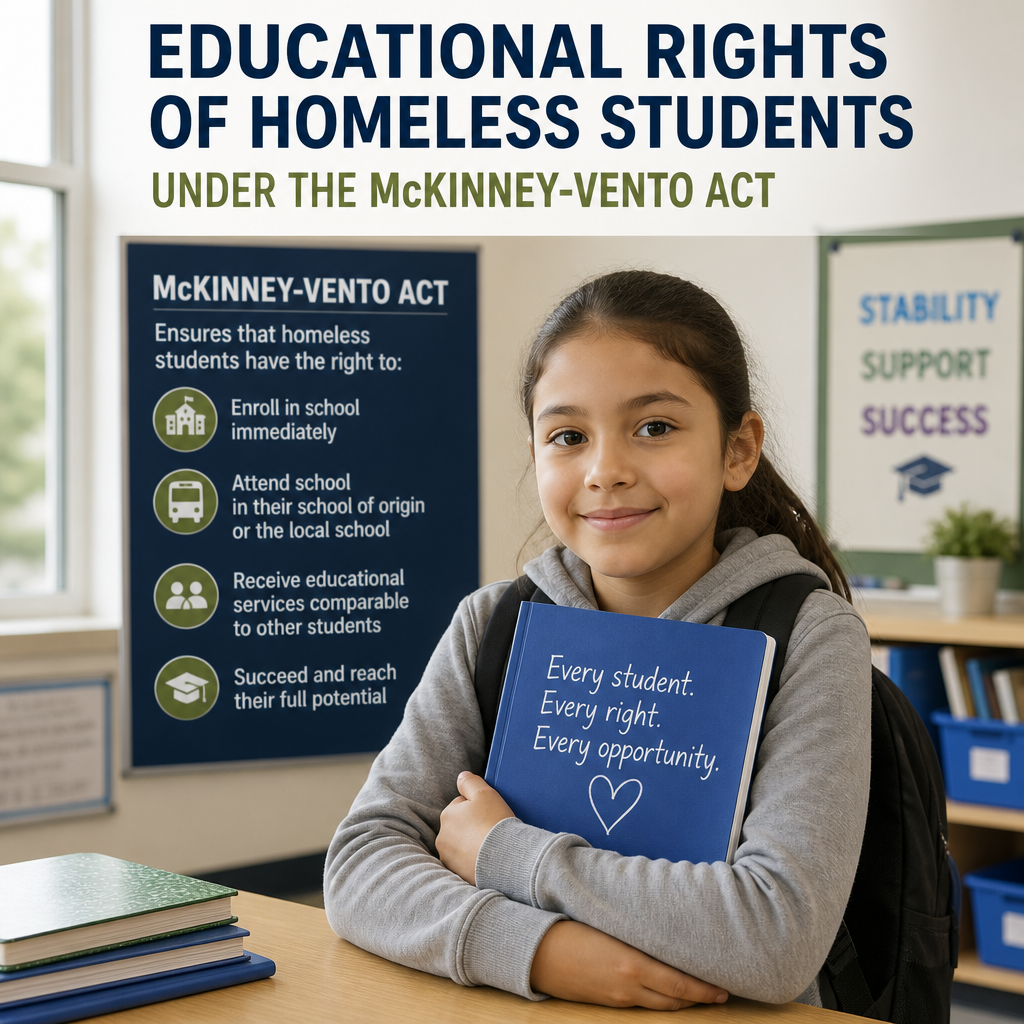
Educational Rights of Homeless Students Under the McKinney-Vento Act
The McKinney-Vento Act helps homeless students stay enrolled, access transportation, and remain connected to the school and support systems they depend on. If your family is facing housing instability, understanding these rights can make it easier to protect your child’s education.
By: Jennifer Collins on August 1, 2026
Anúncios
Homelessness can disrupt every part of a child’s life, but it should not interrupt their education. The educational rights of homeless students under the McKinney-Vento Act were created to help children and youth stay in school, remain connected to their support systems, and continue learning even when housing is unstable. For families experiencing shelter living, motel stays, doubled-up arrangements, or other forms of housing loss, this federal law can make a real difference.
Understanding these rights matters for parents, caregivers, school staff, and advocates. The law gives homeless students access to enrollment, transportation, and support services that reduce barriers to school success. Just as important, it protects students from being turned away, delayed, or placed in a less appropriate school simply because of where they are living.
Anúncios
What the McKinney-Vento Act Does
The McKinney-Vento Homeless Assistance Act is a federal law designed to support people experiencing homelessness, including children and youth in public schools. Its education subtitle sets out specific protections so students can remain enrolled and succeed academically even during unstable housing situations.
At its core, the law aims to:
Anúncios
Remove barriers to school enrollment and attendance
Keep students in their school of origin when it is in their best interest
Provide transportation when needed
Ensure access to school meals, special education, and extracurricular activities
Assign a school liaison to help families navigate the process
The educational rights of homeless students under the McKinney-Vento Act are not limited to students in shelters. They also apply to children and youth who are living in cars, motels, campgrounds, abandoned buildings, or temporarily doubled up with others due to economic hardship or loss of housing.
Who Is Covered Under the Law?
A student may qualify for McKinney-Vento protections if they lack a fixed, regular, and adequate nighttime residence. That definition is broader than many people realize.
Common living situations that may qualify
Students may be covered if they are:
Living in a shelter or transitional housing
Staying in a motel or hotel because there is nowhere else to go
Sharing housing with another family due to loss of housing, financial hardship, or similar reasons
Living in a car, bus station, park, campground, or similar public place
Sleeping in an abandoned building or other inadequate housing
Migratory children living in similar unstable conditions
Unaccompanied youth who are homeless and not in the physical custody of a parent or guardian
Eligibility is based on living circumstances, not paperwork or a formal homelessness label. Schools should not require a parent to “prove” homelessness in a way that creates delays or prevents a child from attending class.
Key Educational Rights Under McKinney-Vento
The educational rights of homeless students under the McKinney-Vento Act are broad, practical, and meant to reduce disruption. Below are the most important protections families should know.
Immediate enrollment
Homeless students have the right to enroll in school immediately, even if they do not have all the usual records.
That means a school must allow enrollment even if the family does not have:
Proof of residency
Immunization records
Birth certificates
Previous school records
Guardianship paperwork in some cases
The school must also help obtain missing records after enrollment. A child should not miss school simply because a family is moving, displaced, or unable to gather documents quickly.
School stability and school of origin
One of the most important rights is the ability to stay in the school of origin—the school the student attended when permanently housed or the last school attended.
Why does this matter? Staying in the same school can help preserve:
Academic progress
Friendships and peer support
Access to familiar teachers and counselors
Special education services
Extracurricular participation
If staying in the school of origin is not in the student’s best interest, the student has the right to enroll in the local school serving the area where they are living.
Transportation support
Transportation is often the biggest barrier for homeless students. McKinney-Vento requires schools and districts to provide transportation to and from the school of origin when it is needed for school stability.
This may include:
Bus passes
District-arranged transportation
Coordinated travel between districts if the student crosses school boundaries
The goal is simple: a child should not lose access to school because the commute became impossible after a housing change.
Access to school meals and services
Homeless students are also entitled to participate fully in school programs and services. This includes free school meals and access to educational supports that help them succeed.
Depending on the student’s needs, this may include:
Title I services
Tutoring or academic intervention
Special education evaluation and services
English learner support
Counseling and social-emotional supports
Access to clubs, sports, and other activities
Schools should avoid making assumptions about a student’s needs based on housing status. The law requires a practical, student-centered response.
Protection from barriers caused by paperwork
Families in crisis often do not have time to gather documents. The McKinney-Vento Act recognizes this reality and prevents schools from using missing paperwork as a reason to stall enrollment or placement.
If a school asks for records, it must still:
Enroll the student right away
Assist the family in collecting records
Help resolve barriers quickly
Place the student in school without unnecessary delay
This protection is especially important when a family has moved across district lines or lost everything in a sudden eviction, fire, or other emergency.
How School Decisions Are Made
When a homeless student is identified, schools must decide what placement best supports that child’s education. The decision should focus on the student’s best interest.
Factors schools may consider
Schools may look at:
The student’s age
The length of the commute
The impact on attendance and learning
The student’s need for special services
Safety concerns
The wishes of the parent or unaccompanied youth
Continuity with friends, teachers, and support programs
The law favors stability, but it does not force a child to stay in a school that no longer meets their needs. The decision should be individualized.
What happens if families disagree?
If there is a disagreement about school placement or enrollment, the student should be enrolled immediately in the school requested by the parent or youth while the dispute is being resolved.
This is called the dispute resolution process. It helps prevent children from sitting out of school while adults sort out where they should attend.
The Role of the McKinney-Vento Liaison
Every school district must designate a McKinney-Vento liaison. This person helps identify homeless students and connect families to the services and rights they need.
What the liaison can help with
A liaison may assist with:
Immediate enrollment
Transportation arrangements
School records retrieval
Referrals to community resources
Access to tutoring, meals, and other supports
Resolving disputes with the school
Supporting unaccompanied youth
For many families, the liaison is the most important point of contact. If you are unsure where to start, ask the school office or district administration for the McKinney-Vento liaison.
Rights of Unaccompanied Homeless Youth
Unaccompanied youth face unique challenges. They may be living on their own because of family conflict, abuse, rejection, or unsafe conditions at home. The McKinney-Vento Act gives them specific protections.
Important rights for unaccompanied youth
They may:
Enroll in school on their own without a parent or guardian
Receive support from the liaison
Participate in the dispute process
Access transportation and other school services
Be considered for independent student status in financial aid situations, when applicable
Schools should treat unaccompanied youth with dignity and privacy. These students may be hesitant to ask for help, so sensitive communication is essential.
How Homeless Status Affects Special Education and Other Supports
Homelessness does not erase a student’s right to special education or related services. In fact, housing instability can make these supports even more important.
Special education protections
If a homeless student already has an individualized education program (IEP), the school must work to continue services without interruption. If there are concerns about a disability, the student still has the right to evaluation and support under the Individuals with Disabilities Education Act.
English learners and academic support
Students who are learning English should continue to receive language services. Homelessness should never be a reason to delay placement or reduce support.
Schools should also watch for signs that a student needs:
Reading intervention
Counseling
Behavioral support
Attendance assistance
After-school academic help
The law is not only about access to a seat in class. It is about meaningful participation in school.
Practical Steps for Parents and Caregivers
If your family is experiencing homelessness, taking a few concrete steps can help protect your child’s educational continuity.
What to do first
Tell the school that your child is experiencing homelessness or unstable housing.
Ask to speak with the McKinney-Vento liaison.
Request immediate enrollment or continued placement in the school of origin.
Ask about transportation, meals, and support services.
Keep notes about who you spoke with and when.
Helpful documents to keep if possible
Even though schools cannot require full paperwork before enrollment, it helps to keep copies of:
Immunization records
Birth certificates
Report cards
IEPs or 504 plans
Proof of prior school attendance
Contact information for shelters, caseworkers, or relatives when available
If you do not have these documents, do not wait. The law still protects your child’s right to attend school.
What Schools Should Do Well
Schools play a major role in making the educational rights of homeless students under the McKinney-Vento Act meaningful in practice. Good policy is not enough; implementation matters.
Best practices for schools
Schools should:
Train staff to identify signs of homelessness
Use respectful, private conversations with families
Avoid asking for unnecessary proof
Explain rights in clear language
Coordinate quickly with transportation and records staff
Review placement decisions carefully
Support students academically and emotionally
When schools respond promptly and compassionately, students are more likely to attend regularly and stay engaged.
Common Misunderstandings About the Law
There are several myths about McKinney-Vento that can create confusion for families and school employees.
“Homeless students must attend the school near where they live.”
Not always. The school of origin may be the better choice, especially if it helps preserve stability.
“Families need official shelter documentation.”
No. Many eligible families are not in shelters. Doubled-up living arrangements and other unstable housing situations can also qualify.
“A student can’t enroll without full records.”
Incorrect. Immediate enrollment is required, and schools must help gather missing records afterward.
“This law only applies to younger children.”
No. It applies to children and youth through high school, including unaccompanied youth.
Why These Rights Matter
School can provide structure, safety, and a sense of normalcy for a child facing instability at home. When homeless students lose access to school, the effects can spread quickly: missed instruction, lower attendance, emotional stress, and disengagement from peers and adults who care about them.
The educational rights of homeless students under the McKinney-Vento Act are designed to prevent that spiral. They help keep students connected to learning during a time when everything else may feel uncertain. For many children, staying in school is one of the strongest protective factors they have.
Frequently Asked Questions
1. What qualifies a student as homeless under the McKinney-Vento Act?
A student may qualify if they do not have a fixed, regular, and adequate nighttime residence. This includes living in shelters, motels, cars, campgrounds, abandoned buildings, or temporarily doubled up with others because of housing loss or financial hardship. The definition focuses on living conditions, not a formal homelessness designation.
2. Can a school refuse to enroll a homeless student because of missing documents?
No. Schools must enroll homeless students immediately, even if records are missing. They can help the family obtain immunization forms, transcripts, proof of residency, or other paperwork after the student is enrolled. Missing documents should not delay access to education.
3. What is the school of origin?
The school of origin is the school a child attended when permanently housed or the last school they attended. Under McKinney-Vento, students often have the right to remain in that school if it is in their best interest. This helps preserve academic continuity, relationships, and school services.
4. Who pays for transportation to the school of origin?
School districts are responsible for arranging transportation when a homeless student needs it to stay in the school of origin. In some cases, districts must coordinate across district lines to make sure the student can attend without interruption. Families should ask the McKinney-Vento liaison for help right away.
5. What should I do if the school says my child must transfer?
Ask to speak with the district’s McKinney-Vento liaison immediately and request a best-interest review. If there is still disagreement, the student should be enrolled in the school you requested while the dispute is resolved. Keep written notes of conversations and ask for the district’s dispute process in writing.
The educational rights of homeless students under the McKinney-Vento Act exist to protect one of the most important parts of a child’s life: the chance to keep learning without unnecessary disruption. When housing becomes unstable, school can provide consistency, belonging, and access to essential support. That is why the law emphasizes immediate enrollment, transportation, school stability, and access to services.
For families, knowing these rights can prevent delays and reduce stress during an already difficult time. For schools, understanding the law helps create a more responsive and equitable system. And for advocates, teachers, and administrators, McKinney-Vento offers a clear framework for making sure no student is left behind because of homelessness.
If you are helping a child or youth who is experiencing housing instability, the most important next step is simple: contact the school’s McKinney-Vento liaison and ask what support is available right away. Every school day matters, and this law is designed to make sure students can keep moving forward even when life outside the classroom is uncertain.
Jennifer, M.Ed., holds a degree in Higher Education Administration, with
a focus on U.S. college financial aid, admissions policy, and student
support systems. She researches and writes about scholarships, federal
aid programs, and the college planning process to help students and
families make informed, well-supported decisions.