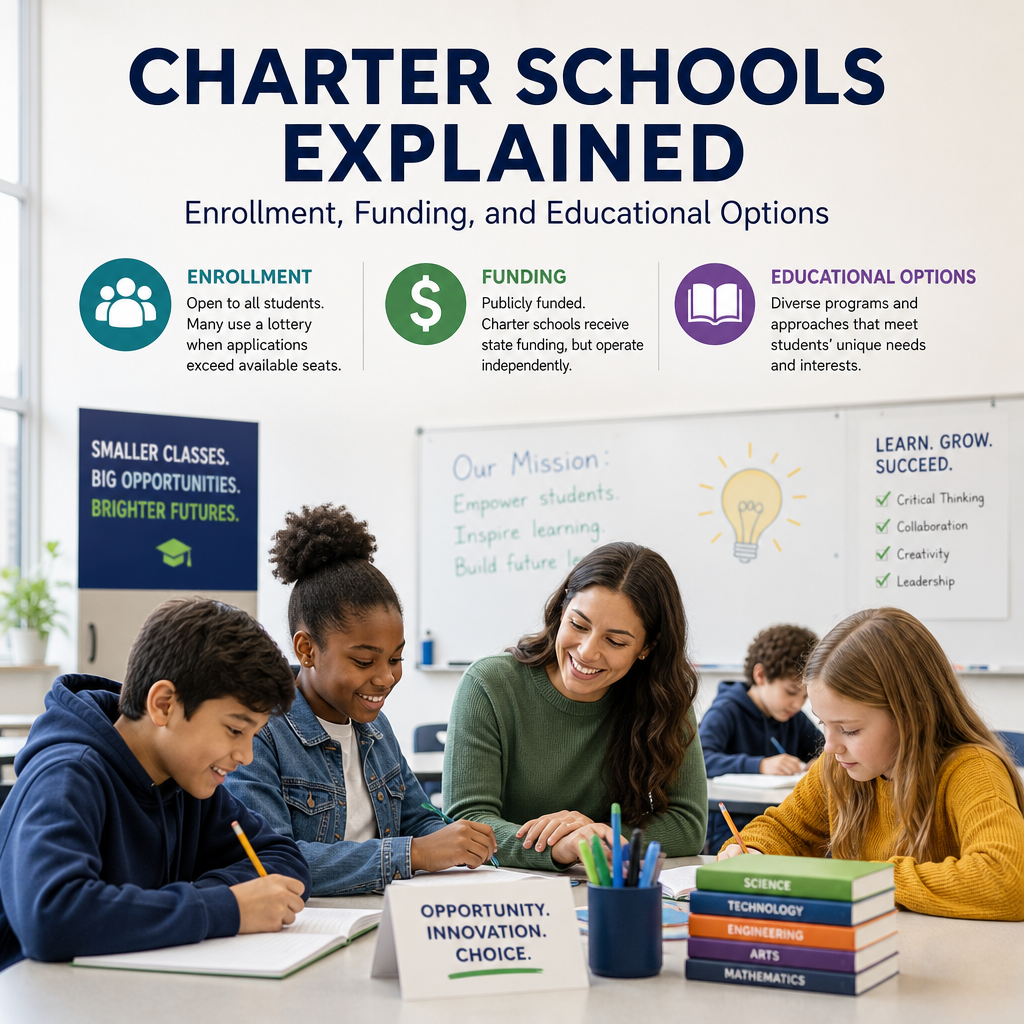
Charter Schools Explained: Enrollment, Funding, and Educational Options
Charter schools offer families a tuition-free public school option with more flexibility in teaching, scheduling, and curriculum than many traditional district schools. In this overview, you’ll learn how charter schools work, how students enroll, and what funding supports them.
By: Jennifer Collins on August 1, 2026
Anúncios
Charter schools have become an important part of the K–12 education conversation in the United States. For families comparing public school choices, charter schools often stand out because they offer tuition-free access, distinct teaching models, and more flexibility than traditional district schools. But what exactly are they, how do they enroll students, and where does their funding come from?
This guide breaks down charter schools explained: enrollment, funding, and educational options in clear, practical terms. Whether you are a parent researching school choices, a teacher exploring different environments, or a community member trying to understand how charter schools fit into public education, this article will help you make sense of the basics.
Anúncios
What Are Charter Schools?
Charter schools are public schools that operate under a “charter,” or performance contract, with a state or local authorizer. That charter gives the school more autonomy than a traditional public school in exchange for accountability for academic results and other agreed-upon goals.
Key characteristics of charter schools
They are publicly funded and tuition-free
They must follow state laws and federal education requirements
They often have more flexibility in curriculum, schedules, staffing, and teaching methods
They are open to all students, though enrollment may be limited by space
They can be closed if they do not meet performance expectations
Charter schools are not private schools. They are part of the public education system, but they operate with a different governance structure than neighborhood district schools.
Anúncios
How charter schools differ from traditional public schools
Traditional public schools are generally run by a school district and governed by a local school board. Charter schools are usually managed by a nonprofit charter organization, a board, or another approved operator, depending on state law.
That difference can affect:
School calendar and daily schedule
Classroom approach
Discipline policies
Teacher hiring and evaluation
Special academic focus, such as STEM, arts, language immersion, or college prep
In short, charter schools give families another public-school option without charging tuition.
How Charter School Enrollment Works
For many families, the enrollment process is one of the biggest questions. While details vary by state and school, charter school enrollment is designed to be open and accessible.
Open enrollment and admissions
Most charter schools use an open enrollment process. That means families can apply regardless of where they live, though some schools may give preference to students in a specific geographic area or district if state law allows it.
Because charter schools often have more applicants than available seats, they may use a lottery system. If a school receives more applications than it can accept, students are randomly selected.
Common enrollment steps
Here is a typical process:
Research the school
Review the school’s academic focus, schedule, mission, and services.
Submit an application
Applications are usually available online and may require basic student information.
Meet the deadline
Many charter schools have specific enrollment windows, often months before the school year begins.
Participate in a lottery if needed
If the school is oversubscribed, a random lottery determines admission.
Complete registration
After acceptance, families submit documents such as proof of age, immunization records, and residency information if required by the school or state.
Can charter schools turn students away?
In general, charter schools cannot select students based on academic performance, behavior history, disability, English proficiency, race, or family income. They must serve students fairly and comply with civil rights laws.
However, some schools may have limitations because of:
Building capacity
Grade-level openings
Specialized program requirements in some states
Deadlines for applying
What about waitlists?
If a student is not selected in the initial lottery, they are often placed on a waitlist. Openings may occur later if an admitted student moves, declines the seat, or leaves the school.
For families interested in charter schools, it helps to apply early, keep track of deadlines, and consider backup options.
How Charter Schools Are Funded
One of the most common questions is how charter schools are funded. Because they are public schools, they receive public money. However, the way that money flows can be different from district schools.
Public funding sources
Charter schools usually receive funding from:
State education funds
Local tax revenue, depending on state policy
Federal education programs, such as Title I or special education funding
Sometimes grants, donations, or fundraising support
The amount varies widely by state, district, and school model. Funding formulas can be complex, and charter schools may not receive the same level of local funding or facility support as traditional district schools.
Why funding can look different
In many places, the money follows the student. When a student enrolls in a charter school, a portion of public funding may transfer to that school. Still, charter schools often face different financial realities than district schools because they may have to cover:
Rent or mortgage costs for school buildings
Facility maintenance
Transportation services
Administrative systems
Specialized program costs
This is one reason charter schools sometimes rely on additional philanthropic support or grants.
Do charter schools charge tuition?
No. Charter schools are public schools and do not charge tuition. Families should be cautious if they encounter a school that requests tuition for a standard K–12 charter program.
Are charter schools allowed to accept donations?
Yes. Many charter schools accept private donations or partner with nonprofit organizations. However, they still must remain publicly accountable and cannot base admissions on a family’s ability to donate.
Educational Options Charter Schools May Offer
One reason families explore charter schools is the range of educational options they can provide. Some charter schools follow a traditional academic model, while others emphasize a specialized approach.
Common charter school models
STEM-focused schools
These schools place extra emphasis on science, technology, engineering, and math. Students may have more hands-on labs, robotics, coding, or project-based learning.
Montessori charter schools
Montessori programs support student independence, mixed-age classrooms, and self-directed learning within structured boundaries.
Arts-centered schools
These schools may integrate music, visual art, theater, dance, and creative writing into the core curriculum.
Dual-language or language immersion schools
Students learn academic subjects in two languages, which can support bilingual proficiency and cultural awareness.
College-preparatory charter schools
These schools often focus on rigorous academics, test preparation, and readiness for higher education.
Expeditionary or project-based schools
Students learn through long-term projects, research, collaboration, and real-world problem solving.
Benefits of educational variety
The flexibility of charter schools can help them build programs that match family priorities and student needs. For example:
A child who thrives in a structured classical model may benefit from a school with a content-rich curriculum
A student interested in engineering may do well in a STEM charter school
A bilingual family may prefer a language immersion program
A student who learns best through movement and creativity may enjoy an arts-integrated environment
Important trade-offs to consider
Not every charter school offers transportation, sports, music, advanced placement classes, or extensive extracurriculars. Some are smaller than district schools, which can be a benefit for community feel but may also mean fewer course options or services.
Families should ask:
What subjects and electives are available?
Does the school provide special education and English learner support?
How does the school handle transportation?
What is the homework load?
What are the student behavior expectations?
Accountability and Oversight
Because charter schools receive public funding, they must be held accountable. That accountability is part of the charter model itself.
Who oversees charter schools?
Oversight usually comes from:
A state education agency
A local school district
A charter authorizer
A state charter board, in some states
The authorizer reviews school performance and determines whether the charter should be renewed, revised, or revoked.
What happens if a charter school underperforms?
If a charter school does not meet academic, financial, or operational standards, it may be placed on probation, required to improve, or eventually closed. That accountability mechanism is one of the defining features of charter schools.
Why accountability matters to families
A strong charter school should be able to explain:
Its mission and goals
How it measures student growth
What supports it offers struggling students
How it handles staffing and finances
How it communicates with families
Transparency is a good sign that a school is serious about serving students well.
Pros and Cons of Charter Schools
No school model is perfect for every child. Understanding the strengths and limitations can help families make a thoughtful decision.
Potential advantages
Tuition-free public school choice
Different instructional models and themes
Smaller school environments in some cases
More flexibility in staffing and curriculum
Strong community culture in many schools
Focused academic or enrichment programs
Possible drawbacks
Limited seats, making lotteries common
Transportation may be unavailable or limited
Services and extracurriculars may vary
Quality can differ significantly from school to school
Some schools may have stricter rules or longer school days
Facility resources may be more limited than in some district schools
The key is not to assume all charter schools are alike. Each one has its own structure, strengths, and challenges.
How to Decide if a Charter School Is a Good Fit
If you are comparing school choices, the best approach is to look beyond the label and evaluate the actual school.
Questions to ask during your research
What is the school’s mission?
How does it support different learning styles?
What are the teacher qualifications?
How does the school measure academic progress?
Does it have services for special education or English learners?
What does the daily schedule look like?
How does the school communicate with families?
What do current parents and students say about the experience?
Signs of a strong charter school
A well-run charter school usually has:
Clear expectations for students and families
Responsive leadership
Transparent academic data and policies
Consistent communication
A supportive learning environment
Evidence that students are learning and growing over time
Practical example
Imagine two charter schools in the same city:
School A offers a STEM curriculum, extended lab time, and project-based learning, but has limited bus service.
School B focuses on college readiness, offers tutoring and advisory periods, and has a longer school day.
If your child loves science and you can manage transportation, School A may be the better fit. If your child benefits from more structure and extra academic support, School B might make more sense.
That is why choosing among charter schools should always come down to fit, not just reputation.
Charter Schools and Families with Special Considerations
Families often want to know whether charter schools can serve children with unique needs. The answer depends on the school, but public-school protections still apply.
Special education and accommodations
Charter schools must follow federal laws that protect students with disabilities. That means they need to identify, evaluate, and support eligible students just as other public schools do.
English learners
Charter schools that serve students who are learning English must provide appropriate language support services.
Highly mobile families
Because charter school enrollment can involve deadlines, applications, and waitlists, families who move frequently should keep track of calendars and document requirements.
Transportation concerns
Some charter schools offer buses; others do not. Transportation is an important practical factor for families to review early.
The Bottom Line on Charter Schools
Charter schools are one option within public education, and they can offer families meaningful choice. They are tuition-free, publicly funded, and designed to operate with flexibility in exchange for accountability. For some students, that flexibility creates a better fit than a traditional district school. For others, a neighborhood school may be the stronger choice.
The best way to evaluate a charter school is to look at the full picture: academic approach, enrollment process, funding structure, student supports, school culture, and daily logistics. When families understand how charter schools work, they can make a more informed decision about the learning environment that best supports their child.
Frequently Asked Questions
1. Are charter schools public or private?
Charter schools are public schools. They are publicly funded, tuition-free, and part of the public education system, even though they operate under a different management structure than traditional district schools.
2. Do charter schools have to accept every student?
Charter schools are open to all students, but if there are more applicants than available seats, they usually hold a lottery. They cannot legally discriminate in admissions.
3. How are charter schools funded?
Charter schools receive public funding from state, local, and federal sources, though the exact amount and structure vary by state. They may also receive grants or donations, but they do not charge tuition.
4. Are charter schools better than traditional public schools?
Not necessarily. Some charter schools offer excellent programs and strong outcomes, while others may not be the right fit. The best choice depends on the child’s needs, the school’s quality, and the family’s priorities.
5. What should parents look for when choosing a charter school?
Parents should review academic performance, school culture, teacher quality, student support services, transportation, extracurricular options, and enrollment deadlines. Visiting the school and asking direct questions can also help.
Charter schools can give families another pathway within public education, but the details matter. Enrollment rules, funding structures, academic models, and student services can vary significantly from one school to another. That is why it helps to understand charter schools explained: enrollment, funding, and educational options before making a decision.
For families, the strongest choice is usually the one that matches a child’s learning style, support needs, and daily reality. A charter school may offer a specialized curriculum, a close-knit community, or a flexible teaching model that better fits your student. It may also come with trade-offs such as transportation limits or fewer extracurriculars. By asking the right questions and reviewing each school carefully, you can separate hype from real value.
If you are considering a charter school, start with the mission, look at the data, and visit if possible. The more you understand how the school works, the easier it becomes to choose an environment where your child can thrive.
Jennifer, M.Ed., holds a degree in Higher Education Administration, with
a focus on U.S. college financial aid, admissions policy, and student
support systems. She researches and writes about scholarships, federal
aid programs, and the college planning process to help students and
families make informed, well-supported decisions.