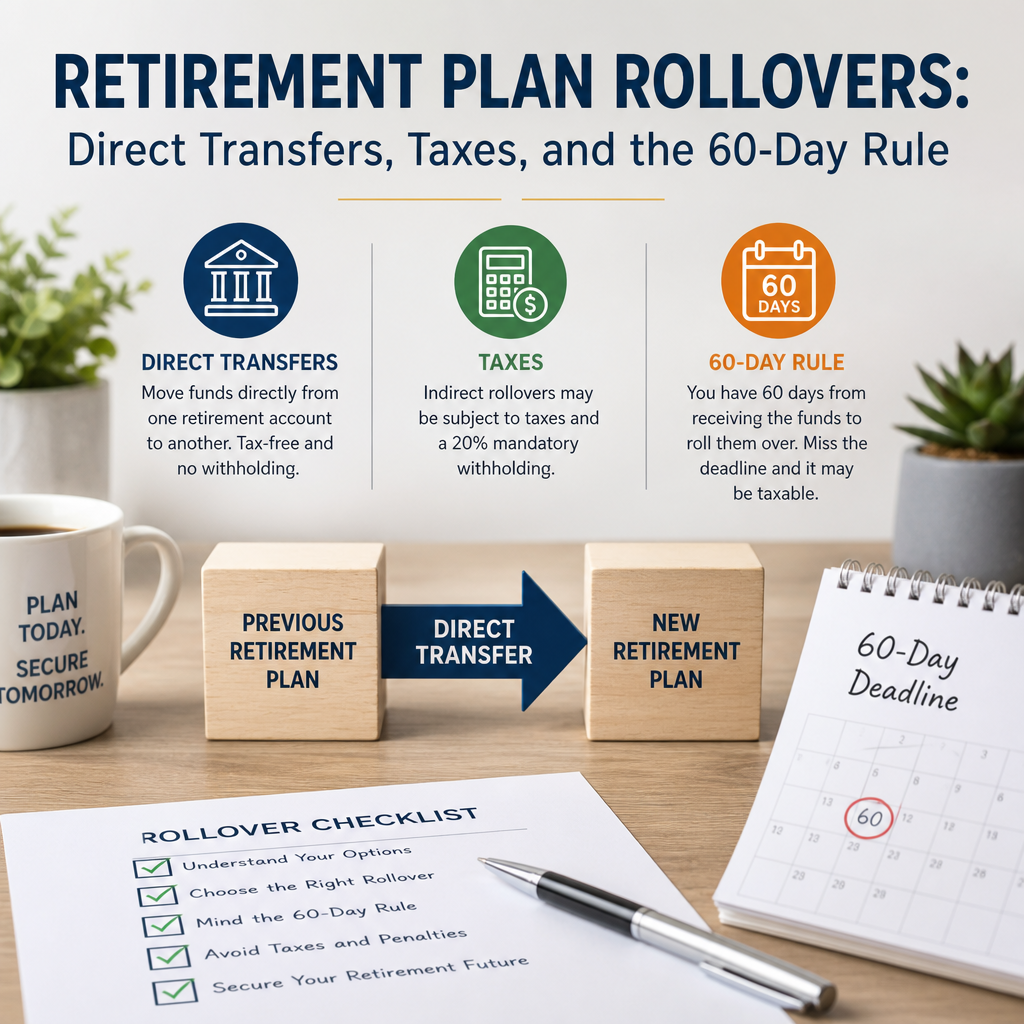
Retirement Plan Rollovers: Direct Transfers, Taxes, and the 60-Day Rule
Retirement plan rollovers can be a smart way to move old savings without losing valuable tax advantages, but the details matter. Learn the difference between direct transfers, rollovers, and the 60-day rule so you can avoid unexpected taxes and penalties.
By: Mary Mitchell on August 2, 2026
Anúncios
Changing jobs, retiring, or consolidating accounts often leads to one big financial question: what should you do with an old retirement plan? For many savers, retirement plan rollovers are the answer. Done correctly, a rollover can help you keep your savings tax-deferred, simplify account management, and expand your investment choices. Done incorrectly, it can trigger taxes, penalties, and unnecessary stress.
The rules can feel confusing at first because terms like direct transfer, rollover, trustee-to-trustee transfer, and the 60-day rule all sound similar. But each one matters. Understanding the differences can help you avoid costly mistakes and make smarter choices with your 401(k), 403(b), traditional IRA, or other qualified retirement account.
Anúncios
What Is a Retirement Plan Rollover?
A retirement plan rollover is the movement of money from one retirement account to another without losing the tax advantages of the original account. In many cases, people roll money from an employer-sponsored plan, such as a 401(k), into an IRA or another eligible retirement plan.
Common reasons for a rollover include:
Anúncios
Leaving a job and needing a new home for your old 401(k)
Consolidating several retirement accounts into one
Seeking broader investment options
Looking for simpler account management
Adjusting your tax strategy in retirement
A rollover is not the same as simply cashing out an account. If you take the money and spend it, you may owe income tax and, if you are under age 59½, an additional early withdrawal penalty in many cases.
Direct Transfers vs. Rollovers
One of the most important distinctions in retirement plan rollovers is whether the money moves directly between financial institutions or passes through your hands.
Direct Transfer: The Cleaner Option
A direct transfer usually means the money moves from one retirement custodian to another without you receiving the funds personally. This is often called a trustee-to-trustee transfer.
Why people like direct transfers:
No 60-day deadline to worry about
No mandatory tax withholding in most cases
Less risk of accidental taxes or penalties
Cleaner recordkeeping
For example, if you move funds from a traditional IRA at one brokerage to a traditional IRA at another brokerage, that can often be completed as a direct transfer. Similarly, many 401(k) balances can be moved directly to an IRA after a job change.
Rollover: Money Passes Through You
A rollover often means the distribution is paid to you first, and then you deposit it into another eligible retirement account. This is where the 60-day rule becomes critical.
If you receive a check made out to you, the clock starts ticking. You typically must redeposit the money into another eligible retirement account within 60 days to preserve the tax-deferred status.
The key risk: if you miss the deadline, the IRS may treat the distribution as taxable income.
Understanding the Tax Consequences
Taxes are the reason retirement plan rollovers deserve careful attention. The account type matters, the destination account matters, and the method of transfer matters.
Traditional to Traditional
A rollover from a traditional 401(k) to a traditional IRA is generally tax-deferred if handled properly. You do not usually owe tax at the time of transfer if the money goes directly between custodians or is rolled over within the allowed time period.
Roth to Roth
A rollover from a Roth 401(k) to a Roth IRA can also generally preserve tax-free treatment if done correctly. Roth accounts follow different tax rules than traditional accounts, but the same caution applies: the transfer must be structured properly.
Traditional to Roth
Moving money from a pre-tax retirement account into a Roth account is not a tax-free rollover. This is a Roth conversion, which usually creates taxable income in the year of conversion. It can still be a smart strategy for some people, but it is not the same thing as a simple rollover.
Cash Distributions
If you take the funds in cash and do not complete a proper rollover, the distribution may be taxable. Depending on the plan type and your age, you could also face an early withdrawal penalty.
Mandatory Withholding
Employer-sponsored plans often withhold taxes when a distribution is made payable to you. Even if you intend to complete a rollover, withholding can create a problem because you must replace the withheld amount from other funds to roll over the full distribution amount.
For example, if your 401(k) distributes $20,000 and withholds taxes, you may need to come up with the withheld portion from outside money to avoid having part of the distribution treated as taxable.
The 60-Day Rule Explained
The 60-day rule is one of the most important parts of retirement plan rollovers. If you receive a distribution from a retirement account, you generally have 60 days to deposit it into another eligible retirement account.
How It Works
Here is the basic idea:
Your plan sends you a distribution.
You receive the money.
You have 60 days from the date you receive it to complete the rollover.
If completed correctly, the distribution may retain its tax-deferred status.
If you miss the deadline, the distribution is usually taxable. In some cases, penalties may also apply.
Why the Rule Matters
The 60-day deadline exists to prevent people from using retirement funds like short-term personal loans. It also helps keep retirement money inside qualified accounts unless a true distribution is intended.
Common Mistakes
People often run into trouble because they:
Miscalculate the deadline
Deposit the money into the wrong account
Assume weekends or holidays extend the deadline
Forget about withholding and fail to roll over the full amount
Combine a rollover with other transactions without checking the rules
If you are relying on the 60-day rule, documentation matters. Keep records of the distribution date and the date you redeposited the money.
When a Direct Rollover Is Better Than a 60-Day Rollover
In most cases, a direct rollover is safer than taking possession of the funds first. It reduces the chance of a missed deadline and avoids the logistical problem of replacing withheld taxes.
A direct rollover may be the better choice if you:
Want to avoid timing pressure
Do not want to manage a large temporary cash balance
Are consolidating multiple retirement accounts
Prefer a lower-risk process
A 60-day rollover may still be useful in some situations, but it requires more care. If the plan administrator issues a check to you, you need a system for tracking the deadline and making sure the full rollover amount is completed on time.
Rollover Rules That Can Surprise People
Retirement plan rollover rules include several details that can catch even experienced savers off guard.
One Rollover Per 12 Months for IRAs
The IRS limits certain IRA-to-IRA indirect rollovers to one per 12-month period. This rule does not apply to direct transfers between custodians in the same way.
That means if you use a 60-day rollover with an IRA, you may not be able to repeat that strategy again immediately. Many investors do not realize this until after they’ve already made a second move.
Employer Plan Rules Can Differ
401(k), 403(b), and other employer plans may have their own distribution rules. Some plans allow rollovers to IRAs or other employer plans, while others have restrictions. Your plan’s summary documents should explain what is permitted.
Required Minimum Distributions Are Different
If you are old enough to take required minimum distributions, those amounts generally cannot be rolled over once they are due. That’s an important distinction, especially for older retirees managing multiple accounts.
After-Tax Contributions
If your retirement account includes after-tax contributions, the rollover rules may become more complex. It may matter whether you are moving pre-tax money, after-tax money, or a combination of both. Getting this wrong can affect your tax outcome.
How to Complete a Retirement Plan Rollover the Right Way
A careful process can help you avoid unnecessary taxes and paperwork headaches.
Step 1: Confirm the Destination Account
Decide where the money is going before you move anything. Common destinations include:
Traditional IRA
Roth IRA
Another employer plan
New employer’s retirement plan
Make sure the destination account accepts the type of money you want to move.
Step 2: Ask for a Direct Rollover First
Whenever possible, request a direct rollover or trustee-to-trustee transfer. This is usually the simplest and safest route.
Step 3: Understand Withholding Rules
If the distribution is payable to you, ask whether taxes will be withheld. If so, determine whether you can replace the withheld amount with personal funds to complete a full rollover.
Step 4: Track the Dates
If you receive the money directly, write down:
The date the distribution was received
The date you deposited it
The deadline for the 60-day rule
Do not rely on memory alone.
Step 5: Keep Records
Save:
Distribution statements
Deposit confirmations
Account transfer paperwork
Tax forms, such as Form 1099-R
Good records make tax reporting easier and help if there is ever a question about the transaction.
Practical Example: Direct Rollover vs. Indirect Rollover
Imagine you leave a job with a $50,000 401(k) balance.
Scenario A: Direct Rollover
You instruct the plan administrator to send the money directly to your IRA custodian. The funds move without passing through your hands. You avoid the 60-day rule, and the money remains in a tax-advantaged account.
Scenario B: Indirect Rollover
The plan sends a check to you for $50,000. The plan withholds taxes, so you receive less than the full balance. To complete the rollover properly, you must deposit the full rollover amount into your IRA within 60 days, including the amount that was withheld if you want to avoid having part of the distribution treated as taxable.
Both paths may be legal, but one is far easier to manage.
When to Get Professional Help
Not every rollover requires a financial advisor or tax professional, but some situations deserve expert guidance.
Consider getting help if you:
Have both pre-tax and after-tax money in the account
Are rolling funds into a Roth account
Are near the age for required minimum distributions
Have multiple old retirement accounts
Are unsure how withholding will affect your rollover
Need to coordinate with a new employer plan
Want to avoid a costly 60-day mistake
A tax professional or qualified financial advisor can help you compare options and understand the consequences before you act.
Frequently Asked Questions
1. What is the difference between a rollover and a transfer?
A transfer usually moves money directly between financial institutions, while a rollover often means the money is distributed to you first and then deposited into another retirement account. Direct transfers are generally simpler because they avoid the 60-day deadline and reduce the chance of taxes or penalties.
2. Do I have to pay taxes on a retirement plan rollover?
Not necessarily. A properly completed rollover from one traditional retirement account to another traditional retirement account is usually tax-deferred. However, if you move pre-tax money into a Roth account, that is generally a taxable conversion. Also, if you miss the 60-day deadline on an indirect rollover, the distribution may become taxable.
3. What happens if I miss the 60-day rollover deadline?
If you miss the deadline, the IRS will usually treat the distribution as taxable income. Depending on your age and the type of account, you may also owe an early withdrawal penalty. There may be limited exceptions in certain situations, but you should not assume you qualify without reviewing the rules carefully.
4. Can I roll over a 401(k) into an IRA?
Yes, many people roll over a 401(k) into a traditional IRA after leaving a job. In some cases, a Roth 401(k) can be rolled into a Roth IRA. Your plan documents and the receiving institution’s rules will determine the exact options available.
5. Is a direct rollover always better?
A direct rollover is usually the safer option because it avoids the 60-day deadline and reduces withholding complications. That said, the best choice depends on your goals, the type of account, and whether you are moving the money into a traditional or Roth account. For many people, direct is the cleaner and lower-risk path.
Retirement plan rollovers can be a powerful tool for keeping your savings organized and tax-advantaged, but the details matter. The safest path is usually a direct rollover or trustee-to-trustee transfer, since it minimizes the risk of taxes, penalties, and missed deadlines. If you do receive the funds yourself, the 60-day rule becomes critical, and you must also pay close attention to withholding and account eligibility.
The right move depends on your goals. Maybe you want to simplify multiple old accounts, move money into an IRA with more investment options, or prepare for retirement with a clearer long-term strategy. Whatever your reason, it pays to slow down, read the plan rules, and confirm the tax treatment before moving money.
A little preparation can save you from a costly mistake. If you are considering a rollover now, start by comparing your options, gathering your account documents, and choosing the transfer method that best fits your situation. When handled carefully, retirement plan rollovers can support a smoother, more flexible retirement strategy for years to come.
Mary S, CFP®, is a Certified Financial Planner with over 12 years of experience in personal finance, retirement planning, and wealth management. She writes educational content that helps readers understand financial concepts and make informed decisions based on reliable information.