Roth IRA Conversions: Taxes, Eligibility, and Rollover Requirements
A Roth IRA conversion can offer valuable tax-free growth in retirement, but it also comes with rules that can affect how much you owe and whether you qualify. Before you move money, it helps to understand the tax impact, eligibility requirements, and rollover details so you can make a smarter decision.
By: Mary Mitchell on August 2, 2026
Anúncios
A Roth IRA conversion can be a smart move for savers who want tax-free withdrawals in retirement, but it is not as simple as moving money from one account to another. Before you convert, you need to understand the tax impact, who is eligible, and how the rollover rules work. Done correctly, a Roth IRA conversion can help reduce future tax uncertainty and give you more flexibility later in life.
This guide breaks down the essentials in plain English so you can make a more informed decision. Whether you are converting a traditional IRA, a SEP IRA, or a SIMPLE IRA, the details matter. The rules around taxes and timing can affect how much you owe and whether the conversion makes sense for your financial plan.
Anúncios
What Is a Roth IRA Conversion?
A Roth IRA conversion is the process of moving money from a pre-tax retirement account into a Roth IRA. Most often, people convert funds from:
Traditional IRAs
SEP IRAs
SIMPLE IRAs, if certain requirements are met
In some cases, eligible employer plan rollovers that first move into an IRA
The key difference is tax treatment. Traditional retirement accounts usually grow tax-deferred, meaning you pay taxes later when you withdraw the money. A Roth IRA uses after-tax dollars instead. That means you pay taxes at the time of conversion, but qualified withdrawals in retirement can be tax-free.
Anúncios
Why People Choose a Roth IRA Conversion
A Roth IRA conversion may appeal to people who want:
Tax-free growth and withdrawals
More control over future taxable income
No required minimum distributions during the original owner’s lifetime
A way to diversify retirement tax strategies
For many investors, the real question is not whether a Roth IRA conversion is allowed, but whether it fits their long-term tax picture.
Roth IRA Conversion Taxes: What You Need to Know
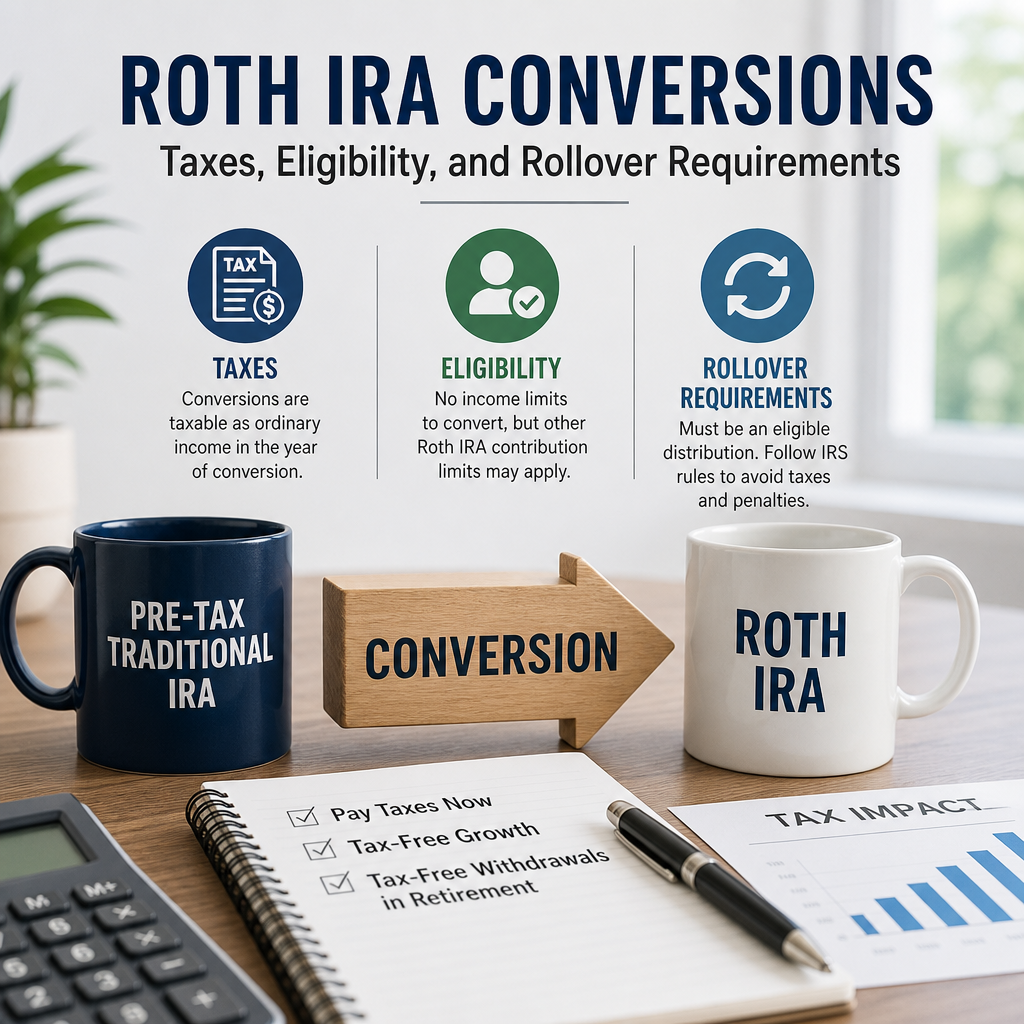
The biggest cost of a Roth IRA conversion is usually the tax bill. In most cases, the amount you convert is treated as ordinary income in the year of the conversion.
How Conversion Taxes Work
If you convert $20,000 from a traditional IRA to a Roth IRA, that $20,000 is generally added to your taxable income for that year. You do not pay an early withdrawal penalty just for converting, but you may owe:
Federal income tax
State income tax, depending on where you live
Potentially higher taxes if the conversion pushes you into a higher bracket
The tax is based on the pre-tax portion of the conversion. If your IRA contains after-tax contributions, things get more complicated because of the pro-rata rule.
The Pro-Rata Rule
If your traditional IRA includes both pre-tax and after-tax money, the IRS does not let you choose to convert only the after-tax portion. Instead, the conversion is treated as coming from a mix of both types of funds across all your non-Roth IRAs.
That means:
You may owe tax on part of the conversion even if some contributions were made with after-tax dollars
You cannot isolate one IRA and treat it as fully after-tax if you have other pre-tax IRA balances
The pro-rata rule can significantly change the tax result
This is one of the most important Roth IRA conversion rules to understand before you move money.
When You Owe the Tax
You owe the tax for the year in which the conversion occurs. In most cases, that means the conversion is reported on your tax return for that calendar year.
Because the tax can be substantial, many people plan a conversion carefully by estimating:
Their current marginal tax rate
Expected taxable income for the year
Whether they can pay the tax from outside funds
Whether the conversion should happen all at once or in smaller pieces
Paying the tax with money outside the retirement account is often preferred, because using converted funds to pay the tax can reduce the long-term benefit of the conversion.
Roth IRA Eligibility: Who Can Convert?
One of the advantages of a Roth IRA conversion is that there is no income limit for converting pre-tax retirement money into a Roth IRA. That makes it different from direct Roth IRA contributions, which do have income restrictions.
Who Can Do a Roth IRA Conversion?
Generally, you can do a Roth IRA conversion if you have money in an eligible account, such as:
Traditional IRA
SEP IRA
SIMPLE IRA, after the required waiting period and account rules are satisfied
Certain retirement plan rollovers that are first eligible to move into an IRA
You do not need to meet a Roth IRA income limit to convert.
Who May Benefit Most
A Roth IRA conversion may be worth considering if you:
Expect to be in a higher tax bracket later
Have a year with unusually low income
Want to reduce future required minimum distributions
Have a long time horizon before retirement
Can pay the conversion tax from non-retirement funds
It may be less attractive if:
You expect to be in a much lower tax bracket later
You need the converted funds soon
You do not have money available to pay the tax
The conversion would create a large tax bill this year
Roth IRA Rollover Requirements and Timing Rules
Although people often use the terms “conversion” and “rollover” interchangeably, the IRS treats them differently. A Roth IRA conversion usually refers to moving money from a traditional-type account into a Roth IRA. A rollover is a broader term that can apply to moving retirement money between similar or different accounts.
Direct Conversion vs. Indirect Rollover
The cleanest method is usually a direct trustee-to-trustee transfer, where the financial institutions move the money directly.
This approach helps avoid:
Withholding mistakes
Missed deadlines
Avoidable tax consequences
Confusion about whether the transaction qualifies
An indirect rollover, where you receive the money first and then redeposit it, can be riskier because deadlines matter and withholding may apply.
The 60-Day Rule
If you receive retirement funds indirectly and intend to complete a rollover, you generally have 60 days to deposit the money into the new qualifying account. If you miss the deadline, the transaction may become taxable.
This rule is especially important when dealing with IRA rollovers and conversions. A missed deadline can turn what you thought was a tax-deferred transfer into a taxable distribution.
One-Rollover-Per-Year Rule
For IRAs, the IRS limits how often you can do certain indirect rollovers. In general, you may be restricted to one rollover per 12-month period across all your IRAs.
This does not usually apply to direct trustee-to-trustee transfers, which is another reason those transfers are often the safer option.
SIMPLE IRA Waiting Period
If you want to convert a SIMPLE IRA to a Roth IRA, there is typically a waiting period before the account becomes eligible for conversion. The rules depend on how long the SIMPLE IRA has been established and whether the account has met the required conditions.
Because SIMPLE IRA rules can be tricky, it is smart to verify timing before initiating the conversion.
How to Decide Whether a Roth IRA Conversion Makes Sense
A Roth IRA conversion is not automatically good or bad. The right choice depends on your personal tax situation and retirement goals.
Ask These Questions First
Before converting, consider:
What tax bracket am I in now?
Will the conversion push me into a higher bracket?
Do I expect higher taxes in retirement?
Can I pay the tax without tapping retirement savings?
How long will the money stay in the Roth IRA?
Will the conversion affect other tax credits or deductions?
If you are early in your career or have many years before retirement, a conversion may have more time to pay off. If you are near retirement, the math can be more sensitive.
A Practical Example
Suppose you have $15,000 in a traditional IRA and your income is temporarily lower this year because of a job change or a sabbatical. Converting part or all of that account could mean paying tax at a lower rate now rather than later at a higher rate.
On the other hand, if you convert a large balance in a year when your income is already high, the extra tax may outweigh the benefits.
Common Mistakes to Avoid
Roth IRA conversions are powerful, but simple mistakes can reduce the benefit.
1. Ignoring the Tax Bill
Many people focus on the future tax-free withdrawals and forget that the conversion creates a current tax obligation. If you cannot cover the tax, the strategy may not work as planned.
2. Overlooking the Pro-Rata Rule
If you have multiple IRAs with both pre-tax and after-tax money, the taxable portion may be larger than expected.
3. Converting Too Much at Once
A large conversion can push you into a higher tax bracket or create unintended effects on Medicare premiums, credits, or deductions.
4. Missing Rollover Deadlines
If you use an indirect rollover, timing errors can create tax problems. Direct transfers are usually simpler and safer.
5. Not Coordinating With Your Overall Plan
A Roth IRA conversion should fit into your broader retirement, tax, and estate strategy. It should not be made in isolation.
When a Partial Roth IRA Conversion May Be Better
You do not have to convert everything at once. In many cases, partial conversions can offer more flexibility.
Advantages of Partial Conversions
A smaller conversion may help you:
Stay within a target tax bracket
Spread the tax cost over several years
Adjust to changing income
Reduce the risk of converting during a high-income year
For example, someone might convert just enough each year to “fill up” a lower tax bracket without crossing into the next one. That approach can be especially helpful during early retirement or during years of lower earned income.
Tax Reporting After a Roth IRA Conversion
A Roth IRA conversion is not something you do and forget. It must be reported properly on your tax return.
What to Expect
The financial institution usually sends tax forms showing the distribution and conversion amount. You will need to report the transaction on your tax return so the IRS can distinguish between taxable and non-taxable portions.
Be sure to:
Keep records of contributions and conversions
Save account statements
Confirm how much was pre-tax versus after-tax
Work with a tax professional if your situation is complex
Accurate reporting is especially important when the pro-rata rule applies or when you have multiple retirement accounts.
Frequently Asked Questions
1. Is a Roth IRA conversion taxable?
Yes, in most cases. The pre-tax portion of the conversion is generally taxed as ordinary income in the year you complete the conversion. If you have after-tax IRA contributions, part of the conversion may be non-taxable, but the pro-rata rule often applies.
2. Can anyone do a Roth IRA conversion?
Most people with eligible retirement accounts can do a Roth IRA conversion. There is no income limit for conversions, unlike direct Roth IRA contributions. However, the account type and timing rules still matter.
3. Do I have to pay the tax out of the converted account?
No, and paying the tax from outside funds is often the better option. If you use money from the conversion to pay the tax, you reduce the amount that stays invested in the Roth IRA.
4. What is the difference between a Roth conversion and a rollover?
A Roth conversion moves money from a pre-tax retirement account into a Roth IRA and usually triggers taxes. A rollover generally refers to moving retirement money between eligible accounts and may or may not be taxable depending on the type of transfer.
5. Can I undo a Roth IRA conversion if I change my mind?
Recharacterizations of Roth IRA conversions were largely eliminated for tax years after 2017 by the Tax Cuts and Jobs Act. That means conversions are generally permanent, so it is important to plan carefully before completing one.
A Roth IRA conversion can be an effective way to create tax-free income in retirement, but only when the tax consequences and rollover requirements are understood in advance. The conversion itself is usually straightforward, yet the details can have a major impact on your final tax bill. You need to think about your current income, future tax expectations, account composition, and whether the pro-rata rule will apply.
For some investors, a conversion makes sense during a low-income year or as part of a long-term tax diversification strategy. For others, the immediate tax cost may outweigh the benefits. The best results often come from careful planning, accurate reporting, and timing the move when it supports the rest of your financial picture.
If you are considering a Roth IRA conversion, review your account balances, estimate the tax impact, and confirm the rollover rules before acting. A thoughtful approach can help you avoid mistakes and make the most of this valuable retirement planning tool.
Mary S, CFP®, is a Certified Financial Planner with over 12 years of experience in personal finance, retirement planning, and wealth management. She writes educational content that helps readers understand financial concepts and make informed decisions based on reliable information.