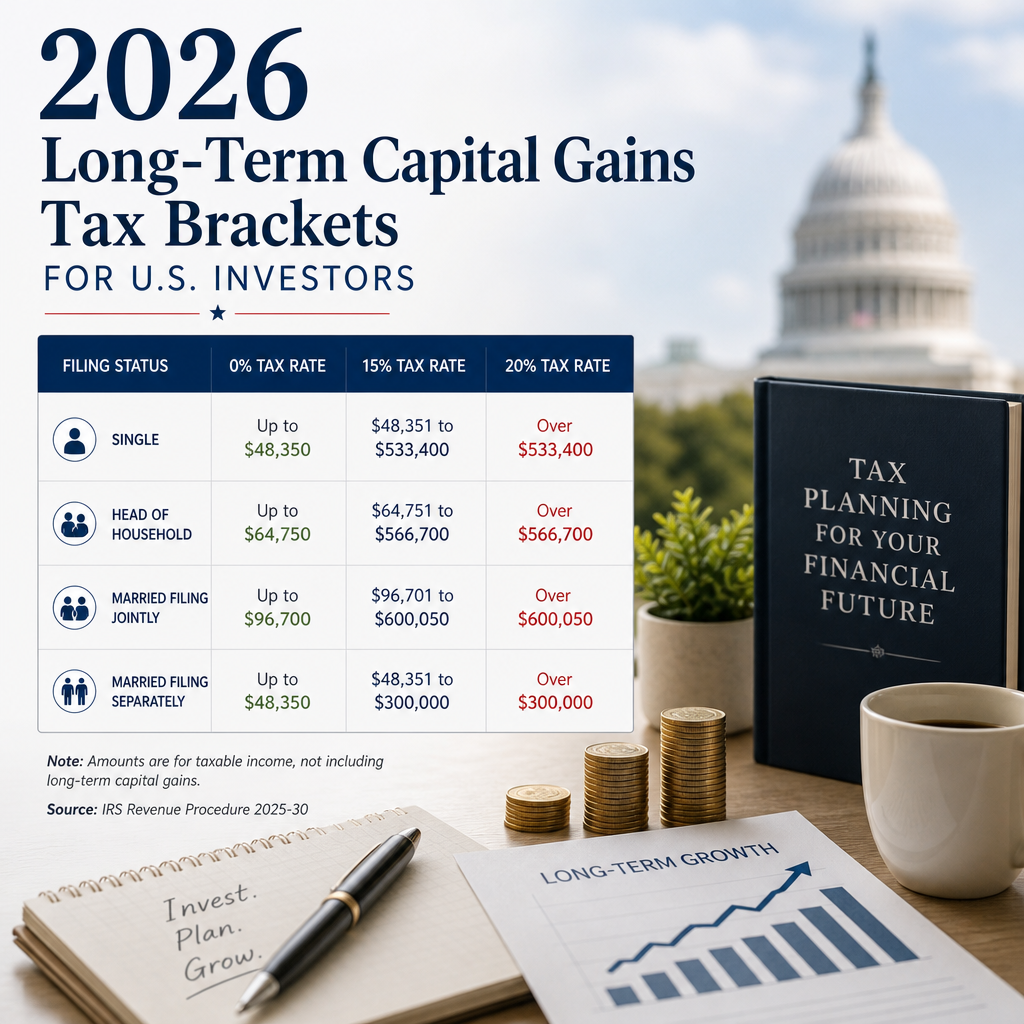
2026 Long-Term Capital Gains Tax Brackets for U.S. Investors
The 2026 long-term capital gains tax brackets can make a big difference in what you actually keep after selling investments. Here’s how the rates work, who qualifies for each bracket, and what U.S. investors should watch before making a move.
By: Mary Mitchell on August 2, 2026
Anúncios
Understanding the 2026 long-term capital gains tax brackets can help U.S. investors make smarter decisions about when to sell assets, harvest losses, and plan for retirement. Whether you hold stocks, ETFs, mutual funds, real estate, or other investments, the tax rate you pay on profits can have a meaningful impact on your after-tax return.
The good news is that long-term capital gains are taxed more favorably than ordinary income in many cases. But the rules still matter. Your filing status, taxable income, and the type of asset you sold all affect how much tax you owe. In 2026, investors will once again need to pay close attention to bracket thresholds, because crossing even one income line can change the tax rate on an otherwise profitable sale.
Anúncios
What Long-Term Capital Gains Mean in 2026
A long-term capital gain is the profit you make when you sell an investment you’ve held for more than one year. If you sell before the one-year mark, the gain is usually treated as a short-term capital gain and taxed at ordinary income rates.
Long-term capital gains typically apply to:
Anúncios
Stocks and ETFs
Mutual funds
Bonds in some cases
Real estate held for investment
Certain business assets
Other capital assets
The key advantage is tax treatment. Instead of being taxed like wages, long-term gains are taxed at special rates that are often lower than regular income tax rates.
2026 Long-Term Capital Gains Tax Brackets Explained
The 2026 long-term capital gains tax brackets determine whether your gains are taxed at 0%, 15%, or 20%. These rates generally apply to most capital assets held for more than one year.
Your rate depends on your taxable income, not just your total salary or investment profit. Taxable income is what remains after deductions and adjustments.
The three main long-term capital gains rates
For 2026, the long-term capital gains structure is expected to follow the familiar three-tier system:
0% rate for taxpayers whose taxable income falls within the lowest bracket range
15% rate for middle-income taxpayers
20% rate for higher-income taxpayers
Some high-income investors may also owe the Net Investment Income Tax (NIIT), which can add another 3.8% on certain investment income, including capital gains. That means your effective tax rate could be higher than the headline capital gains rate.
Why bracket thresholds matter
Even a small increase in taxable income can push part of your gains into a higher bracket. For example, if you’re near the top of the 0% range, selling just a little more than planned may cause some gains to be taxed at 15% instead.
That’s why investors often coordinate sales with:
Retirement withdrawals
Bonus income
Roth conversions
Charitable giving
Tax-loss harvesting
2026 Long-Term Capital Gains Tax Brackets by Filing Status
While the IRS final numbers for 2026 will depend on inflation adjustments and official announcements, the long-term capital gains framework will still be organized by filing status and taxable income.
Below is the structure investors should expect to use when planning:
Single filers
Single taxpayers generally receive the 0% long-term capital gains rate up to the lowest income threshold, then move into the 15% range, and eventually the 20% range at higher taxable income levels.
Married filing jointly
Joint filers usually benefit from wider income ranges, which can make it easier to stay in the 0% or 15% long-term capital gains brackets.
Married filing separately
This filing status usually has narrower income thresholds and can create less favorable tax outcomes for capital gains planning.
Head of household
Head of household filers receive brackets that are typically more favorable than single filers but not as wide as married filing jointly.
Qualified widow or widower
Eligible surviving spouses may use joint-filing-like rates for a limited period, which can affect how long-term gains are taxed.
How Long-Term Capital Gains Are Calculated
To understand your tax bill, it helps to know how the gain itself is measured.
Step 1: Determine your cost basis
Your cost basis is usually what you paid for the investment, plus certain adjustments. For stocks, it may include:
Purchase price
Reinvestment of dividends
Brokerage fees in some situations
For real estate, basis can include:
Purchase price
Closing costs
Capital improvements
Certain acquisition-related expenses
Step 2: Subtract the sale price
Your gain is generally calculated like this:
Sale price – cost basis = capital gain
If the result is positive, you have a gain. If it’s negative, you have a capital loss.
Step 3: Apply holding period rules
If you held the asset for more than one year, the gain is long-term. If not, it’s short-term.
Example
Suppose you bought shares for $10,000 and sold them for $15,000 after holding them for two years.
Cost basis: $10,000
Sale price: $15,000
Long-term capital gain: $5,000
That $5,000 is then taxed based on your 2026 taxable income and filing status.
2026 Capital Gains Planning Strategies for Investors
You can’t control tax law, but you can often control the timing and structure of your investment decisions. A little planning can make a real difference.
1. Use tax-loss harvesting
If you have losing investments in a taxable account, you may be able to sell them to offset gains. This is called tax-loss harvesting.
It can help you:
Reduce taxable gains
Offset up to a limited amount of ordinary income
Improve portfolio efficiency
Be aware of the wash sale rule, which can disallow a loss if you buy a substantially identical security too soon before or after the sale.
2. Time gains carefully
If you are close to a bracket threshold, consider whether to:
Defer the sale until a later year
Spread sales over multiple tax years
Pair gains with losses
Coordinate sales with lower-income years
This is especially useful for early retirees, business owners, and investors with variable income.
3. Watch the 0% bracket
Some taxpayers can realize long-term capital gains and still pay 0% federal tax on those gains if taxable income stays within the lowest range.
This can be valuable if you are:
In early retirement
Between jobs
Living on cash reserves
Managing a low-income year
4. Consider charitable strategies
Donating appreciated securities instead of selling them can be tax-efficient. In many cases, you may avoid capital gains tax and still receive a charitable deduction if you itemize.
5. Review retirement income sources
Traditional IRA withdrawals, pension income, Social Security, and Roth conversions can all influence taxable income and therefore your long-term capital gains rate.
Common Mistakes Investors Make
Even experienced investors can trip up on capital gains tax planning.
Mistake 1: Ignoring taxable income
Many people focus on salary alone, but taxable income is the number that actually drives bracket placement.
Mistake 2: Confusing short-term and long-term gains
Selling after 11 months is not the same as selling after 13 months. The tax difference can be significant.
Mistake 3: Forgetting state taxes
Some states tax capital gains like ordinary income. That means your total tax bill may be higher than the federal long-term rate suggests.
Mistake 4: Overlooking NIIT
High-income investors may owe the 3.8% Net Investment Income Tax in addition to federal capital gains tax.
Mistake 5: Not adjusting for basis
If you don’t track reinvested dividends, stock splits, or improvements to real estate, you may overstate your gain.
How the 2026 Long-Term Capital Gains Tax Brackets Affect Different Investors
The same tax bracket rules can have very different effects depending on your situation.
Retail investors
If you invest in a taxable brokerage account, tax awareness can improve your long-term results. Even modest gains matter if you trade frequently or rebalance often.
Retirees
Retirees may have lower taxable income than during working years, which can create opportunities to realize gains at the 0% or 15% rate.
Real estate owners
Real estate investors may face additional complexity, especially if depreciation has been claimed. Gain recognition and special tax rules can make professional guidance especially useful.
High-income professionals
If most of your income comes from wages, bonuses, or pass-through business income, you may land in the 15% or 20% long-term capital gains bracket quickly. Timing becomes especially important.
What Investors Should Watch for in 2026
Tax brackets are adjusted periodically, so investors should pay attention to the final IRS guidance for 2026. Inflation adjustments may shift threshold amounts, even if the rate structure remains the same.
You should also monitor:
IRS updates to capital gains thresholds
Changes to NIIT rules
State tax law changes
Legislative updates affecting investment income
Updates to standard deduction and ordinary income brackets
A tax move that made sense in 2025 may not be as efficient in 2026 if your income changes or new rules take effect.
A Practical Example of 2026 Capital Gains Planning
Let’s say a married couple filing jointly has taxable income that places them near the upper edge of the 0% long-term capital gains bracket.
They’re considering selling $20,000 of appreciated ETF shares.
They might compare a few options:
Sell all shares in 2026 and pay tax on part of the gain at 15%
Sell half in 2026 and half in 2027
Pair the sale with tax losses from another investment
Delay the sale until after a retirement account withdrawal year ends
The best choice depends on their full tax picture, not just the investment gain itself. That’s why long-term capital gains planning works best when tied to overall household income.
Why Professional Tax Guidance Can Help
Capital gains rules are manageable for many investors, but the details can get complicated fast. A CPA, enrolled agent, or fee-only financial planner with tax expertise can help you:
Estimate your capital gains tax
Model bracket thresholds
Coordinate investment and retirement decisions
Reduce unnecessary taxes
Avoid filing mistakes
This is especially valuable if you have multiple income sources, business ownership, real estate, or a large taxable portfolio.
Frequently Asked Questions
What are the 2026 long-term capital gains tax brackets?
The 2026 long-term capital gains tax brackets are the federal rate tiers that determine whether qualifying investment gains are taxed at 0%, 15%, or 20%. The exact income thresholds depend on filing status and IRS inflation adjustments for 2026.
Do I pay long-term capital gains tax on every investment sale?
No. You only pay long-term capital gains tax if you sell a capital asset for more than your cost basis and you held it for more than one year. If you sell at a loss, you may be able to use that loss to offset gains.
Are long-term capital gains taxed the same in every state?
No. State tax rules vary. Some states tax capital gains like regular income, while others have no state income tax at all. You need to check your state’s treatment separately from federal rules.
What is the difference between long-term and short-term capital gains?
Long-term capital gains apply to assets held longer than one year and usually receive lower tax rates. Short-term capital gains apply to assets held one year or less and are typically taxed at ordinary income tax rates.
Can I reduce my capital gains tax bill in 2026?
Yes. Common strategies include tax-loss harvesting, managing the timing of sales, donating appreciated assets, staying within lower brackets when possible, and coordinating capital gains with other income sources.
The 2026 long-term capital gains tax brackets will remain an important part of smart investing for U.S. taxpayers. While the tax rates themselves are straightforward at a high level, the actual tax you pay depends on taxable income, filing status, asset type, and whether additional taxes like NIIT apply. That means the best approach is not just to know the brackets, but to understand how they fit into your broader financial picture.
For many investors, careful planning can reduce taxes without changing the core investment strategy. Timing a sale, harvesting losses, donating appreciated assets, or managing retirement income can all influence your final tax bill. Even modest adjustments may help you keep more of your investment gains over time.
As 2026 approaches, it’s wise to review your portfolio, estimate your taxable income, and confirm the latest IRS bracket thresholds before selling appreciated assets. A little preparation can go a long way toward improving after-tax returns and avoiding surprises at filing time.
Mary S, CFP®, is a Certified Financial Planner with over 12 years of experience in personal finance, retirement planning, and wealth management. She writes educational content that helps readers understand financial concepts and make informed decisions based on reliable information.