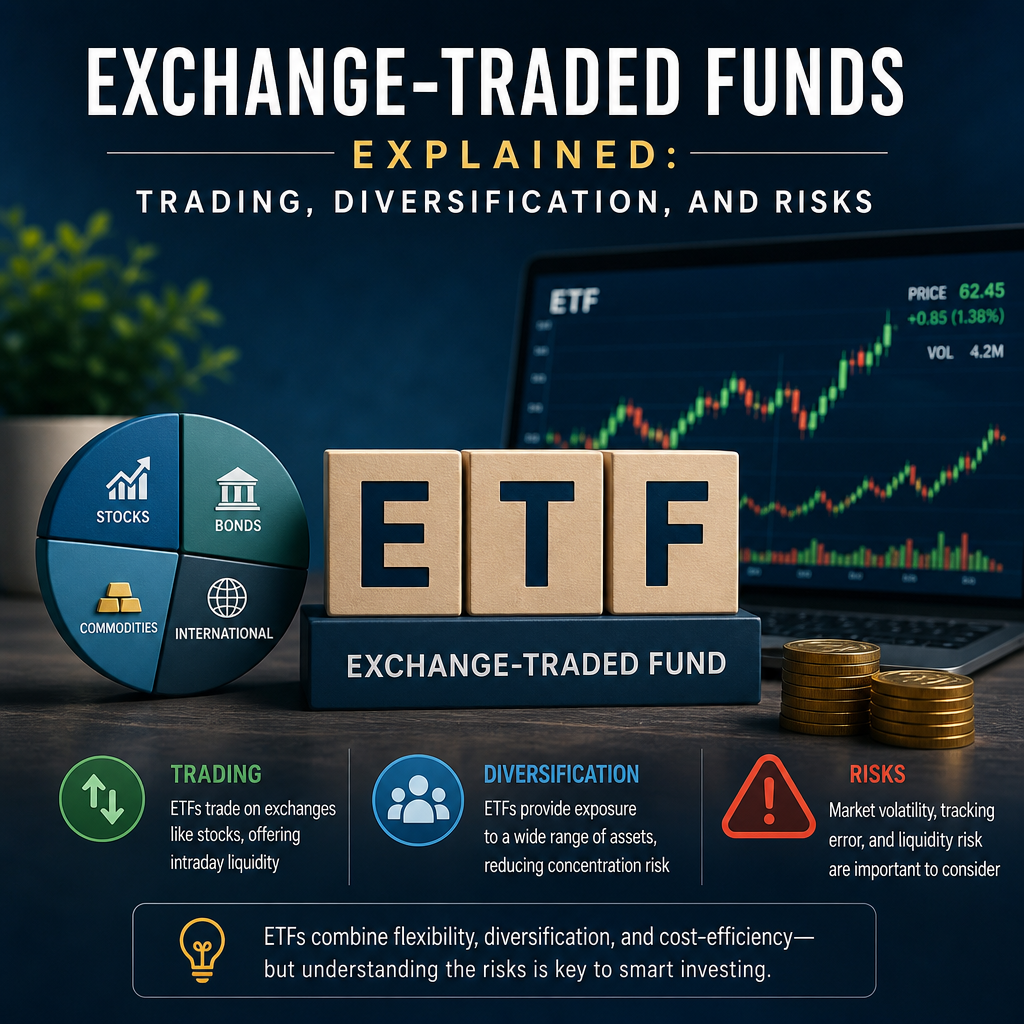
Exchange-Traded Funds Explained: Trading, Diversification, and Risks
Exchange-traded funds offer a simple way to diversify your portfolio, giving you access to many stocks, bonds, or other assets in one trade. In this guide, you’ll learn how exchange-traded funds work, why investors use them, and the key risks to watch before buying.
By: Mary Mitchell on August 2, 2026
Anúncios
Exchange-traded funds, or ETFs, have become one of the most popular ways to invest for both beginners and experienced market participants. If you’ve ever searched for a simple way to build a diversified portfolio without buying dozens of individual stocks or bonds, exchange-traded funds explained is a topic worth understanding in depth.
ETFs combine features of mutual funds and stocks. They offer broad market exposure, trade during the day, and often come with lower costs than many actively managed funds. But like any investment, they also come with risks that investors should understand before buying.
Anúncios
This guide breaks down how ETFs work, why investors use them, what makes them different from other funds, and how to evaluate the benefits and risks.
What Is an ETF?
An ETF is an investment fund that holds a collection of assets such as stocks, bonds, commodities, or a mix of securities. The fund is divided into shares, and those shares trade on an exchange, just like a stock.
Anúncios
That structure gives ETFs two important traits:
Diversification through a basket of holdings
Liquidity because you can buy and sell shares throughout the trading day
Many ETFs track an index, such as the S&P 500, but others follow specific sectors, strategies, or themes. For example, you can find ETFs focused on technology, dividend-paying stocks, international markets, municipal bonds, or even gold.
How ETFs differ from mutual funds
ETFs and mutual funds both pool investor money into a portfolio of assets, but they operate differently.
Key differences include:
Trading style: ETFs trade intraday; mutual funds price once at the end of the day
Cost structure: Many ETFs have lower expense ratios, though not always
Tax efficiency: ETFs are often more tax-efficient because of their creation/redemption structure
Minimum investment: You can usually buy a single ETF share, while some mutual funds require a minimum deposit
For many investors, that flexibility makes ETFs a practical building block for long-term investing.
How ETFs Trade in the Market
One of the main reasons ETFs are so widely used is that they trade on an exchange. You can buy or sell shares during market hours at market price, limit price, or stop order price, depending on your brokerage platform.
Bid, ask, and market price
Like stocks, ETF shares have a:
Bid price: what buyers are willing to pay
Ask price: what sellers want to receive
Spread: the difference between the two
A narrow spread usually means better liquidity and lower trading friction. Highly traded ETFs often have tighter spreads, while niche or less liquid ETFs may cost more to trade indirectly.
Creation and redemption
ETF shares are created and redeemed through large institutional participants called authorized participants. This process helps keep the ETF’s market price close to the value of the underlying securities.
Here’s the simple version:
An authorized participant assembles the assets held by the ETF.
The participant exchanges those assets for newly created ETF shares.
Those shares are sold in the market.
If ETF shares trade at a discount or premium, this mechanism helps bring prices back in line.
You do not need to understand the mechanics in detail to invest, but it helps explain why ETFs often stay close to their net asset value.
Why Investors Use ETFs
ETFs have earned a strong reputation for flexibility and cost efficiency. They work well for many goals, from retirement saving to short-term tactical moves.
Diversification made easier
Diversification means spreading money across multiple investments to reduce the impact of any one holding. An ETF can give you exposure to hundreds or even thousands of securities in a single purchase.
For example:
A broad U.S. stock ETF may hold large, mid, and small companies across many industries
A bond ETF may include government, corporate, or municipal debt
An international ETF may add exposure outside the United States
This makes it easier to reduce concentration risk without building a portfolio one security at a time.
Lower costs
Many ETFs are known for low expense ratios, especially index-tracking funds. Lower ongoing costs matter because fees can eat into returns over time.
Still, investors should compare more than just expense ratios. Also look at:
Trading commissions, if your broker charges them
Bid-ask spreads
Tax implications
Fund turnover
A low-fee ETF is appealing, but only if it fits your overall strategy.
Flexibility and transparency
ETFs usually publish their holdings regularly, which gives investors a clearer view of what they own. That transparency can make portfolio planning easier.
Investors also use ETFs for a variety of purposes:
Long-term core portfolio holdings
Sector or industry exposure
Income generation
Hedging
Cash management
Tactical short-term trades
Types of ETFs You Should Know
Not all ETFs are the same. Understanding the main categories can help you choose the right fund for your goals.
Broad market ETFs
These funds seek to track major market indexes and are often used as core holdings.
Examples include ETFs that track:
The S&P 500
Total U.S. stock markets
Global stock indexes
They are common choices for investors who want simple, diversified equity exposure.
Bond ETFs
Bond ETFs invest in fixed-income securities and may focus on government, corporate, municipal, or short-term debt.
They can help investors:
Generate income
Reduce portfolio volatility
Balance stock exposure
However, bond ETFs still carry interest rate risk and credit risk, especially in rising-rate environments or when they hold lower-rated debt.
Sector and industry ETFs
These ETFs focus on a specific part of the economy, such as:
Technology
Healthcare
Energy
Financials
Consumer staples
Sector ETFs can be useful for targeted investing, but they are less diversified than broad market funds and can be more volatile.
International ETFs
International ETFs provide exposure to companies or bonds outside the United States. Some focus on developed markets like Europe and Japan, while others invest in emerging markets.
They can help diversify currency and geographic exposure, though political and economic risks may be higher in some regions.
Commodity and specialty ETFs
Some ETFs track commodities like gold or oil, while others use strategies based on dividends, factors, volatility, or environmental, social, and governance criteria.
These funds can play a supporting role in a portfolio, but they often carry unique risks and may be harder to evaluate than broad index funds.
The Main Benefits of ETFs
ETFs appeal to many investors because they combine several advantages in one package.
1. Easy access to diversification
You can buy one ETF and gain exposure to an entire index or market segment. That makes it a convenient way to diversify without picking individual securities.
2. Intraday trading
Unlike mutual funds, ETFs can be traded throughout the day. That gives investors more control over trade timing and execution.
3. Tax efficiency
ETFs are often more tax-efficient than mutual funds because of how they create and redeem shares. This can reduce taxable capital gains distributions in many cases.
4. Lower barriers to entry
You usually don’t need a large amount of money to get started. If one ETF share fits your budget, you can begin building a portfolio with a modest investment.
5. Portfolio flexibility
ETFs allow investors to tilt toward value, growth, dividends, international markets, bonds, or niche themes based on their personal goals.
The Risks of ETFs
The phrase exchange-traded funds explained should always include risk. ETFs are not guaranteed, and they are not automatically safe just because they are diversified.
Market risk
An ETF can lose value if the market or sector it tracks falls. A broad stock ETF can still decline sharply during a market downturn.
Diversification helps, but it does not eliminate losses.
Concentration risk
Some ETFs appear diversified on the surface but are heavily concentrated in a few stocks or industries.
For example:
A technology ETF may be dominated by a handful of large companies
A thematic ETF may depend on a narrow trend
A country-specific ETF may be highly dependent on one economy
Always look under the hood before investing.
Liquidity risk
While many ETFs trade actively, some smaller funds have low trading volume. That can lead to wider bid-ask spreads and more expensive trades.
Low liquidity matters especially if you plan to trade large amounts or use niche funds.
Tracking error
An ETF may not perfectly match the performance of the index or asset it is designed to track. This difference is called tracking error.
It can happen because of:
Fees
Trading costs
Sampling methods
Cash drag
Rebalancing timing
Small tracking differences are normal, but larger gaps may be a red flag.
Interest rate and credit risk in bond ETFs
Bond ETFs can lose value when rates rise, and bonds issued by weaker borrowers may default or weaken in price.
This means bond ETFs are not risk-free. Their value can move in ways that surprise investors who expect stability.
Premiums and discounts
An ETF can trade above or below the net value of the assets it holds. This is more common in less liquid or specialized funds.
If you buy at a premium, you may pay more than the underlying value. If you sell at a discount, you may receive less.
How to Evaluate an ETF Before Buying
Choosing an ETF takes more than scanning for a low fee. A thoughtful review can help you avoid unpleasant surprises.
Check the underlying index or strategy
Ask yourself:
What does the ETF actually hold?
Is it broad or narrow?
Does it match my investment goal?
A clear strategy is usually better than a trendy theme you don’t fully understand.
Review the expense ratio
Expense ratios are important, especially for long-term investors. Lower is often better, but don’t treat fees as the only factor.
A slightly more expensive ETF may still be a better choice if it offers better liquidity, broader diversification, or a more suitable index.
Look at holdings and concentration
Review the top holdings and sector weights. Make sure the ETF does not overlap too much with your existing investments.
Examine trading volume and spread
A fund with high average daily volume and tight spreads is generally easier and cheaper to trade.
Understand tax treatment
ETF taxation can vary depending on the fund’s structure and the assets it holds. Bond ETFs, commodity ETFs, and international ETFs may have different tax consequences.
When in doubt, review the fund’s prospectus or speak with a qualified tax professional.
Practical Examples of ETF Use
To see how ETFs fit into real portfolios, consider a few simple examples.
Example 1: Beginner long-term investor
A new investor might build a basic portfolio using:
A U.S. stock market ETF
An international stock ETF
A bond ETF
This approach creates broad diversification with just a few funds.
Example 2: Investor seeking income
An income-focused investor may use:
Dividend ETFs
Short-term bond ETFs
Municipal bond ETFs, depending on tax situation
This may help generate regular cash flow, though income is never guaranteed.
Example 3: Tactical investor
An experienced investor might add a sector ETF to express a view on healthcare, energy, or technology. This can offer targeted exposure, but it should usually complement, not replace, a diversified core portfolio.
Common ETF Mistakes to Avoid
Even simple-looking funds can lead to mistakes if you rush in without research.
Watch out for these common pitfalls:
Buying an ETF without understanding its holdings
Chasing recent performance
Ignoring the bid-ask spread
Assuming all ETFs are equally diversified
Overloading on narrow sector or thematic funds
Using leveraged or inverse ETFs without understanding how they work
Leveraged and inverse ETFs are designed for sophisticated short-term strategies and can behave very differently from standard funds. Many long-term investors should avoid them.
Building an ETF Strategy That Makes Sense
ETFs work best when they support a clear plan.
A solid ETF strategy often includes:
A diversified core holding
Clear goals for income, growth, or balance
Periodic rebalancing
Attention to fees and taxes
Discipline during market volatility
Instead of chasing the newest fund theme, focus on how each ETF contributes to your overall allocation.
Frequently Asked Questions
What is the main advantage of an ETF?
The biggest advantage of an ETF is that it combines diversification, flexibility, and easy trading in one investment. You can buy or sell shares throughout the day while gaining exposure to a broader basket of assets than a single stock.
Are ETFs safer than individual stocks?
ETFs are generally less risky than owning one stock because they spread your money across multiple holdings. However, they are not risk-free. A stock ETF can still fall in value if the market declines, and some ETFs are concentrated in a single sector or theme.
How do ETFs make money for investors?
ETFs can generate returns through price appreciation, dividends, bond interest, or other income distributions depending on the assets they hold. Your total return depends on how the underlying securities perform and whether the ETF distributes income.
Can ETFs lose value?
Yes. ETFs can lose value if the assets they track decline. Bond ETFs can also fall when interest rates rise, and specialized ETFs may be especially volatile. Even diversified funds can experience losses during broad market downturns.
Are low-cost ETFs always the best choice?
Not always. Low cost matters, but investors should also consider liquidity, tracking error, tax efficiency, diversification, and whether the ETF actually matches their goals. The cheapest fund is not necessarily the best fit.
ETFs have changed the way many people invest because they make diversification more accessible, trading more flexible, and portfolio construction more efficient. When exchange-traded funds explained is the goal, the key takeaway is simple: ETFs can be powerful tools, but they work best when you understand what they hold, how they trade, and what risks they carry.
For many investors, ETFs provide a practical way to build a core portfolio, add income, or gain exposure to specific markets without buying dozens of separate securities. That said, not every ETF is the same. Broad funds, sector funds, bond funds, and thematic funds each come with different costs, risks, and uses. The best approach is to focus on your goals, review the underlying holdings, and avoid buying based on hype alone.
If you are building an investment plan, ETFs can be an excellent place to start. Learn how each fund fits into your strategy, keep costs in check, and stay patient through market ups and downs. A thoughtful ETF plan can support long-term investing with clarity and confidence.
Mary S, CFP®, is a Certified Financial Planner with over 12 years of experience in personal finance, retirement planning, and wealth management. She writes educational content that helps readers understand financial concepts and make informed decisions based on reliable information.